Stop Treating Your Plan Like a Prediction
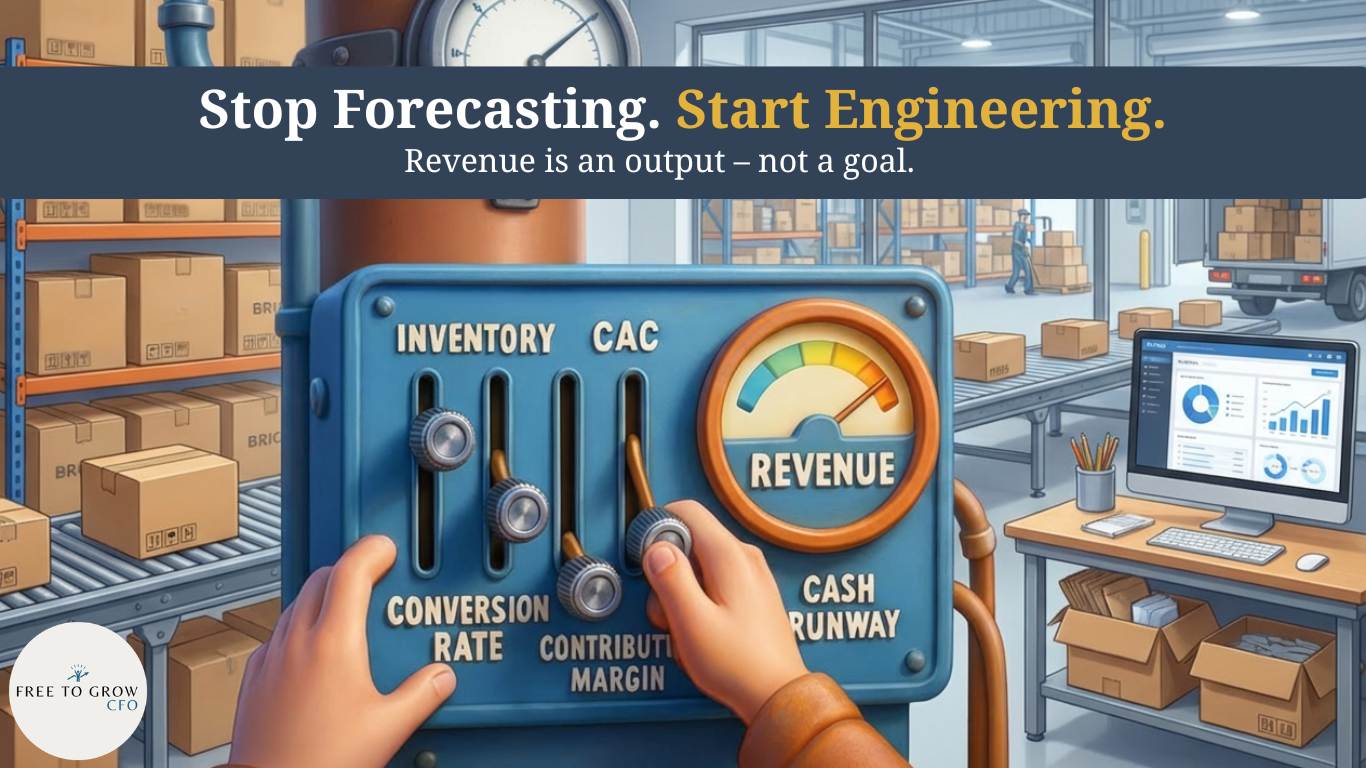
The biggest failure I see in DTC business planning isn’t a lack of ambition.
It’s the assumption that your plan will go exactly as expected.
In reality, something in your plan will go wrong. Not because you’re bad at forecasting. Not because your team isn’t capable. But because direct-to-consumer is a dynamic, fast-moving environment. CAC fluctuates. Conversion rates shift. Inventory gets delayed. Consumer demand surprises you—both up and down.
The brands that scale profitably understand a critical distinction:
Planning is not an exercise in prediction. It’s an exercise in understanding cause and effect.
Prediction-Based Planning: The Hidden Risk
Here’s a common example.
A brand sets a goal to hit $10 million in Q4 revenue. Based on that prediction:
They place purchase orders to support $10 million in sales.
They raise debt to finance the inventory.
They hire team members to operate at that scale.
They increase ad spend in anticipation of the volume.
Everything is aligned around one predicted output: $10 million.
This feels strategic. It feels bold. It feels like leadership.
But it’s also incredibly risky.
Because when you align all inputs—inventory, debt, payroll, marketing spend—around a single forecasted outcome, you’ve created a binary bet:
Hit the number → success.
Miss the number → cash crunch, margin compression, or worse.
You’ve boxed your business into a narrow path. And in DTC, where things are always changing, that’s dangerous.
Cause-and-Effect Planning: A Smarter Approach
A sound plan doesn’t assume a specific output will happen.
Instead, it asks:
If we invest in this much inventory, what revenue levels are required to stay cash-flow neutral?
If CAC increases by 20%, how does that impact our break-even?
If conversion rates drop, how long is our cash runway?
What happens to working capital if sales come in 30% below forecast?
This is scenario-based planning.
Instead of building a single rigid path forward, you map multiple paths based on different business conditions.
You’re not trying to predict the future with perfect accuracy.
You’re building a framework that says:
“If X happens, we will deploy Y resources in Z way.”
That distinction reduces risk and increases flexibility at the same time.
Why This Matters More in DTC Than Anywhere Else
DTC operates in constant volatility — CAC moves, conversion rates shift, inventory timing changes.
When you treat forecasts as a promise instead of a hypothesis, you expose yourself to unnecessary risk.
But when you understand the cause-and-effect relationships in your business—how inputs like ad spend, inventory purchases, discounts, and hiring decisions drive outputs like revenue, contribution margin, and cash flow—you gain leverage.
You can:
Make smaller, smarter bets.
Stage inventory purchases instead of front-loading risk.
Tie hiring decisions to leading indicators, not lagging optimism.
Align debt usage with realistic cash conversion cycles.
In short, you stop gambling and start engineering.
The Real Goal: Optionality
Great financial planning doesn’t eliminate uncertainty.
It creates optionality.
Optionality means you can scale when signals are strong and protect cash when they’re weak.
It keeps growth from becoming existential.
That’s what separates brands that survive growth from brands that get crushed by it.
Where Most Founders Get Stuck
Most founders intuitively understand this concept.
What they lack is the financial infrastructure to execute it.
Scenario planning requires:
Clean, reliable financial data.
Clear visibility into contribution margin by channel.
Accurate inventory and cash flow forecasting.
A deep understanding of payback periods and working capital cycles.
Without those, planning reverts back to guessing.
And guessing at scale is expensive.
This Is Where a Real CFO Changes the Game
At Free to Grow CFO, we don’t build plans based on hope.
We build models that map the cause-and-effect dynamics of your business.
We help you answer questions like:
What revenue do you actually need to support this inventory bet?
How much debt is safe given your cash conversion cycle?
How flexible is your operating structure if demand underperforms?
What are the trigger points for scaling up—or pulling back?
Our role isn’t to predict your future.
It’s to design a financial framework that lets you adapt to it.
Because in DTC, things are always changing
The brands that scale profitably aren’t the ones with the most optimistic forecasts.
They’re the ones that understand their inputs, protect their downside, and preserve flexibility.
If you’re planning your next growth stage, the question isn’t:
“Will we hit the number?”
It’s:
“What happens if we don’t—and are we built to handle it?”
If you’re not confident in that answer, it might be time to bring in a CFO who can help you build a plan designed for reality—not just for best-case scenarios.