Podcast: How to Turn E-commerce Profits into Long Term Wealth
Episode Summary
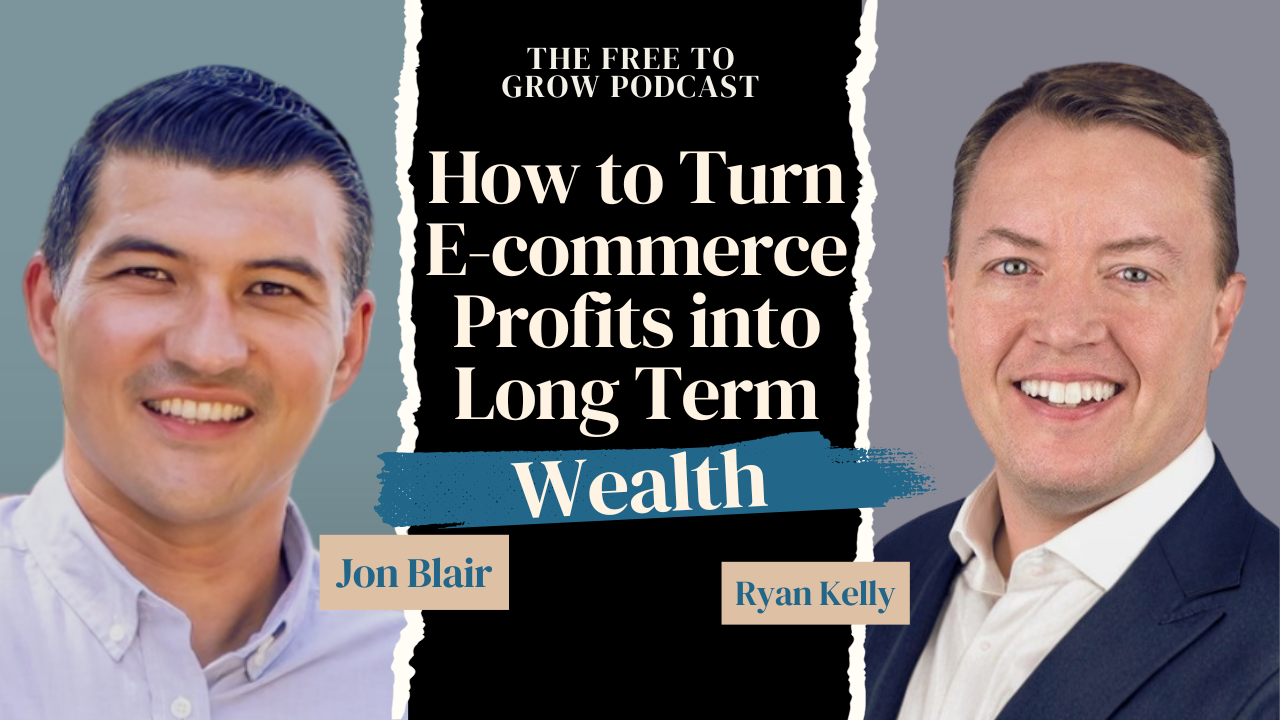
In this episode of The Free to Grow CFO Podcast, Jon Blair interviews Ryan Kelly, a real estate agent and investor, discussing the importance of investing in real estate and the nuances of working with an investor-focused agent. They explore the differences between buying a primary residence and an investment property, the importance of analyzing deals, common traps for new investors, and the current market dynamics in Austin. Ryan shares insights on strategies for real estate investing and emphasizes the need for continuous learning and adaptability in the ever-changing market.
Key Takeaways
Real estate is a great asset for building wealth.
New investors often overlook hidden costs in financial projections.
Building a diverse toolkit of strategies is important for adapting to market changes.
Episode Links
Jon Blair - https://www.linkedin.com/in/jonathon-albert-blair/
Ryan Kelly- https://www.linkedin.com/in/ryanekelly/
Free to Grow CFO - https://freetogrowcfo.com/
Meet Ryan Kelly
Ryan Kelly is a top-producing real estate broker, licensed mortgage loan originator, and seasoned real estate investor with a mission to help others build lasting wealth through real estate. With over $100 million in closed transactions and more than 300 clients served, Ryan brings a unique blend of investment insight, market knowledge, and personalized service to every client relationship.
Known for his responsiveness, integrity, and fierce negotiation skills, Ryan goes above and beyond to deliver smart solutions and seamless experiences. His dual license as both a broker and lender gives clients access to creative financing options, transparent guidance, and full-spectrum support—before, during, and long after the close.
A proud Austinite since 1992, Ryan moved to the city to attend the University of Texas and has called it home for more than 30 years. He actively supports local nonprofits including Austin Sunshine Camps, KW Cares, and Foundation Communities, and lives in South Austin with his wife Andi and their two boys, Andrew and Spencer.
Whether you're relocating, refinancing, or building a real estate empire—Ryan Kelly is the partner you want in your corner.
Transcript"
~~~~~~~~
00:00 Introduction and Background
02:59 The Importance of an Investor-Focused Agent
06:02 Analyzing Investment Properties
08:56 Common Traps for New Investors
12:08 Market Dynamics in Austin
14:57 Strategies for Real Estate Investing
17:59 Opportunities in the Austin Market
21:05 Final Thoughts for Aspiring Investors
Jon Blair (00:00)
Hey everyone. Welcome back to another episode of the Free to Grow CFO podcast, where we dive deep into conversations about scaling a profitable D T C brand.
I'm your host, Jon Blair, founder of Free to Grow CFO. We are the go-to outsource finance and accounting firm for eight and nine figure D T C brands.
All right, today is an exciting day. I am here with one of my real estate agents, one of my agents out here in Austin, Ryan Kelly. Ryan, what's up, man?
Ryan Kelly (00:24)
Hey man, enjoying a nice ice storm day here in Austin.
Jon Blair (00:28)
Yeah, yeah, so we're recording this on January 26th, 2026 and a big ice storm came through over the weekend so we got our like one time a year that we get to take the kids out to go sledding. ⁓ And it's funny, we have a person on my team, she lives in Dallas, she sent in this video on Slack to the team of her kids sledding on a baking sheet and she's like, hey in Dallas none of us own sleds. I was like, hey we're sledding on the...
Ryan Kelly (00:39)
Exactly.
Jon Blair (00:53)
the top of a storage container that we flipped upside down because ⁓ there's no reason to have a sled for the one time a year that it snows,
Ryan Kelly (01:01)
never even maybe not even once a year so like half the kids are in sweatpants and pajamas they don't even have ski clothes right they're just out in clothes until they get wet and then they come inside so you know the southern the southern way to enjoy ice and snow
Jon Blair (01:07)
Hahaha!
man,
yes, absolutely. Well, I appreciate you being here, The reason I wanna have you on the show is because those of you that listen, you've heard me talk before my opinion that real estate is a great invest in, to build wealth. You a Free to Grow CFO, we're fractional CFOs who help Ecom brands improve their profit and cash flow.
distribute more cash flow to themselves and then hopefully the brand founders are investing that in assets that build their wealth. And I couldn't think of anyone better than you to come on and talk about investing in real estate. So before we dive in, can you tell everyone a little bit about you, who you are and what you do?
Ryan Kelly (01:56)
Absolutely. Born and raised in Texas, grew up in Waco, halfway between Austin and Dallas, came to UT in the 90s, pre-internet, as I like to tell people. But my first career was actually as a broadcast journalist. So I did TV news. If you ever watched 5, 6, 10 o'clock news, that was my first career. Worked in Waco, worked in Austin, moved into PR. But ultimately, as I got kind of my midlife crisis stage, I was looking to do something more in the wealth building aspect.
Jon Blair (02:04)
Hahaha.
Ryan Kelly (02:24)
I wanted to run my own business. So I was actually looking to become a certified financial planner and help people, you know, invest in the stock market, you know, get 401ks Roth IRAs, but...
As I started exploring, how do I want to build my wealth? What can I control? And then that's where I really kind of led me to real estate. My in-laws actually were the first ones that really kind of gave me a visual of what it would look like to own real estate. They own a pretty sizable portfolio of rental properties in Texas. So when I started talking to them, how does that work? How do you make income? You don't have to sell these properties to get that income. That's when I really pivoted quickly. And this was probably a little over 10 years ago, moved into real estate, have been a residential real estate broker here in Austin. I'm also now a mortgage lender as well. then my wife and I have been building our rental portfolio for the past 10 years, along with some syndications and some other real estate related investments and multifamily and industrial. But on a personal level, single family duplex, don't make it complicated. There's a lot of great properties in the residential space.
Jon Blair (03:29)
I love that. So yeah, I met Ryan through a real estate investor network that I'm a part of and that he's a part of called Bigger Pockets. And I met Ryan on this journey of trying to find investor focused real estate agents in the Austin area where I live. that's where I want to start our discussion because I think a place where a lot of people get hung in my opinion and in my experience, is they go talk to their agent who sold them their personal residence, which may or may not be, I have found in my personal experience, may or may not be a fit for helping you build your portfolio. So my first question to you is, can you help the audience understand why it's important, if they wanna get started real estate investing, to find an agent who focuses on and understands investing?
Ryan Kelly (04:15)
Absolutely, you know the language is different and it's not complicated but it's different if you own an investment property it is about two things cash flow and Then also what are the other benefits that you're going to try to get off that property? Or do you need tax benefits? Do you need to come into a property from a 1031 tax exchange or do you need to? Facilitate you need to sell that property maybe with a 1031 tax exchange and get tax benefits
And then you also have ⁓ what I call the network of services. You might need property management. You're going to need different insurance. You might need an LLC. You're going to need some different avenues. And so when you're in an agent that works with investment properties, you understand more why people are buying that property. You're not buying it because it has a nice paint color or because the pool is cool looking or you want to live in that neighborhood. You're never going to live in that property. You're buying it because you're trying to put an asset into your portfolio needs to have some sort of a performance. And then on top of that strategy, if you're buying a house for yourself, the only strategy is are you gonna enjoy living there?
if you're buying it as an investor, most people are gonna underwrite that property as you and I would say, as a long-term rental. Well, what does that mean? That's what you and I think of as a long-term lease, 12 months of rent. However, that's only one strategy. There's lots of different strategies that I have clients doing from midterm rentals, short-term rentals, rent by the room you know, flipping, arbitrage. So understanding the different ways that you can take the same property and do different things with it, I think is where investor agents spend their time compared to a regular retail real estate agent.
Jon Blair (05:57)
Yeah, it's interesting because you have to think about what is the objective of buying your primary residence versus what is the objective of buying a rental property. The objective of buying a rental property is you're actually starting a business or you're growing a business. Running a rental is a business. It may not be a full time job, right? But you need to go to an agent who understands the ins and outs, the nuances of running a real estate business when you're buying your personal residence, you want to, you want a place that you enjoy that suits your needs from a comfort level at, you know, aesthetics level that you're in the neighborhood where you want to send your kids to school, those things, different considerations, different objectives. And, and also I think the other thing that I want to mention or that, that I was thinking of is when it comes to comping or the ability to analyze a deal, this is where I saw my agent.
who my original agent who helped me buy my last few personal residences. Incredible at that. If I gave him a list of things that I wanted in the house, he would go find it, right? Gave him my budget. He would go find what I needed. If it was missing something, he would give me the vision of how we could turn it into that. And he would help me to negotiate a decent deal. Great at that. But when I started having him sending me rentals, he was not really the greatest at understanding things like comping, helping me understand how might that property appreciate over time.
What do, what, is the range of possible rents that I might be able to get for that property? Right? ⁓ how does, how does a school district rating, impact rents over time? it's interesting because when we started working with you, it was very clear off the, ⁓ off the get-go that you are an investor focused agent, because when we would say, Hey, this is an interesting place. Just by like second nature, you would say,
Hey look, I pulled this up, I pulled all the comps in the last 12 months for rents and all the comps for the last 12 months for purchase prices and here's some factors that you need to consider when it comes to the durability of those rents or the durability of the value of this property. And you just did that on the first email response back to us. It gave me so much intel to make an informed decision. What would you say when you're talking about analyzing a deal, right, from an investment standpoint?
Walk me through the short list of like the steps of the information that you pull and need to kind of understand before you decide if the numbers make sense.
Ryan Kelly (08:17)
Yeah, would start, let's say you were a new client too. I would say, first of all, you hit it kind of on the head. If you're gonna go buy a primary home, you're always looking for the best neighborhood you can buy in. You want the nicest house for your budget. You might be happy with an HOA, because you get to use the pool and tennis courts or whatever. But as an investment property, most of the things I just said are probably gonna be negatives for you as a rental property. HOAs are a cost. A nice school district means that house is expensive.
Jon Blair (08:40)
Hmm, for sure.
Ryan Kelly (08:46)
those types of things. And so when you're trying to find an investment property, think of Warren Buffett, right? Like he's not going to go buy the most rich company in the world. He's going to go look for value. He wants a good company. You want a property that can produce cash flow, but you need it at the best price that you can get it. And so I look at that as you might say, hey, maybe I don't want to be in an HOA or maybe I need to pick a zip code.
maybe isn't the best school district, but it's such a good location. It's known to be a strong rental area, not a purchase area. It's a good rental area. So first of all, you start with, we start with the high level.
And that's always location, right? Location with your budget. And then when you look for rents, we want to go to that first. How's that area renting? We can pull up rental comps. Are people paying rent? Are they going up or down? How long are properties sitting on the market? Because vacancy, as we know right now, has gone up because the market got soft with kind of oversupply in the last couple years. So you want to make a judgment. Is it one month that it takes me to get a tenant?
or is it gonna take like four or five months? In which case there might be too many properties on the market to compete against. So you wanna know rental data, you wanna know property tax, that's a big one too. How expensive is it? Because that's a cost, that's expense for your business. Insurance, having kind of a gauge of how expensive is it gonna be to go get insurance. And what are the factors that are gonna negatively influence your insurance, like an old roof?
So putting those together, then you can run a property pretty quickly. Like you could send me a link or I could send you a property and go, hey, here's an address within five minutes, maybe 10. We could probably pull a basic rent analysis or portfolio analysis for that property to determine if it's even within range of making sense. And that's assuming we don't adjust the price. Then you can get into, do we think we'll be able to negotiate some of these terms to make it a better investment?
Jon Blair (10:38)
Yeah.
Yeah, one of the biggest traps that I see new investors get in is, maybe it's two things, but it's centered around the same concept. But it's it's a faulty financial projection. And either because they're poor comps, right? The rents are unreasonable or the purchase price comp is wrong. Or the financial projection is based on producing cashflow, positive cashflow, but not accounting for all expenses.
Ryan Kelly (10:59)
Yeah.
Jon Blair (11:10)
And to go into that like one level deeper, you know, you have to think about, and this is something that Ryan has really started, gotten me thinking about, because I have a number of very solid performing properties in Mississippi that by and large on average are older, right? With Ryan, the first property I bought was brand new. And he got me thinking about, okay, listen, look, of course we got to factor in your ⁓ mortgage payment, taxes, insurance.
But here's some of the costs that some people don't think about. Do you have property management? You're going to self manage this repairs and maintenance and capital expenditures and the difference of those on a, on a 2025 build versus a 1955 build is completely different. So something might have a tighter margin, right? when not accounting for your repairs and maintenance and capex, but if you're buying a brand new home and you expect those things to be low, or maybe you have a warranty on it with a builder, you can afford to write those smaller expenses into your projection. So, it's really helpful to have an agent who invests themselves and understands those differences. I'm curious, Ryan, what would you say is the biggest trap that you see new investors get involved in before they've kind of been around the block on a couple deals?
Ryan Kelly (12:24)
think the first one, and this is a conversation I have every day, is nothing pencils, nothing works, I can't find anything, they're not wrong, and...
but they're not looking in enough places. And so what typically happens is they'll call me, they want to invest in Austin. I love Austin. I'm bullish on Austin long-term. We have great jobs. There's a lot of tailwinds that are gonna make Austin a great place to live. The challenge is Austin has gotten more expensive. And so it's very hard to start penciling properties once the median home price is 400,000, 500,000. There's only so much rent people are gonna pay until they decide to just move and go buy something. And so what happens is they're looking in very nice areas. And so as you and I know, you know, there's other markets. And so what maybe not work in Austin, it might work in Temple or College Station or Waco or Abilene. And so sometimes you have to look in a different area. They weren't doing the wrong analysis. They were doing it in the wrong place. So that would be one thing. And then the other thing I would say is,
Jon Blair (13:24)
Yeah.
Ryan Kelly (13:28)
As markets shift and change, what worked five years ago or 10 years ago may not actually be the strategy that's great today. There might be a different strategy that works really well today. And then five years from now, it might be a different one. And a perfect example is BRRRR So for those that aren't familiar with the BRRRR method, and Jon, you've done this. So the BRRRR method is an acronym for buy, rehab, ⁓
Jon Blair (13:38)
Totally.
Ryan Kelly (13:53)
rent it out, then refinance it, because you've improved that property, and then ideally you can get some cash out and then repeat. You got some money back and you can go and do it again. I always tell people, BRRRR works today, it's not gonna work in Austin, okay, it's too expensive. You need to go to a market where maybe that...
Entry level price is $100 or $75 or $125. You need a cheap property where if you put in $30 to $50K and fix it up, it appraises at 200. You need easy numbers like that. And then you might be able to get some money out. You might be able to get some rent to kind of cover your costs. As the value of that property goes higher, those ratios just stop working. It's like you would need the property to appraise at such a higher level. And the rents also don't keep pace as properties get more expensive. And so BRRRR worked in Austin probably 10 or 15 years ago. Probably doesn't work the way people think of it.
Jon Blair (14:42)
Yeah.
Ryan Kelly (14:50)
today, but there are other markets, lower priced markets with those older properties, those kind of starter homes where I think BRRRR works. The other one that I think works today, which you and I took advantage of last year, is that all of sudden you might catch these little pockets of new construction where quite honestly, you and I bought new construction properties cheaper than we were able to find resale properties in the same market for the same returns of rent. And yet now we have something brand new with very low capex. Whereas if we had to buy something 10 or 20 years old, we've already got to start building in some of that replacement cycle. So it's just trying to figure out what the market can give you. And sometimes people come into it with one plan.
Jon Blair (15:16)
Yeah.
Yeah.
Ryan Kelly (15:36)
If the plan doesn't work, they're like nothing works.
Jon Blair (15:36)
Totally.
No,
no, you have, you have to build a toolkit. You have to have a toolbox that you keep putting tools in. Right. And that's why, like for me, I am a continuous learner when it comes to real estate. listen to numerous, numerous podcasts every week. I read at least half a dozen books a year on real estate. And like right now I'm reading a book on flipping. I've never done a flip and flips don't particularly work well in this market because transaction volume is low, but
Ryan Kelly (15:50)
No, no.
Jon Blair (16:04)
they will work at some point and they will work in some markets, right? And I'm looking in, I'm looking in three different markets at any point in time, Austin, Temple, and in Mississippi. And at some point that's going to work. And the other thing is even if it doesn't, let's say I find a market where BRRRR works. Well, the first step of BRRRR is very similar to a flip, right? You got to do a rehab. So all the tools from in terms of flipping, I'm putting into my toolbox, but what I want to add to what Ryan just said is like,
Ryan Kelly (16:06)
Absolutely.
That's right. It is flipping.
Jon Blair (16:32)
You have to have a toolbox that has enough tools that you know how to pivot based on what the market is giving you. The more and more ⁓ kind of lifetime real estate investors that I follow read their content, whatever, I find that they have transitioned over time into different strategies as the market gave them the opportunity to leverage those different strategies, right? So it just comes down to if you want to be a student of real estate investing. There's still plenty of just tried and true, long-term rentals will always be a strategy that works somewhere, 100 % of the time, no matter where the market is, somewhere you can find rentals that work, right? But it just depends on what strategy you wanna deploy. I wanna ask you another question here, which is about Austin in particular, because I've been looking in and around Austin for a few years, just recently started doing.
Ryan Kelly (17:02)
I'm sorry.
Jon Blair (17:21)
You know, deals in central Texas in the last six months or so. But you know, as, as you know, and have put out in your own content, you know, a couple of months ago, Austin was named the number one buyer's market in the nation. I actually heard read somewhere last week that it's now Dallas and Austin is still in the top five. But anyways, exactly, exactly. So Austin. First buyer's market in years. I mean, I moved here in 2013.
Ryan Kelly (17:39)
Yeah, we're falling out of the top two right now. So we're getting there. Yeah.
Jon Blair (17:48)
And in 2013, there was 6 % a year appreciation. And it was hard to get a place, let alone what COVID did to Austin. But in your opinion, I the national news, I would generally say, says stay away from Austin. I don't agree with that. You don't agree with that. What do you personally think the opportunity is in the greater Austin area from an investing standpoint?
Ryan Kelly (17:52)
Absolutely.
I'll separate it in two ways. Let's forget housing for one second and just talk about the market demographics. So Austin right now is still a top five city in America for population growth. Last year we grew about 40,000 people in the metro. So if you added 40,000 people to any town, I call that a suburb. So you added a suburb of more people to the market. You're doing that consistently every year. So how come it doesn't feel like that right now?
And so if you look back at Austin, can go look at charts of appreciation and population growth. Austin went like a straight hockey stick lineup for the past 30 years. Even the last housing downturn, the 08 to 2012 window, Austin really kind of went flat. It didn't have a big dip like a Vegas or a Phoenix. And so what happened was Austin just kept going. And so when we got to like 2020, what happened was is we had tons of demand, but we were actually short on supply. The supply wasn't keeping up. So prices just went through the roof. But when that happened and money was cheap, everybody in the universe said, we need to go build something there. Let's go to Austin. Look at that market. Let's go build apartments and office towers and retail and single family homes and you name it. And they did. But those take
Jon Blair (19:27)
Hahaha!
Ryan Kelly (19:36)
two to three to five years to like get into the market. So what happened was we get to 2022, the prices went nosebleed level and they then jacked the interest rates up. So what happens is all of a sudden for a consumer like you and me, the buyer side said, whoa, we can't afford that.
And so we need the prices to come down, but that's also when the wave hit the beach of all this new supply and it said, hey, I thought everybody wanted something, right? So we added, I think 115,000 or more apartment units to the market. So that's like you know, three years of population growth of empty apartments on top of the market. So they're filling up. They're over 90 % occupancy now, but it took a minute to get those apartments filled up. have all these new single family homes. And when the builders overbuild, what are they going to do? They're going to, they're not lowering the price quite as much, but what they're doing is they're incentivizing the heck out of the buyers to buy new construction with low interest rates and credits and all those things. And so, there are opportunities in there. The challenge is we started way up here on price. We're now back to what I'd call fair price. We're probably not at a discount. I don't know if we'll get there. Some properties will get there. And then you have also on the multifamily side, let's say quadplex, duplex, residential, multifamily. Most of those have been owned for five, 10, 15 years. Well, they have 3 % interest rates.
They bought the property a long time ago. They have a 3 % interest rate. Even if their rents aren't great, they're making money. So they're not in a hurry to like give you and I a deal. It doesn't mean there aren't deals to be had, but they're not in a hurry to give you a deal. So right now what's happening is Austin is stabilizing.
Jon Blair (21:12)
Totally.
Ryan Kelly (21:19)
It's not great. It's not crashing. We kind of finished that part. I think Austin's corrected now. Depends on where you're looking, maybe 20 to 30 % off COVID. So we've had a pretty sizable correction, but I'd say now it's stabilizing. So if you want to get into the Austin market, you know, the next 12, maybe 18 months is probably going to be a good window to do it. There's going to be some opportunities there. Austin's a better value add market where you're trying to increase equity with your
Jon Blair (21:45)
Yeah.
Ryan Kelly (21:47)
effort versus, I can just turnkey something. Put 25 % down, buy it, it'll cash flow. It takes a little more energy in Austin to get a positive cash flow property. But I think if you're looking 10 years ahead, if you look at jobs and you look at demographics, those things haven't changed.
All that's changed is we had to let the oversupply crash through the market and the interest rates resettle the price. That seems to be getting close. I think this year will still feel a little soft, but I would expect over the next five or 10 years, you're going to see Austin hit its next wave, whatever that wave looks like.
Jon Blair (22:21)
Yeah, totally agree. And there's a couple of key things I want to draw out of what you just said. As a real estate investor, in my opinion, you should look metrics to gauge overall market movement, but you don't base your strategy on that. And when I say that, mean, like, if median rent is a given number and median purchase price is a given number, I always seek to pay lower than the median purchase price and hopefully get the deal, the pencil at rents that are below the median rent for that segment of the market. Because if you start playing in a situation where you got to charge above the median rent in a soft market, those are the ones that are sitting even longer than everything else, right? That's one thing. The second thing is you mentioned value add, or you mentioned that like there's not a lot of incentive for sellers to sell right now. What you need to be finding
Ryan Kelly (23:02)
Certainly.
Jon Blair (23:11)
is people who are ready to retire and they want to sell into this market. People who don't want to sell into this market just won't sell into this market. But the ones that do need some liquidity and you're at an advantage because transaction volume is low right now, you know, compared to recent history. So find someone who wants to retire and to target stuff that's vacant because that thing, no matter what the interest rate is, is likely losing money every single month. So some of the best deals I've ever found
Ryan Kelly (23:18)
That's right.
Yes.
Jon Blair (23:39)
is someone who wants to retire and had a partially vacant multifamily property. And they're like, they want to get out and they're not, they've either lost the energy to try to lease it up. There are some work that need to be done on it before someone would even consider renting it. And so they're like, what can I get to just get out of this thing? Right. And so, but what does that require? That requires looking at a lot of deals, right? You have to become, in my opinion, you have to become
You have to love looking at deals. I look at hundreds of deals before one closes. And that actually doesn't even matter. It doesn't matter whether I'm talking about Austin or temple, or I'm talking about Mississippi, all of the markets that I play in, you've got to look at dozens and dozens of deals before you get one to stick. And, ⁓ I do think this isn't, this is anecdotally for me and maybe my opinion. I do think that's another thing that matters about finding an investor focused agent.
is that sometimes I have found agents that focus on the retail sales of single family homes, they get annoyed by like tons of deals not getting under contract. If you're making a hundred offers and they're all, whatever, they're aggressively low and like those kinds of agents are like, come on, you're wearing me out. Whereas an agent who works with investors knows this is just part of the process. You don't know if someone's ready to retire until you make that low offer and they counter you with a nice counter offer, right? You lose, you miss 100 % of the shots that you don't take. And I just personally feel a lot more comfortable making, taking lots of shots with an agent who understands you need to take a lot of shots on goal before you get something to stick and actually get something that cash flows.
Ryan Kelly (25:04)
I'm sorry.
100%. In fact, thank you because I was working with Jon and I work with a lot of other investor clients and we commonly are looking at duplexes. Duplexes is a space that I like a lot. They're kind of built for investors, but they can also be sold to primary homeowners when you're done. So it's kind of a nice little hybrid property. Well, one of the markets I target is Temple, Texas. It's about an hour north of Austin. I like their numbers. A lot of properties can pencil well there. However, even with that, it was still hard. Last year we looked at tons of properties. I think you and I individually have looked at that market for a couple years. We were trying to find properties and we kept making offers and kept working deals. Well, ultimately we got to December.
And we worked out an incredible deal with a builder up there who was, you know, needed something to kind of hit their numbers at the very end of the year, had to move in transact fast. Jon was ready. And so this is why I like being an investor friendly agent, because we negotiated and got that deal under contract for Jon. My brain says, well, I want one too, because I'm an investor.
Jon Blair (26:21)
Hahaha
Ryan Kelly (26:22)
And so the next day I'm going to do some videos for Jon at his property. I called the builder and I go, I want that same deal. Right. And so, you know, having somebody that wants what you want, they want to find deals for you because they're looking for deals for themselves. It's a win-win situation. And they also know how to structure those deals, you know, where to look. They're already, you know, chasing the market themselves. They're scanning for deals themselves.
Jon Blair (26:42)
Totally.
Ryan Kelly (26:51)
It makes it a lot easier for me to share information when Jon reaches out and says, what do you think about this neighborhood or this property over here? I already have insight and data on that. And then the second thing I was going to share was if you always write your property to today, don't write it on what ifs or it could be or maybe one days. You got to underwrite it today. If it can work today, even if it's thin, that's fine.
Jon Blair (27:11)
Totally.
Ryan Kelly (27:20)
If it works today, you have to understand inflation is going to work for you in the future. You might get one opportunity to maybe refi at a lower interest rate in the future. Never guarantee, but if you can, that's a bonus. know, rents over time typically go up, but you don't want to write it to like, hey, it needs to be here in five years. You've got to make it work today. And if you can do that, typically I call that insurance. That's defense. You're good to go in the future because You wrote it conservatively at today's interest rate, price, insurance, the whole thing.
Jon Blair (27:55)
So, man, we could talk for a long time about this, but unfortunately, we're gonna have to come to a close here. But before we do, what if, you know, speak to the brand founder who's listening to this right now, who, you know, is interested in using some of the cashflow from their e-comm brand to invest in an asset class and real estate is interesting to them. What are the final thoughts you want to share with them about, like, what's the first step they, that you think they should take to just dip their toe in and get started?
Ryan Kelly (28:07)
Yeah.
Yeah, I would say ask yourself, it's kind of the Rich Dad Poor Dad question of like, do you want another job?
which is more active income and there's opportunities in real estate for that, flipping, wholesaling, short-term rentals, these are gonna be more active strategies or do you purely want passive or at least more passive income? And this is where you are gonna be looking at longer-term rentals. Typically, you can hire property management for those and make them very, as passive as you can. And then also what tax breaks, if any, are you interested in?
If you don't need big tax breaks, then long-term rentals are great. You're going to get lots of depreciation over 30 years or 27 years. You know, you get a long one. Whereas if you need like a big chunk now because of bonus depreciation and you know, all that stuff and the big beautiful bill, well then there are loopholes where you could do a short-term rental. I have numerous doctors, for example, that you know, they have W-2 income, they're surgeons or they're dentists, you know, but they want to get that bonus depreciation and so they're to focus on short-term rentals. So, you know, I would just think about it. What do you want?
And then ultimately owning a business and owning real estate are typically the two biggest ways to build wealth. And so you're a business owner. You already have a business and it sounds like, you know, if you have profits and you have that extra money to invest, you're doing well there. So the next question is, do you want to buy a business, another one, or would you like to add real estate to your portfolio? Start with those real simple questions and then you can drill down into strategy and things later, but that will get you started on, you where that's going to feel and fit in your portfolio.
Jon Blair (30:05)
Absolutely. Look, anyone who listened to this show knows I'm bullish on real estate, but the bottom line is, this is what I want everyone to take away from this episode. One, real estate, real estate investing is still alive and well. Don't believe the news, but you do need professionals on your team to help you through it. And a real estate agent that works with investors is one of those key linchpins that you need to add to your team first and foremost. And the next thing I want you to hear is to just remember, scaling your brand is all about generating more profit, but ultimately turning that profit into cash flow that you can take out of the business. Take out of the business your lifestyle, but also to buy assets to build real wealth. anyways, I think this is a great jumping off point for any of you guys who are interested in getting into investing in real estate. Before we go, if you wanna reach out to Ryan, Ryan, where can people find more information about you?
Ryan Kelly (30:57)
Yeah, you can go to RyanKellyGroup.com. You can find me on LinkedIn and Facebook at Ryan Kelly Group. Those are easy ones. And if you want to email me, very easy, Ryan Kelly, K-E-L-L-Y at KW for KellerWilliams.com.
Jon Blair (31:11)
wait, what about your YouTube channel? Because I watch your YouTube updates every single week.
Ryan Kelly (31:13)
at Ryan Kelly Group on YouTube. And you can see my weekly market update videos for Austin Metro.
Jon Blair (31:17)
Definitely.
Definitely, I watch them every single week. They're super helpful. I appreciate you putting that content out. And you know what, man, thank you for coming on. I really appreciate it and I'm obviously looking forward to the next deal we can do together.
Ryan Kelly (31:31)
Let's do it. Thanks, Jon. Stay warm.
Jon Blair (31:34)
Don't forget, if you liked today's episode, please hit the subscribe button wherever you're listening and leave us a review. It helps us reach more people like you. Also,
If you want more tips on scaling a profitable DTC brand, follow me, Jon Blair on LinkedIn. And if you're interested in learning more about how Free to Grow CFO can help your brand increase profit and cashflow as you scale, check us out at freetogrowcfo.com.