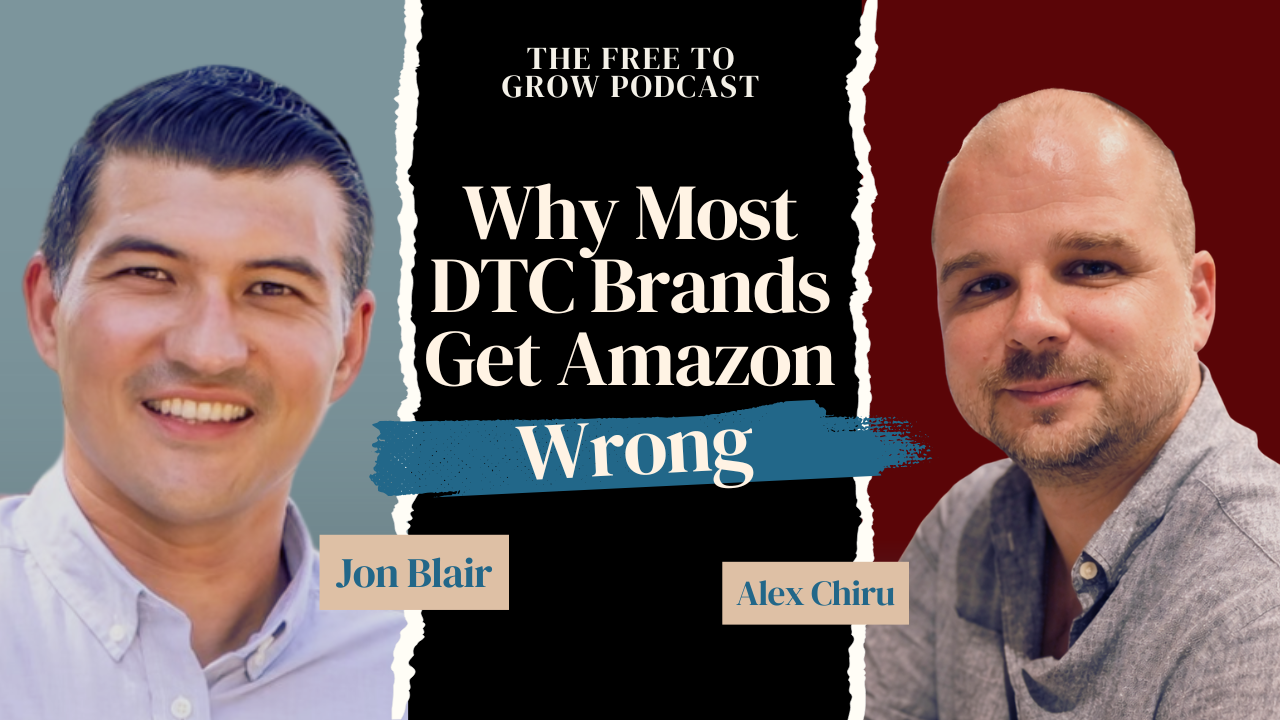
Podcast:Why Most DTC Brands Get Amazon Wrong
Episode Summary
If you’re a DTC founder who’s hesitant to launch on Amazon because you’re afraid it will cannibalize your website sales, this episode will challenge that assumption.
In this episode of The Free to Grow CFO Podcast, Jon Blair and Alex Chiru break down what’s actually happening inside Amazon today — from intent-based search and AI-driven personalization to why ranking and momentum matter more than ever. We also unpack one of the biggest mistakes growing brands make: treating Amazon like a keyword game instead of a relevance and conversion engine. And finally, we zoom out to the CFO lens — why scaling too fast on Amazon without understanding your cash flow can put you in a dangerous position.
Whether you’re already on Amazon or considering launching, this episode will give you a clearer framework for how to think about the platform strategically — not emotionally.
Key Takeaways
Amazon usually adds incremental revenue rather than cannibalizing DTC sales.
Ranking improves when you generate conversions quickly after launch.
External traffic helps, but Amazon still rewards on-platform spend.
Search on Amazon is now intent-based, not just keyword-based.
Episode Links
Jon Blair - https://www.linkedin.com/in/jonathon-albert-blair/
Alex Chiru- https://www.linkedin.com/in/alexandru-chiru-44315941
Free to Grow CFO - https://freetogrowcfo.com/
Meet Alex Chiru
Alex Chiru has been selling on Amazon since 2013 and has built, scaled, and successfully sold multiple businesses along the way. Today, he operates his own consumer brands—one of them scaling rapidly in the automotive space—and works closely with established brands ranging from seven to nine figures in annual revenue.
Alex focuses on Amazon SEO, conversion optimization, and long-term catalog strategy, helping brands grow sustainably and recover when rankings or performance drop. He is an active member of the Million Dollar Sellers community, where he has been involved since 2017 and currently serves on the Advisory Council, leading discussions around SEO and CRO.
Known for his practical, operator-first approach, Alex enjoys sharing what he’s learned and helping as many sellers as possible through consulting, community involvement, and speaking at industry events. He’s especially known for staying calm when Amazon “breaks” and turning complex problems into clear, actionable solutions.
Transcript
~~~
00:00 Introduction to Alex Chiru and Trubuilt Automotive
01:23 Misconceptions About Selling on Amazon
09:36 Impact of Returns on Ranking and Momentum
14:34 Challenges for Established Brands
18:49 Debunking Myths in Amazon Scaling
19:33 The Reality of Running an Amazon Business
22:08 The Value of a Fractional CFO
25:11 Advice for DTC Brands Considering Amazon
27:28 Final Thoughts
Jon Blair (00:00)
Hey everyone, welcome back to another episode of the Free to Grow CFO podcast where we dive deep into conversations about scaling a profitable DTC brand. I'm your host, Jon Blair, founder of Free to Grow CFO. We are the go-to outsource finance and accounting firm.
for eight and nine figure DTC brands.
Jon Blair (00:16)
All right, today I'm here with Alex Chiru He is one of the owners of Trubuilt Auto, one of our beloved Free to Grow clients. He also runs Vander Group, Vander Studios, I don't know, there may be other things, but Alex, what's up, man?
Alex Chiru (00:28)
Hey, what's up Jon? Nice to be here.
Jon Blair (00:31)
Yeah, thanks for joining. mean, look, the reason I wanted to have you on is because, mean, obviously we've been working with you, you know, as your fractional CFO for some time, but you also just have like a really deep background in the Amazon world. And, you know, we work with a lot of brands that are DTC first and launch on Amazon. We also work with Amazon brands who are Amazon first and then tried to come over to DTC. But I think Amazon is one of those channels where from a growth and brand building standpoint, man, there's just so many different agencies and contractors. I've personally had my fair share of like bad agencies and contractors give bad advice. And you're just the kind of guy that's like cut straight to the point, says it how it is. So I wanna talk a little bit about growing a brand on Amazon and get your take. But before we do that, can you just tell the audience a little bit about who you are and where you came from?
Alex Chiru (01:23)
Sure. So I started this journey back in 2013. I found it by accident through some friends. My first product was a complete fail. And then we started learning the algorithm and exactly the whole system and how Amazon works. And I started building different brands. sold four of
an agency which I exited and then right now we still have two other brands, another agency and on the side I started doing a ton of consulting for different big brands, for different aggregators, training their teams and in the last three to five years I would say I specialized more into
the SEO and the CRO realm of the Amazon algorithm. So usually I'm behind the curtains, but I've always been involved in the Amazon space.
Jon Blair (02:18)
Yeah, so mean, you've been doing Amazon for we'll call it like 13 years or something like that. I'm curious, like, I think a lot of DTC founders have misconceptions about selling on Amazon. What would you say is the top biggest, misconception that DTC brands have about selling successfully on Amazon?
Alex Chiru (02:39)
They are afraid that the moment they are going to jump on Amazon, their sales are going to drop on their website, which is completely untrue. They don't see Amazon as an extra additional channel to their business. And I've seen so many cases of that. In most cases, the Amazon customers are unique. They are completely different from your average DTC customers.
Jon Blair (02:52)
Totally.
Alex Chiru (03:04)
And they usually do not mix. Yes, you have a huge overflow of traffic. If you have a good DTC brand that's doing over 20, 30 million dollars per year. And that spillover will help you tremendously with the overall Amazon algorithm and what not.
Jon Blair (03:23)
Yeah, absolutely, because like, I mean, I see this time and time again, brands who are spending meaningful money on Meta on Facebook, right? And when you see that spend go up, you see all the traffic go up on Amazon, see sales go up. So I'm curious, like, if you've got a brand that's already got a meaningful DTC business, they've got meaningful Meta spend, if they want to launch on Amazon,
Alex Chiru (03:38)
Correct.
Jon Blair (03:50)
and they come to you, what are some of the first things that you're like, hey, we've gotta get this dialed to really capitalize on this traffic that you're driving through your Facebook spend?
Alex Chiru (03:59)
First of all, it would be understanding customer and seeing exactly how you can adapt that customer to the Amazon customer.
and optimizing for flow of traffic that they are getting. I still have that perfect example. I took a large DTC brand on Amazon three years ago. First year, we reached eight figures and we've been growing close to 60 to 70 % every single year because of that.
People should not sleep on this. This is a huge opportunity for most brands, especially for large DTC And they should jump on it immediately, in my opinion.
Jon Blair (04:39)
are the things that make for, or what are the factors that make for a successful brand on Amazon? Are there certain product categories? Is there something about the marketing that a DTC brand already has in place? Like what makes for a successful brand on Amazon?
Alex Chiru (04:57)
Any marketing that that successful brand has would have to be adapted for that specific customer for Amazon. it will have to speak to that specific audience.
And Amazon has already all the tools in place inside of Seller Central or anything to help you optimize for that specific traffic. So Amazon works in customer audiences because they shifted from the regular keyword search like it was two years ago. They shifted to intent-based search and customized experience. I had this case a few months back. I was on stage presenting and we did an exercise in the room where I asked...
all the people to search for a specific keyword on Amazon, for example, like headphones and to show and compare the results with the person next to them. Every single person had different results. So they are going after a very personalized search intent based on your browsing history, based on your purchasing history, based on where you are located, demographics, income and so on.
Jon Blair (05:58)
Wow.
Alex Chiru (06:13)
So the traditional keyword search is no longer, I mean it's still relevant but it's not enough.
Jon Blair (06:13)
So that's.
Yeah.
But it's not the same because like I, I, Guardian bikes, the brand that I helped start and scale. We, we start on Amazon about 2015, 2016. And I remember sitting down and, and working with our ad buyer on our first, like, you know, sponsored brand, you know, campaigns, uh, sponsored product campaigns. And it was all about keyword research. Right. And.
and dialing in the bid parameters to win the bid for that particular keyword. With this intent-based discovery, how does that change the ad buying strategy?
Alex Chiru (06:57)
huge expert in the ad buying strategy but that changes based on the customer that you are going after and for Amazon for the algorithm mostly everything that I've seen over the years everything comes down to three different factors it's basically relevancy click-through rate and conversion rate
Jon Blair (07:05)
Mm-hmm.
Alex Chiru (07:18)
If you manage to win all three you are going to do great on Amazon. Relevancy meaning everything that you are feeding to that ideal customer base in your listing from attributes, front-end, intent-based search and everything that you speak naturally to those customers is going to count in that relevancy
The click-through rate is mainly 95 % considered the main image of the listing and the first 90 to 100 characters of that title. And conversion rate is calculated what happens after people click on your listing.
In most cases, everything is based on the overall graphics and images and your offer. But right now, Amazon, well, right now for the past two years, Amazon has been tracking also the time spent, where are you spending that time, where your mouth moves, where your eyes move on that page, what are you clicking on, what are you most likely to look at, what are the bits and pieces of review.
that you are looking for, are you looking at the videos, you looking at the UGCs in the review section and so on. So it's calculating everything and it's always going to create the perfect customer avatar in order to show that listing furthermore to different customers.
Jon Blair (08:44)
That's fascinating. mean, it makes sense with all the proprietary data they have on their platform. Like, they should be heading in this direction, right? Because they just have so much more data than even the average D T C brand store. You can plug in all these different apps to try to capture some of the same information, but it's just totally different in the Amazon world, right? Especially when you have people going and buying, searching and buying stuff over a long period of time from different brands, different categories. You can really learn a lot about
Alex Chiru (08:51)
Yeah.
Correct.
Jon Blair (09:13)
a consumer. that's that's pretty fascinating. I did want to ask you because one thing that comes up all the time when it comes to brands trying to scale on Amazon is this dreaded like like two words ranking and momentum ranking momentum ranking momentum right explain a little bit about why ranking and momentum are so important specifically on the Amazon platform.
Alex Chiru (09:36)
So Amazon algorithm works in time buckets. They will start counting your relevancy in the marketplace on the platform from the moment you create that listing.
And the more wasted time you have, the more negative history you have on the platform, the more it's going to hurt you overall. That's why the momentum is so important. So the faster you can generate sales and bring conversions to your listing, the faster you're going to move through the rankings, the faster you're going to spread your listing across all the other relevant audiences.
And they are...
Ties together momentum with ranking. If you, for example, open a listing now that you're going to send in inventory in two months and inventory takes another one month to get there, by that time you already are looking at probably three months of negative history, which are going to be almost impossible to rewrite from an Amazon standpoint. You can still do that in not very orthodox methods, but
Jon Blair (10:32)
Yeah.
Alex Chiru (10:42)
But
it's not going to be as easy as sending traffic and conversions from day one. There are tricks to do to stop that negative history to accumulate.
It has different names, people are calling it a honeymoon period, I don't agree with that term, I don't think it's real that much, the way they describe it, it's just a momentum based relevancy and nothing else. The faster you can send conversions, the faster you're going to do,
Jon Blair (11:07)
does.
does product returns or customer returns affect either ranking or momentum? Does that impact it at all?
Alex Chiru (11:18)
Yes, calculates, well, it's not Amazon, it's Rufus who's calculating basically everything for that listing right now. So Rufus, Amazon has two
AI algorithms that we know of, they have a third one that's in the back end, but most commonly you will hear about the Rufus, which is your personal shopping experience, which is the front end for the customers, and you have Cosmo in the back end that's analyzing every single attribute, every single piece of information that you're feeding into your listing, and matching that with...
the customer base or the correct audience.
Yeah, so Cosmo is going to analyze all the customer returns, any refunds you are going to have, any negative feedbacks, any negative reviews, why you are getting those negative reviews. It's analyzing every single word, and based on that, it's going to penalize you. So...
Every single metric counts a lot more than it was two years ago. Before it was just standard SEO, keyword search, you were sending a ton of traffic, you were doing some rebates, giveaways, you were pushing through PPC and everything worked well. Now it's not like that. You need to be...
properly optimized for Rufus and for Cosmo in order to just to show up.
Jon Blair (12:37)
Interesting. I actually did not know what have you learned about those AI systems like Rufus and Cosmo? What have you learned about to work with them that has changed how you advise brands and what they do on Amazon?
Alex Chiru (12:55)
They are not as complicated as people think. We have full access to Rufus on the front end and you can just have normal conversations with it. You can just analyze whatever answers it's giving you. You can ask him why would you choose this product over this product.
and monitor exactly the answers that it's giving you. The moment you're searching for, let's say you're searching for a bed pillow, you can go on Amazon and ask Rufus, find me a bed pillow, and it's going to prompt, okay, are you a side sleeper, are you a back sleeper, or are you whatever sleeper there are?
It's going to ask you are you searching for next support? Are you searching for something else? And then it's going to prompt you different results. Those results are not going to be the best sellers in the marketplace. Those results are always going to be the most optimized listings for that specific So playing around with this...
Jon Blair (13:50)
Interesting.
Alex Chiru (13:55)
and analyzing what customers actually want and what actually love about that product. And that can be just a normal conversation with Rufus, just like a normal conversation with ChatGPT or Gemini. And you will know exactly how to optimize that listing with no issues. It's going to tell you exactly what it's looking for.
Jon Blair (14:14)
Wow. That's okay. So are you seeing by any chance? This just makes me think like, are you seeing any brands that have been on Amazon for a long time and like crushed it as like the top ranked brand? Are you seeing any of those get threatened by this new way of like delivering product recommendations on Amazon?
Alex Chiru (14:34)
There were a ton of brands that had that issue.
and I've been dealing with them every single month for the past years. And we've been optimizing constantly for this. Most of them have never touched their brands since 2015 because if that listing blew up, then why wouldn't we touch it? But now they are just losing momentum in the last two years and they cannot explain it properly. Now, the overall AI algorithm in the backend of Amazon are not fully, fully integrated.
Jon Blair (14:41)
Yeah.
Yeah, yeah, yeah.
for sure.
Alex Chiru (15:04)
but they are moving extremely fast, I think by the summer everything will be intent-based and you will have to be properly optimized in order to sell on Amazon.
Jon Blair (15:16)
Wow, that's pretty, so how does this shift connect with the PPC ad spend tactics that you carry out on Amazon? Does that change things for how to think about PPC on Amazon?
Alex Chiru (15:30)
It should, it's going to move into a more intent-based instead of the overall keyword-based search. But again, not a huge expert in PPC. I was some time ago, right now I'm just paying good people to do the same thing.
Jon Blair (15:50)
So I'm curious, even though you're not doing the PPC yourself, what have you seen with brands? So if you got a brand has a decent D T C business already, let's call it 10, 20, 30 million a year in revenue, they're spending significantly on Meta, they go to set up shop on Amazon, do you have any advice about how to think about whether or not spending significantly on the Amazon platform?
actually creates net new demand or not? And the reason I'm asking this is because I have a lot of DTC brands who debate this. Like, you know, it's our meta spend that's driving all the traffic. It's a waste to spend on Amazon also. It's kind of like the same debate. There's this same debate about spending on meta and Google and whether or not you're kind of like double spending on a customer. I'd love to know your advice on how to think about that with Amazon.
Alex Chiru (16:40)
Well, I've seen real examples where people believe that and they started cutting their spend on Amazon and suddenly their ranking just tanked completely. And they messed with the overall relevancy buckets when they did that. And it's very, hard to get it back on track. so Amazon is extremely reliant on the overall ad spend.
Even if you're searching a ton of traffic from the outside, from meta, from TikTok and so on, and ideally it would be to have a blend of traffic that's going into Amazon, not one single channel. Amazon still requires their ad spend to be done on the platform. It's going to increase your overall relevancy score and it's going to optimize your listing.
overall relevancy based on that as well. So spend, it will basically be the death of that brand in my opinion and I've seen it happen. If you have any examples of people not running any kind of ads that are doing amazingly on Amazon, I really want to see that.
Jon Blair (17:41)
Yeah, well, and I think...
Alex Chiru (17:41)
Unless
they are searching only through brand search and that's it. They are selling only through brand search but they are losing like over 60 % of their potential of that.
Jon Blair (17:45)
Well
why
I think it probably and you tell me if you agree with this it also probably Depends significantly on what else is happening on Amazon within your product category because even like let's just say even you're spending a bunch of money on Meta and driving a bunch of traffic I've seen this happen where there's a competitor that is spending on Amazon and what happens is they're converting a bunch of your Meta driven traffic because
because the brand themself is not soaking it all up. So they're not, they're not even defending their own turf. I have seen it work with very little spend. Now, by the way, this is an exception. This is not the rule. I know a couple brands that have like patents on a product that is very hard to copy, right? And because of that, there is like pretty much no competition. It's a, it's a hard thing to even cop for a Chinese, you know, manufacturer to even copy. And so,
Alex Chiru (18:18)
Exactly. Yeah. Correct.
Correct.
Yeah, but that's a
unicorn in the Amazon space.
Jon Blair (18:45)
Yeah,
but that's not the rule. That's the exception. ⁓ I'm curious to get your opinion on like, look, I can't stand all of the content creators out there that have these like hacks about scaling a brand. I see it all over the place and I'm like, that's, what they said is like half true, but the...
Alex Chiru (18:49)
Correct. Correct.
Jon Blair (19:09)
the real story is not actually uncovered in that content. What do you think are some of the biggest lies out there in like that content creators, Amazon gurus it sounds good and it's emotionally like a hook to people who buy their course or whatever, but it's just not true in reality.
Alex Chiru (19:29)
that this is a two hour per week job.
Jon Blair (19:32)
Hahaha!
Alex Chiru (19:33)
That's the biggest lie told to the system. I mean, you can get there, yes, 100 % once you build your team. You need to be on top of it every single day. I remember in the beginning I was working between 14 to 16 hours per day just to understand the system, just to find all the metrics. Yes, it's becoming much more easier now since they gave us access to...
the overall reports in brand analytics and so on. Well, it's been happening for the past few years. But before we were just flying blind with without any kind of data and we were relying on stolen Chinese data from different Amazon servers and so on. And most of Amazon tools are still relying on something like that.
This is a proper business that takes a ton of time and it takes a ton of testing until you make it right. And having someone that does that for living every single day helps a little bit. If not, it's like you are going to start Facebook ads today for the first time. Good luck.
Jon Blair (20:26)
sure.
Totally.
Yeah.
Well, I think, dude, I think what you're saying is applicable to all business. Like, I get really, really tired of content creators. There's this guy, there's this guy in LinkedIn. I see him all the time. I won't name names, but he's like, hey, stop wasting your time, like, working for the man. Instead, get an SBA loan and buy a laundry mat and work two hours a week. And I'm like, yeah, you can do that.
Alex Chiru (21:04)
Sure.
Jon Blair (21:07)
eventually, but I guarantee you at the beginning, this guy has like eight businesses, he's got a plumbing business, a laundry mat all this. I guarantee you it took a ton of time to build that. I'm also a real estate investor. I own 18 units. I worked my butt off to get that off the ground. Now that they're all rented and everything and I have property managers, does it take a few hours a week? Yeah, but I worked.
Alex Chiru (21:13)
course.
Yeah, exactly.
Jon Blair (21:34)
My wife thought I was crazy when I was building that portfolio. Same thing with Free to Grow. I worked 16 hours a day, seven days a week to get this off the ground. Do I now have a team in place and I focus on specific areas where I can add the most value? 100%. But there's just, there is no free lunch. It all takes work. But what's cool about an Amazon business is there's leverage, right? That over time you can...
Alex Chiru (21:37)
Exactly.
Crap.
Jon Blair (21:59)
build leverage to where you don't have to spend every minute doing all of the work. And so there's light at the end of the tunnel, but you do need to put in the work to get there.
Alex Chiru (22:05)
Great.
Correct, and it's not rocket science to train people to manage your business. So it's not something hard in my opinion, it's just something that takes a ton of time and a ton of strong will to make it in the Amazon space. I've seen so many people come and go and it's...
Jon Blair (22:25)
Totally, totally.
Alex Chiru (22:29)
And Amazon changed a lot. So since 2013 until now, I think I fought all the major battles that Amazon to us. And it was interesting.
Jon Blair (22:42)
Yeah. Well, man, I... I have a lot more grey now that I've been in e-comm for 12 years than before e-comm, right? But you know what? It... Yeah. man. look, I got one final question for you. I know you're not as much in the weeds necessarily on this side of Trubuilt Auto.
Alex Chiru (22:44)
to say at least. I had hair when I started, so yeah.
Because you're not doing Amazon, that's why.
Jon Blair (23:06)
But having worked with Free to Grow CFO, with your CFO Colson, and with my business partner Jeff, for you personally, what's been the most eye-opening thing or most valuable thing about bringing a fractional CFO into your business as you guys are scaling it?
Alex Chiru (23:24)
Understanding our real numbers was a huge detrimental shift that we had in the business and knowing exactly how fast can we scale because we scale that brand extremely fast. I mean, we scaled it in two and a half years to close to eight figures from not doing anything.
So understanding exactly the amount that we can spend and how fast can we grow, we actually had, as you know, we had to slow down the growth because the cash flow was not picking up. understanding all the cash flow cycles and everything that made a huge difference in our business. Huge. Massive.
Jon Blair (24:05)
Absolutely, yeah.
Alex Chiru (24:05)
and knowing exactly
different predictions where our business is going to be in the next 16 months, 2 years, 1 year, 6 months, so we know exactly how to plan properly and where to move our focus on.
Jon Blair (24:20)
Yeah, so it's interesting because counter intuitively working with you guys, we helped you determine to slow down the growth. Not because that's the only path. You could have kept going fast, but you would need more financing in order to keep up, right? And so you guys were able to decide, hey, look, with the financing we have available, we wanna stay within that for now, right? And so we were able to like figure out a
Alex Chiru (24:34)
Correct.
Jon Blair (24:47)
a more steady, slower, but still steady growth rate that you could finance. that's important. We helped you guys make, hopefully, a decision that was helpful to run the business within the constraints that you want to run the business. So, look, I got last question before we land the plane here. You got a DTC brand founder who's listening to this episode right now. They're considering launching on Amazon.
Alex Chiru (24:57)
extremely helpful. Yeah. Yes, 100%.
Jon Blair (25:11)
Give them a tip on what's the first thing they should go research before they decide to jump onto Amazon.
Alex Chiru (25:17)
They shouldn't even research, they should just jump on it because it's just going to be an additional channel without limiting their overall sales revenue that they have right now. And it's just going to build on that plus whenever they will want to exit that company because everybody's building it, most of people are building it for that, it's just going to count as a higher multiple if you are spread out across all the channels. It's...
I've been working with a ton of DTC brands over the years and representing them onto the platform. I've never seen one brand complaining that now their DTC sales have dropped because of Amazon. It's actually the other way around. They are just capturing the people who are not converting on their website.
Jon Blair (26:00)
sure I love it.
I love it, man. So listen to Alex, just get started, do it. Alex, where can people find more information about you, Vander Group, Vander Studio?
Alex Chiru (26:14)
Vandor Studio actually doesn't have a website right now because we are only working based on recommendations and we refuse a ton of brands in the last few months. But they can always contact me on my email address on LinkedIn and I promise we should have a website by the end of this month.
we've been growing in demand so we need to show something apparently.
Jon Blair (26:37)
Absolutely, I know you guys are crushing it over there, and Luis. We will drop your ⁓ information in the show notes when this episode launches, but Alex, I appreciate you coming on and talking shop, man. I appreciate you being real and to the point, and it's been great getting to work with you guys at TruBuilt Auto, and we look forward to working with you guys many years to come,
Alex Chiru (26:41)
Yeah.
Thank you.
same here.
guys just basically changed our business and you are going to be with us for sure until the end. I guarantee you that.
Jon Blair (27:09)
I love it man, I appreciate it. everyone, definitely give this one a listen a second time. Some really great tips in here. And like Alex said, just get started. Get going on Amazon. It can add a lot to your existing scale and profitability. And ⁓ I think that's a wrap for this one. Hope you guys enjoyed it. Until next time, scale on.
Jon Blair (27:28)
Don't forget, if you liked today's episode, please hit the subscribe button wherever you're listening and leave us a review. helps us reach more people like you. follow me, Jon Blair on LinkedIn.
And if you're interested in learning more about how Free to Grow CFO can help your brand increase profit and cash flows you scale, check us out at FreeToGrowCFO.com.