Why Your DTC Brand Isn’t Growing — You’re Ignoring This
Episode Summary
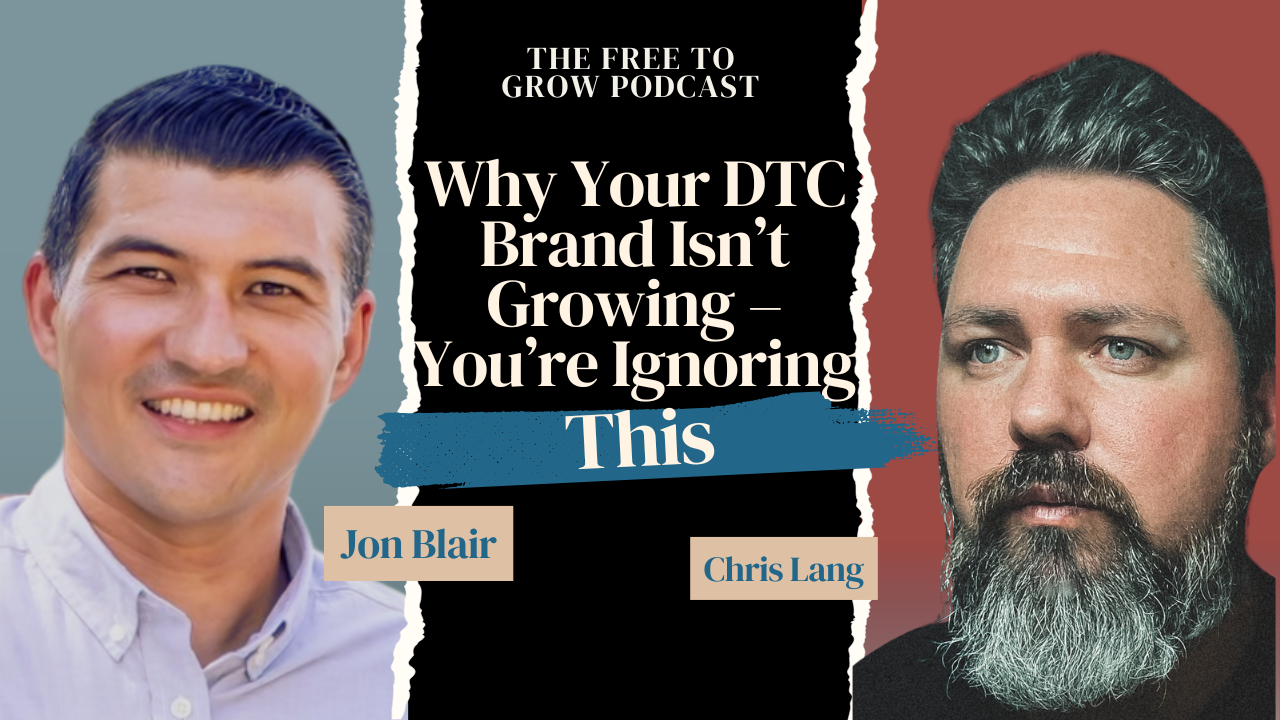
In this episode of The Free to Grow CFO Podcast, Jon Blair sits down with Chris Lang, co-founder of Fresh Chile Co., to break down how organic content and paid media actually work together to drive growth in a DTC brand. They explore why brands that rely solely on ads often struggle to scale—and how content improves marketing efficiency over time.
The conversation covers the link between storytelling and conversion, including how content builds trust across multiple touchpoints before a customer buys. Jon and Chris also introduce the concept of “hunting vs. harvesting,” highlighting the difference between short-term sales from ads and long-term growth driven by consistent content.
They also get tactical, walking through how to use your product page as a content roadmap and why most founders overthink getting started.
This episode is a practical look at why content is a core driver of profitable growth.
Key Takeaways
Consistent, high-volume content beats perfect content that never gets published.
The best ad creative often comes from organic content that’s already proven to engage.
Brands that rely only on paid acquisition are “hunting”; the ones that win are also “harvesting” with content.
Episode Links
Jon Blair - https://www.linkedin.com/in/jonathon-albert-blair/
Chris Lang- https://www.linkedin.com/in/chrislangsocial/
Free to Grow CFO - https://freetogrowcfo.com/
Meet Chris Lang
Chris Lang is a founder, marketer, and operator who helps brands and founders grow through organic social and storytelling. He is a partner at Fresh Chile, where he helped scale the brand into the top 1% of Shopify stores by building community driven content and consistent organic distribution. Chris has built and operated businesses across ecommerce, food, retail, and media, and now runs MOVE FWD, a social and storytelling studio focused on turning a founder’s story into a repeatable growth engine. His work centers on one belief: stories build trust, trust builds community, and community drives sustainable growth.
Transcript
~~~~~~~~
00:00 Introduction
02:48 Building Community Through Storytelling
05:54 The Importance of a Strategic Content Framework
08:20 Navigating the Hunter vs. Harvester Mindset
11:00 Consistency vs. Quality in Content Creation
13:43 The Long Game: Patience in Brand Building
19:05 Visualizing Content Strategy
20:04 The Power of Storytelling
21:36 Financial Considerations in Content Strategy
22:48 Creating Content for Multiple Platforms
26:04 Final Thoughts
Jon Blair (00:00)
Hey everyone. Welcome back to another episode of the Free to Grow CFO podcast, where we dive deep into conversations about scaling a profitable D T C brand.
I'm your host, Jon Blair, founder of Free to Grow CFO. We are the go-to outsource finance and accounting firm for eight and nine figure D T C brands.
Jon Blair (00:17)
Alright, today I've got my homie Chris Lang again for the third time on the show. Chris, I think you're the first three-peat man, what's happening?
Chris Lang (00:26)
And I feel like I had my flu game today, bro. This is like my 10th call of the day. I'm like, you know, just like pushing through. No, dude, three P feels good. Feels good.
Jon Blair (00:30)
Hahaha!
Yeah, I'm excited to chat, man. think we chatted, I mean, we've chatted a bunch of stuff. We've chatted Fresh Chili. We've chatted the kind of like five F's and kind of like, more like life coaching side of Move Forward. But today we're gonna talk about something that I definitely see you playing in constantly with your content game. But we're gonna talk about content, organic social storytelling, whatever people wanna call it.
Chris Lang (00:41)
Yeah, right.
Yes.
this.
Jon Blair (01:02)
The reason why I brought you on to talk about this, one, you're living it, you're breathing it every single day and you're out some great content yourself, but I want brand founders listening to hear about this other side of building a DTC brand. It's not all just Facebook ads, Google ads, direct response marketing. There's a brand building side of things, organic social, content creation, storytelling, all a part of that.
Chris Lang (01:15)
Right.
Right.
Jon Blair (01:28)
And over time, there's this invisible linkage between the two, between ad buying and direct response marketing and that content. And I couldn't think of anyone better than you to come on and chop it up on that. before we dive in, can you give the audience a quick, just a quick background on who you are and what you do?
Chris Lang (01:44)
Yeah, so I'm a creative entrepreneur, Fresh Chili's in the top 1 % of Shopify brands, bootstrapped, no investors, tons of line of credit and loans though, if I'm being honest. And I've been in the DTC game for about 10 years now taken me that long to really wrap my head around.
blended ROAS and content, like how do they all speak to one another? So yeah, yeah, yeah.
Jon Blair (02:08)
So before we get into like, I wanna get into the weeds on some of your advice on how to build organic content, but before we do, what have you seen at a high level over your years of doing ad buying and creating content? What do you see about how those two combine forces to really drive a brand's growth forward?
Chris Lang (02:19)
Mm.
Yeah, I I think the two big takeaways, it's going to make you more efficient on your ad spend, you know, when you're doing it right. Right. I mean, I think every every high level media buyer is saying their job is so much easier when the brand has organic strategy down. that's like organic strategy. going to make me look like a rock star. Right. So.
Jon Blair (02:43)
For sure. Yep.
Yeah, yeah, totally, totally.
Chris Lang (02:48)
Every media buyer loves that. then like number two, it's about depending on the business model. If you're looking at L TV, AOV, all the things, right? Like it's about building a community that you can build your business upon long term. And so I think it's those two foundational aspects that I see that are kind of the biggest takeaways.
Jon Blair (03:08)
Yeah, man, even with, I mean, we've built Free to Grow on the back of, you know, referrals and content. And obviously this podcast is a part of our content. There's no lie about it. But what is the reason why we do it? Yeah, we, we, we want to drive leads. We want to grow our business, but I love being helpful and I love seeing the community that gets built around our content. I've got existing clients who say they listen to the podcast. I have prospects who come in that I've known for a year.
Chris Lang (03:24)
Right.
Jon Blair (03:37)
that heard a podcast episode and said, today's the day I start working with Free To Grow. Another podcast I'm on, Ecom Scaling Show, we just recently started doing monthly live Ecom Scaling Shows to further the community building, to invite people in to watch the show live and ask questions. And I think in a world of AI content creation, right, being on the rise, building genuine organic content and telling your story as a pillar of that, not the only pillar, but
Chris Lang (03:41)
Mm-hmm.
Great.
Jon Blair (04:05)
a core pillar is going to differentiate genuine brand building from like AI driven content. Do you agree? And what do you have to say about that?
Chris Lang (04:06)
Right.
I agree and I think that's really where my framework was really developed is, know, there was a there was a part before the agency kind of got restarted where I had like 10 different businesses and I had to create like this social framework to tell the story repeatedly, you know, every day. And then there's been a few shifts with that, you know, one stories and reels are more important than ever. Like, think I think the worst thing I've seen, you know, clients or brand agency or brand owners obsess over is like the
the grid, know, this the aesthetic and it's like, no, your people are on stories, your people are on reels right? And so like you guys spend more time strategizing, you know, what that content looks like. And that's where if if you know, if you're a Shopify brand owner, this is the best way I can explain it. Go to your PDP, your product page and what's on your product page.
How do you convert that customer? It's images, it's reviews, it's how to use, it's price point, it's shipping terms, your return. And that's what we do. We systematically, call it our shop operating system is what I call it internally, but it's a Figma board. And this Figma board is very systematic where yes, we have the post of the day or carousel post of the day, but we're also building out stories. And those stories are very systematic to the products that
that
are on the Shopify store and also that are relevant to educate very high level top of funnel.
the customer because that's the thing like they see an ad you're spending all this money on meta but then you're not optimizing like the conversion and the other thing is like people obsess over their websites but they don't obsess over social but you're spending money on social and obsessing over you're like like losing a step in between right and so that shop operating system that I've really kind of developed and it's very visual and the reason why brand owners really like it is because they can really see okay
Jon Blair (05:54)
Yeah, totally.
Chris Lang (06:04)
Monday, you know February 2nd or whatever it is
Here's my post of the day. Here's my stories of the day. Here's my email Here's what ads we're launching and that's that's the way that I sort of had to bring it all together visually for people and it just really started to click for them like oh There's a whole strategy behind this and yeah, I was like we're trying to complement the email We're trying to complement the ad strategy now ads if you're a brand that's thrown a thousand ads ad account That's another again, they're all variation. I guarantee those ads
that are in your ad account are variations of what we just talked about. How do you convert people on your PDP is sort of the strategy that we take on. I would say it's our first step on social is where we like to start. You can do in-person events, activations, collaborations, white listing, it goes on. But the first step is to build a foundation through kind of top line education.
Jon Blair (06:59)
That's fascinating. My brain was firing off in all directions as you were talking. Like first, just using the every piece of information on your PDP is kind of like a roadmap of like, we need content that goes deeper on each one of these, right? And I like to think about content and it doesn't matter what kind of business you run. I run a service business, but obviously this applies to an e-comm consumer goods business. You want content to nurture prospects on its own.
prospect can choose to dive deeper and go down a rabbit hole and learn all the things for themselves, right? If you just rely on a top of funnel Facebook ad that drives someone to a site and then maybe some Google ads retargeting, right? They're basically relying on converting a lot of your sales through these really 15 to 20 second like scans of pages, right? And some products can sell that quickly, right? There are some impulse byproducts where
That can happen, right? But there's only some people who are ready to buy today. Like there's this book I read. I forget the name of it. it's called the one page marketing plan by a guy named Alan dib. I read a number of years ago and it really changed my perspective on marketing. This totally applies to an ecom brand. There's harvesters and there's hunters, right? The hunter, the hunter analogy for advertising is you put out a Facebook ad, someone clicks on it. They go right to the landing page and bam.
Chris Lang (08:11)
Thank
Jon Blair (08:20)
they buy, right? Um, there's a small percentage of people who are going to be ready to, to, to, for you to pull out your, your marketing gun and shoot them and bag the kill. Right. And what's great about a hunter is it gets you sales today. It gets you fed today. But what's bad about a hunter is every day you have to net new, find a new piece of game to kill. Right. Or you have to find a new customer who's ready to buy today. So what does a harvester do? A harvester sows seeds.
Right? Fertilizes them, waters them over many, many months. And then patches of that, of that land that's been cultivated starts, start to be able to harvest it one patch at a time. And so he's what this book talks about is you got to think about two layers in marketing. You're going to have some people you're going to hunt where you're going to bag the kill today, but you also need to be tilling the fields.
Chris Lang (08:50)
Right. ⁓ Right.
Jon Blair (09:12)
And you need to be harvesting one section at a time and you need both of those layers of sales. And so if you think, I think about content as being the harvester, you're the harvester, right? And so you may be nurturing someone on your content for two or three months. And then they see an ad the second time and that's the day they click and they buy, right? But you've been nurturing them all along with their content. anyways, I, I, I'm curious if someone wants to get started today.
Chris Lang (09:29)
Right. Right.
Mm-hmm.
Jon Blair (09:39)
What is the first, what is the biggest trap that you would of? Something you see all the time.
Chris Lang (09:44)
Hmm.
Yeah, that's a great question just because it is like a few different answers. But one answer is like not really having a strategy. I think with like,
people are afraid to test maybe is what I'm trying to say. People are not, they're afraid to like, they're almost paralyzed to put something out there, whether it's a reel or whether it's a story because it may feel spammy, but people's thumbs are just doing that, that quick. mean, like, what are you thinking about? Like, what are you obsessing about? Like, and I think that's like, maybe that is the number one thing that I just see is like, just people are like so,
Jon Blair (10:10)
Yeah, yeah, for sure.
Mm.
Chris Lang (10:21)
I'm a brand guy. Trust me, I'm a brand guy. But my biggest viral video was an ugly burrito thumbnail. know, I did not to eat that sucker myself, but it went viral to sell lot of salsa. yeah.
Jon Blair (10:27)
hahahaha
Hahaha
Chris Lang (10:36)
And I think like you just, know the term like Barry uses like ugly ads and I think that's a good analogy of some sort, but it's like you just at least gotta start talking to your community. And I think that's what it is, right? Like people wanna be prepared. It's like going to a networking event. You don't maybe know everyone in the room and you know, but I just, find it fascinating that.
know, brand owners are willing to spend so much money in hunters as a hunter and not really as a harvester. And I think that that's a great analogy. And so I would say don't be afraid to put yourself out there. And because the community is going to tell you it's either going to be engaging or not engaging. And, you know, that's kind of your, you know, your stats you can look at every month. So I think that's kind of the first thing.
Jon Blair (11:17)
Yeah.
Yeah, man, a hunter will feed you for today, but then they have to go out and hunt again. A harvester, a farmer will feed you all year long. Right. but what's the problem? It's delayed gratification, right? ad buying, getting a, getting a hit off of a Facebook ad or a Google ad, there's this adrenaline rush. There's this dopamine hit called direct response marketing. Right. but you know, the, the, more that I,
Chris Lang (11:26)
Mm-hmm.
Yeah, your research is
Jon Blair (11:48)
work with ecom brands at free to grow and even just build my own business. The more that I realized that actually funnels, I funnels, the analogy of a funnel actually ⁓ destroys the ⁓ perception of the value of organic because a funnel assumes that you drop someone right down into that bucket and they buy, right? Whereas like, I'm starting to realize with a content strategy, you have to think about it.
Chris Lang (12:07)
Right. Right.
Jon Blair (12:12)
ecosystem. It's more like a web, right? And there's all these connecting points across different pieces of content and across different ads, across emails. And really people kind of like your prospects are actually traversing up and down and across that web. And then at some point they finally they're convinced and then they go down the funnel and they buy. Do you, do you agree?
Chris Lang (12:14)
Right.
Right.
Right. ⁓
man, I mean...
I'm going to date myself here, I think one of the best analogies I could say is like purchasing a car. like you're going to see, you're going to see like the dealership ads on, on your feed. You're going to maybe hear about the dealership on the radio. You're going to see the, the, you know, kind of cookie TV, you know, commercial off the YouTube. And, that's the thing you go on the website, you look at it, you go on the manufacturer's website and look at it, you know, and that's the thing. Like it took me six months to buy my
Jon Blair (12:55)
Yeah.
Chris Lang (13:05)
last car. And again, it was just a myriad of touch points. just I thought it's funny, I ended up with what I actually started off with. But I just kind of went down this rabbit hole of looking at you know, all these other, you know, types of vehicles. And so I think what's really interesting is you do have to have that approach. And again, people like to research, I think people have been I think I don't know the stats on it, but everyone's been scammed on the Ecom at some point.
think that's kind of like what you kind of have to do. You have to build trust at every touch point.
Jon Blair (13:30)
For sure, for sure, yeah.
So I think I might be able to infer the answer to this question from a few things you just said, but I know with my own content strategy, what got me started was just like, I don't care if this is good or not. there was a lot of, in terms of like engagement metrics, in terms of the data, the first year or two of me building my own personal brand,
Chris Lang (13:44)
Yeah.
Right.
Right.
Jon Blair (14:02)
I would have guessed that it wasn't going well from the data, from the data I was being fed from these platforms. But anecdotally, I knew it was going well because prospects I talked to current clients, they were telling me they were listening to the podcast, keep it up on LinkedIn. And I'm like, really? That post got like 300 impressions. Right. And so, I've, I think I've come to learn that you just do it and you do it for the love of it. Right. And, and.
Chris Lang (14:05)
Right.
Jon Blair (14:29)
That's what keeps you going and it will bear fruit in terms of building your business at the same time. But what's your opinion on consistency and quantity versus quality?
Chris Lang (14:40)
Yeah, I think it's a combination of both if I'm being honest. So there's this graph I just posted and I benchmark us versus Heinz, French's, Tostitos, Kraft, Tabasco. And everyone had a net negative follower growth and we were the only brand that a positive follower growth.
and by a large margin and our engagement is higher than all those companies put together and we've distributed over 500 pieces of content in the last 28 days. So you know I but there's a strategy behind it going back to that right like I'm trying to educate our our consumers on every type of sauce we have. So we have over like we have we have 60 different sauces to be clear. So 28 days I don't even go through all my sauces you know I try to feature a
every day and just to get people like you said I'm just you know in 90 days they're all gonna kind of see that at least maybe we have a cocktail sauce or Dijon mustard but it comes down to the strategy I think today's world you do have to high level output going back to that benchmarking against some of the biggest brands in the world who are not generating as much content
But if I guess, know, what's interesting is, you know, people want to engage. They will either like, am I showing up for this or is, because I kind of do the same thing and I think you do the same thing. Like you might go on an Instagram or X account. ⁓ they haven't really posted in six months. I'm gonna unfollow.
Jon Blair (16:10)
Yeah, you're like,
this company dead or is this creator dead? Like, what is going on here?
Chris Lang (16:14)
Right.
Yeah. And so you might unsubscribe or unfollow. So I think it's a part of that. And so, you know, it's good to have both if you can do both. And I think the framework is, you know, and this is what I tell people, because I don't know what the average Shopify store, like how many SKUs they have, but just say it's 10,
you can really stretch that content out over 30 days pretty easy. When you think of all the touch points that you obsess over on your product page, just really turning that into posts and stories and reels, that's gonna give you 30 days of content.
Jon Blair (16:45)
Yeah, that's interesting, So that's actually one of the next questions that I was gonna ask you, which is you have any other advice for if a brand feels like they've exhausted their PDP and their SKUs, what do they do next? And this is what I'm really getting at, this thing. I hear a lot of content creators say,
Chris Lang (16:58)
Yeah.
Jon Blair (17:08)
I don't want to post the same thing because I just posted that three months ago. My opinion is, yeah, well three months ago a bunch of the people who were following me weren't following me. And all the people who were following me who haven't bought forgot what I said 90 days ago. What is your opinion on that?
Chris Lang (17:12)
Yeah.
Yeah, you know, it reminds me of the story of like Henry Ford, his desk.
was right past the advertisers desk and this advertiser was working on like this new campaign for the car and you know every day Henry Ford just kind of looks down at it just kind of like thinks to himself walks to his office one day he stops he's like can we change that up he was like you know i'm tired of looking at it he's like we haven't released this car yet sir so you know i think
Jon Blair (17:49)
Yeah, yeah, exactly.
Chris Lang (17:51)
I was like, what are you talking about? Like we're not, and I think that's just like, we get in our own way of right, of building community, telling our story. The reality of it is, is...
And I love this example of like Larry the Cable Guy, Like Larry the Cable Guy, you kind of know him as Mater from Cars, you know, from XR and everything. But that guy was that guy for 20, 30 years before Cars, right? And just, he just showed up every day and he was just Larry the Cable Guy. And, you know, it turned to something that's probably beyond his wildest dreams. But I really, what I find success in, and not just in like Shopify, but also creators and actors,
or musicians is the people who are willing to put in the work. You know, after day, and be like, this is who I am, this is who I am. And so...
those are the people that really win at life. And, you know, I mean, if you just actually, you know, take a step back, you'll you have that realization. So it is one of those things where it may feel, you know, but that's where like with us, you know, we we do change up the styles every 30 days, you know, the color schemes or images we do constant creative. So we're constantly doing new photo shoots, new video shoots. So but again, the messaging is still the same, you know, it's has
Jon Blair (19:04)
Yeah.
Chris Lang (19:05)
hatch hatch Chili, hatch Chili, you know? And so, and that's what people come to us for. And so, you know, when I work with other brands, it's kind of the same thing. I mean, I just got off a call earlier. They just were worried about spamming. And it's like, no, like.
And I think once people lay it out visually, so like what's cool is Canva or Figma or Illustrator, whatever you like to work in, they all have a whiteboard where you can just kind of throw everything, just take a look at it see how everything flows and looks out. And I think it'll start to make more sense to people. And this is something I've sort of I don't want to say I'm gatekeeping, but this is something that we've just been having success with internally. And I just haven't really been, you know, sharing it too much because
It was something that I wanted to make sure that it worked. That our clients were seeing positive growth like we were talking about. They weren't seeing negative. I mean the results are in. I mean the brands who are posting more consistently, they're the ones who are winning right now.
Jon Blair (20:04)
Interesting. Yeah, man. one thing that I wanted to dive into off of that is storytelling. Cause we talked about PDP, we talked about SKUs but the next layer the next pillar in my opinion, to great content, a great content strategy is storytelling. Where can a brand start. What are kind of the bullet points, your framework for like, where do we start telling our story in what areas?
Chris Lang (20:28)
Yes, so you definitely want to do it around the hero product comes down to that value system. it is one of those things where I just really define 30 different values.
that we have to be cognizant from a strategy standpoint of selling that product. But the top five are already there. I mean, like we talked about earlier, what is the social proof? How do you use the product? What's the money back guarantee if there is any? What are the shipping? And it's really kind of answering those basic questions around it.
That's where you just want to show up every day and that's where like you'd you see white listing is just it's really kind of king right now I think that's really gonna be the big alpha You know for this year is the brands who are building more social proof and I'm gonna dovetail for a minute because Meta sort of ran out of ad inventory
when it comes to your brand account. So how can it get more ad inventory is that if you actually start whitelisting social proof and start picking back off influencers and getting more ad inventory. So it's a really quite interesting dynamic right now for Meta and for Shopify growth companies.
Jon Blair (21:31)
Interesting. Yeah, totally.
Man, if there's one thing that brands can invest in in 2026 and beyond to provide a tailwind for their ad buying strategy, I think it's this content strategy you've been laying out, I mean, I would say financially speaking, let's talk about the finances of it for a second. Brands do need to think about what is the impact of these efforts gonna have on my...
blended marketing efficiency, right? Because the costs of building out a content strategy need to be considered in your overall advertising budget. But like, just like testing anything else, know, brands are great at like carving out a piece of their budget to test new ad creative, right? So I think personally as a CFO in the DTC space to think about starting an organic strategy and paying for the resources to do so in the same way.
take some amount of your budget, clear it with your CFO, your finance guy. Hey, can I spend X a month on creating content for our organic content strategy? correct me if I'm wrong, you should be able to dovetail that into your ad creative as well. So you can kind of kill two birds with one stone, right? You can create advertising creative. But I would say sometimes, and actually this is a good question.
Chris Lang (22:29)
Right.
Jon Blair (22:48)
I think where I see some brands go wrong is if they're only creating content from an ad creative standpoint, it may not be created in a way that packaging it for organic social. It doesn't, it doesn't, the output doesn't make sense, but if you start with organic content at the beginning and think about how you can dovetail that into ad creative, you can kind of combine efforts. And I think that helps the cost efficiency. Do you agree?
Chris Lang (22:58)
Yeah.
Yeah.
Mmm.
Yeah, so I'm smiling because kind of a
Kind of two points there. Let me answer the first part of your question, right? I mean, it's either going to be a 3000, 6000 or 9000 month investment, right? That's the way I kind of look at it, right? Like either you're hiring some like a good VA overseas to maybe kind of handle some of this content and you know, 6000 maybe you're layering on, you know, organic content and influencer kind of management, right? And then maybe 9000 and above your like custom content, know, custom photo shoots,
custom video shoots. So just to get that price point out of the way that's a good way to look at it. The other thing too on that why I was smiling and I'll just say it because Johnny it just tweets about this constantly with screenshots he's just like
It's a lot of organic content that we started doing for the brand Perfect White Tea, is a national apparel brand. basically, that's kind of it. That's what I'm talking about. What's cool is when we create 30 days of content, and we do this 45 days out, we're actually creating over 500 pieces of content that we're going to schedule and publish throughout the month. And what's cool is all of that content, all those 500 pieces of content,
that can be used in your ad account. That's what's amazing. Yeah.
Jon Blair (24:28)
Yeah. But you got to the strategy from the beginning, right? Like, like you,
you, you can get lucky and be able to use them in both places. But if you have that as a part of your strategy from the beginning, it really changes things. mean, look, I'll, I'll share this right here, like fully candid for everyone listening. The, content strategy strategy at Free to Grow CFO, it hinges the cornerstone content is our two podcasts. We pour our heart out into recording those planning them.
Chris Lang (24:37)
Right.
Right.
Yeah.
Mm-hmm.
Jon Blair (24:57)
editing
them, packaging them. And then we parlay that into all of the content that goes out in short form, daily LinkedIn posts, daily YouTube shorts. And then we also use it to create blogs and weekly emails that go out. And, but we didn't stumble upon that. That was our plan from the beginning, right? We're like, and, so what I want brand founders to hear is like, if you're worried about the cost, right? Of layering in organic content.
Chris Lang (25:04)
Mm.
Right.
Jon Blair (25:25)
on top of your existing kind of ad strategy, rethink it and say, how can we create content which consumes probably a budget you already have for creative, right? And build it out so that it serves both an organic content strategy and the creative that you need for your ads. And then you're gonna get a whole lot more, I think, bang for your buck, out of creating that content. So, ⁓ I'm curious.
Chris Lang (25:47)
Yeah.
Jon Blair (25:49)
Unfortunately, we could talk about this forever, but unfortunately we're gonna have to come to a close in a few, but I'm curious, what is your take on the biggest opportunity, like emerging channel for publishing organic content?
Chris Lang (26:04)
I mean, right now YouTube shorts. I'll be quite honest. This is a this is a channel because I haven't spent as much money on it, right? I've done Google Adwords and meta and some Tik Tok but it's like YouTube shorts is really where a lot of the organic growth is happening. This is actually where I'm pushing a lot of our client content for the last year.
I started a weekly cooking show with Fresh Chili and organically and just kind of getting sitting that as a foundation. So I'm about a year into it as well. I met with Isaac from Mini Katana We had dinner dinner in West Hollywood last month talking about like YouTube, you know, so I would say Isaac is a great guy to talk to you about YouTube growth strategy right now. I think what's interesting
is I didn't realize this, but I actually went to a Google YouTube meetup with like Ezra Firestone and Brett and Jacques from Raindrop. And the most interesting aspect is if you take YouTube from a consumer standpoint and you list Disney, Hulu, Peacock, everything else, all of those combined don't even equal YouTube's monthly viewership.
Jon Blair (27:12)
Well, well.
Chris Lang (27:13)
This
is like phenomenal. was just like So I feel like I that was like a gut punch to me. I was like, I really felt like I was missing the boat on that Meta still king obviously
But what's really cool, what's really cool is like you're already creating content for Instagram and maybe even TikTok. You know, just start putting it on YouTube as well. And then, you you get to a point where you need to really look at your strategy for growth. But what's great is just start repurposing your content across platforms for now.
Jon Blair (27:44)
Totally, Man, this has been everything I was hoping this conversation would be, man, and I appreciate you coming on. What are your final thoughts for a brand founder who's listening right now? What's a single final thought piece of advice you can give for someone who's just interested in getting started?
Chris Lang (27:58)
If you're interested in getting started, just start. Start taking some practical advice, take your product page.
go into Canva, very easy, select the 9x16 social media, select the 4x5 social media templates, and just start building out your PDP, but in social assets, and just start publishing them. I think, one, that's gonna give you clarity over your brand, ⁓ two, it's gonna make you really think how you present your brand and the offers, but I would say just really start converting.
foundational.
I'm not talking about crazy growth strategies, but just from a foundation standpoint, start telling your website story through your social media channels.
Jon Blair (28:39)
Man, I love that. I love that. Well, this has been fantastic, man. Before we land the plane, where can people connect with you or find information about you?
Chris Lang (28:47)
at Chris Lang Social, across all the platforms. Yeah, that's the best way.
Jon Blair (28:51)
Yeah,
definitely follow Chris. Chris's content. It's fantastic. He's, are you speaking at anything, ⁓ anytime soon?
Chris Lang (28:58)
Yeah,
I'll be in Miami next week for the DTC growth summit. I'll be with Ezra and I'll be Expo West in Anaheim.
Jon Blair (29:07)
Are you coming to eCommerce Roundtable in Austin in April? Bam, I'll see you there, man. That's in my town, so I'm looking Forward to seeing you there. Awesome, man. Well, I appreciate you coming on as always, and I look Forward to our next chat, man. All right, have a good one, brother.
Chris Lang (29:10)
Congresswoman table. Yeah, I'm going to be there. ⁓
Amen.
Yeah, same here. Thank you so much.
Bye.
Jon Blair (29:27)
Don't forget, if you liked today's episode, please hit the subscribe button wherever you're listening and leave us a review. It helps us reach more people like you. Also,
If you want more tips on scaling a profitable DTC brand, follow me, Jon Blair on LinkedIn. And if you're interested in learning more about how Free to Grow CFO can help your brand increase profit and cashflow as you scale, check us out at freetogrowcfo.com.