Don’t Make These Fatal Bookkeeping Mistakes
Episode Summary
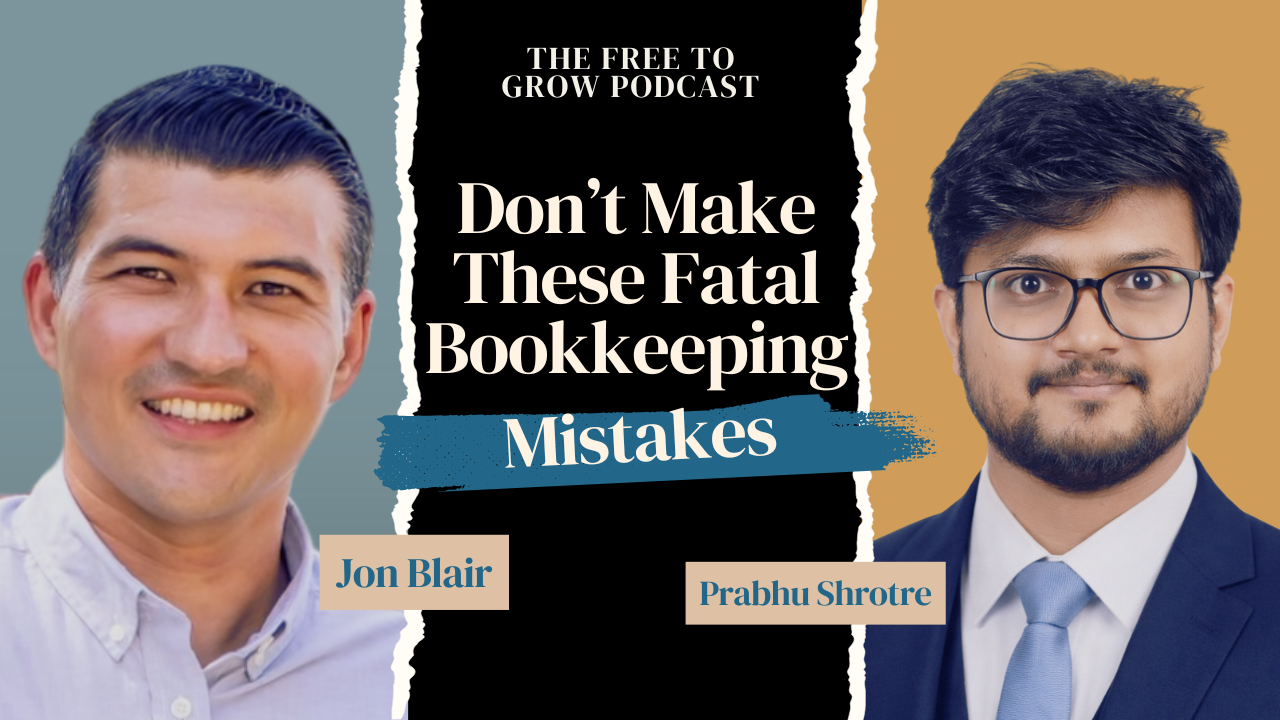
In this episode of The Free to Grow CFO Podcast, Jon Blair sits down with Free to Grow CFO team member Prabhu Shrotre to break down some of the most common issues we see when taking over a new client’s books. They walk through why many DTC brands rely on cash basis accounting and how it leads to misleading financials, poor visibility into performance, and ultimately bad decision-making.
The conversation covers three key areas where things typically go wrong: revenue recognition, cost of goods sold, and operating expenses. Jon and Prabhu explain how recording revenue based on cash deposits distorts true sales, why expensing inventory upfront creates inaccurate margins, and how delayed expense recognition—especially with ad spend and credit cards—disconnects financials from actual performance.
This episode provides a practical look at what’s actually broken in most DTC financials—and why getting the fundamentals right is critical if you want to scale profitably.
Key Takeaways
Most brands don’t have a growth problem—they have a visibility problem.
When revenue, COGS, and expenses are recognized in different periods, your P&L stops being a decision-making tool and becomes noise
If you’re not accounting for liabilities like sales tax, your “cash” balance is overstated—and you may not actually have the money you think you do.
Episode Links
Jon Blair - https://www.linkedin.com/in/jonathon-albert-blair/
Prabhu Shrotre- https://www.linkedin.com/in/prabhanjan-shrotre-0b27903a9/
Free to Grow CFO - https://freetogrowcfo.com/
Transcript
~~~~~~~~
00:00 Introduction to Prabhu and Free to Grow CFO
07:42 Challenges with Cost of Goods Sold Accounting
11:45 Operating Expenses and Their Impact on Financial Analysis
17:08 Culture and Work Environment at Free to Grow CFO
18:00 Final Thoughts
Jon Blair (00:00)
Hey everyone, welcome back to another episode of the Free To Go CFO Podcast where we dive deep into conversations about scaling a profitable DTC brand. I'm your host, Jon Blair, founder of Free To Go CFO. We are the go-to outsource finance and accounting firm for eight and nine-figure DTC brands.
Jon Blair (00:17)
Alright, today is an exciting day. I've got one of my Free to Grow CFO team members on the show today. Prabhu, I'm gonna get this maybe slightly wrong, Prabhu, I'm sorry, but Prabhu Shrotre. Prabhu, thanks for coming on, man. How are you doing today?
Prabhu (00:25)
Okay.
I'm doing good man, how are you?
Jon Blair (00:35)
I am good, I am, let's see what time is it where you at? It's eight in the morning here, what time is it there?
Prabhu (00:40)
at 7.30 in the evening here so yeah it's good
Jon Blair (00:44)
Well,
I appreciate you joining. For those of you that don't know, we have a small team in Pune, India. Prabhu is on that team, has been with us for a while now. There is, what, three people on the team now out there?
Prabhu (00:57)
Yes, we have three people in the beam here.
Jon Blair (00:58)
Yeah, so Prabhu ⁓ has been a steady force in our business for a while now. Has it been two years?
Prabhu (01:06)
It has been two years now, yeah.
Jon Blair (01:08)
Yep, two years. Yeah, it feels like I can't remember Free to Grow before Prabhu, so it's hard to remember pre Prabhu. We've got a couple other really amazing people out there as well, but Prabhu, before we dive into talking about probably mostly cash basis accounting and the importance of accrual versus cash basis, can you just give everyone just like a really quick overview of what you do at Free to Grow CFO?
Prabhu (01:31)
Sure, so I'm Prabhu. Thanks for introduction, Jon
the things that I do in Free to Grow is presenting the historic books to the clients that is recording books correctly, properly, maintaining their books of accounts and preparing their financial models for the client. So that's an overview of what I do in Free to Grow.
Jon Blair (01:49)
So, Prabhu has seen his fair share of bad books that we inherit when we have new clients come on. Prabhu's been involved in a number of cleanup projects as well as a number of onboardings, which inherently in onboarding oftentimes there ends up being at least a small amount of cleanup. today we're going to talk specifically about the dangers of cash basis accounting as opposed to accrual basis accounting, which is the way that we do it at Free to Grow CFO.
And there's three specific areas we're going to dive into. One, revenue recognition, two, cost of goods sold, and three, operating expenses. So Prabhu, let's start with revenue recognition. Can you explain a little bit, can you explain a little bit about the cash basis revenue that we tend to inherit from new clients and why, and some of the areas that the cash basis accounting is misleading.
or incorrect.
Prabhu (02:42)
Sure, so what happens is most of the e-commerce brands they record their revenue as soon as the money hits their bank accounts and what happens is in the initial phases the founders think that they're making big profits due to a lot of cash flowing into their accounts whereas the actual picture it's not right and in a cruel basis accounting what we do is we record revenue in the right period whenever the item was sold.
So the biggest problem I can think about of cash basis accounting is we only record revenue when the money hits our bank account, we record it as sales. But we tend to forget important concepts like discounts and refunds, which can affect the margins of the brands if they're really looking at having the correct picture of their books of accounts and how much they made in a particular month.
Jon Blair (03:29)
yeah, so to go a level deeper, can you explain why when you see a brand that's doing cash basis revenue accounting, can you explain a little bit why discounts and refunds and some of those things are missing from their entries?
Prabhu (03:45)
So what happens is these brands, tend to record only the amount of sale know, for example, $100 hits my bank account and I record $100 in sales. reality, my price of product is maybe 200. I offered $50 of discounts. I had some $50 of refunds. And whereas my actual sale for that period is gross sales of 200 versus net sales of 100. And if we only record
Jon Blair (04:08)
Mm.
Prabhu (04:10)
the amount that's coming to my bank, then that's obviously not the correct picture what I'm looking at.
Jon Blair (04:15)
Yeah, and even worse, there even balance sheet item in that deposit as well, right? Being a sales tax collected, which is actually a liability, and then also to an operating expense, or I guess what we call variable order costs, being the Shopify fees or the credit card fees. So as you pointed out, we're missing the bifurcation of gross revenue.
Prabhu (04:24)
Yeah.
Jon Blair (04:42)
minus discounts, minus refunds, maybe plus shipping income, right? And then sales tax collected, which should be on the balance sheet, and then credit card fees or merchant account fees, whatever you want to call them, which should be an operating expense that's not in the revenue section of the P &L. So let me, do you, I think it would be helpful if you explain, because
because a balance sheet item in sales tax collected is embedded in that, you know, quote, I'm gonna say air quotes, like revenue that they're recognizing and also potentially an operating expense or a variable cost being the credit card fees. What does that do? This form of cash basis accounting where they're just plugging the net deposit that hits their bank account to revenue, what does that do to analyzing margins?
Prabhu (05:23)
you
So it's a really really messed up thing when books are recorded on cash So as I say, if we record revenue when the money is hitting my bank account, for a period I might think I'm generating enough sales but I should be aware that some part of my sales is not actually sales but some part of my cash in is related to sales tax or gift card liability that I'll have to pay in the future period and
If I'm not accounting for that correctly, I might not have a picture of what liability is coming up in the future and in the future I might not have enough cash balance to pay that. So that's an issue that most of the brands are facing.
Jon Blair (06:10)
Yeah, so there's actually, as you're talking, there's three issues I can think of. There's probably more, but one, you have the income potentially in the wrong period because sales had actually got fulfilled at the end of the previous month. That deposit's delayed and not showing up at the bank account for a few days. So you have the revenue in the wrong period. Then two, what you brought up, some of that quote income isn't actually income, it's owed to someone else. It's either owed to the government because it's sales tax or it's owed to
a customer in the future because it's a gift card, is technically a prepayment and is not income. So we're overstating income there, but then we are also understating income by the amount of the credit card fees, right? That are subtracted. That should really be a variable cost. So if we use that, let's say we use these net amount that is deposited to the bank account as your quote net revenue for margin calculations, which is like
margin dollars divided by net revenue, the denominator's wrong. If the denominator's wrong, the percentage you're calculating is wrong. And so it really causes all kinds of issues. So guess the point though I want the audience to take away, it's not just one thing that it causes issues with, it's multiple things. And if you start talking about really important questions like, can I afford to scale ad spend? Is my ad spend profitable? Really, really hard to do when you're doing this incorrect
cash basis revenue. So let's move on next to cost of goods sold. What's the big issue that you most commonly see with cost of goods sold accounting?
Prabhu (07:42)
So most of the brands that come to us for the first time we see that the accounting policy they're following is the record Purchase of inventory as an expense whenever they paid money for it But in actual sense if we look in account correct accounting sense, it's not actually an expense But it's an asset it only becomes an expense when you sell the goods. That's when it moves to cogs until that
you have to record it as an asset, inventory asset. But most of the brands fail to maintain that accounting policy and they have a negative or I would say an artificially low income in the period when inventory is purchased. And when the sale actually takes place, they have this artificially wrong profit since expenses booked in the previous period.
Jon Blair (08:27)
Yeah, so there's actually a commonality between the revenue recognition issue in terms and L value in the wrong period, the wrong accounting period, the wrong month. There's a commonality between that and this cash basis cost of goods sold issue that you're mentioning, which is that in one period your profit will be overstated and in another period it will be understated. And so what's interesting is generally speaking, and this is a trap, so like don't follow this.
Don't try this at home listeners, okay? But like, you can look at a longer time horizon, let's say trailing 12 months, to get a rough idea of what profitability is, because those month over month swings can kind of like offset each other and smooth each other out. But that's a trap, why? Because I can't tell what happened last month, or the month before, or the month before, so I can't follow trends on a month by month basis in real time. And so let's use Cost of Goods Sold as an example.
I want to know if my gross margin is getting better or worse every single month, not just on a trailing 12 month basis. And you cannot do that accurately if you have revenue being recognized on a cash basis and you have cost of goods sold being recognized on a cash basis. think furthermore, Prabhu, what about like, why is it important? Let's remove the P and L for a second and let's not talk about the timing of cost of goods sold hitting the P and L, just the balance sheet.
Why is it important or what are some of the reasons that come to mind for you of why it's important to get the asset value correct of inventory from a balance sheet health analysis standpoint?
Prabhu (09:59)
Alright, so that's a really good question, Jon. It's really important to have the correct asset value on the balance sheet because we calculate several ratios like inventory cycle, cash conversion period, which are broadly linked to our working capital cycle and if we are not getting that number correct, owners might get in trouble if they don't have this correct amount of cash that they're required to pay in the future or
If they are not able to assess their proper working ⁓ capital cycle, then that might cause an issue.
Jon Blair (10:31)
Yeah, well, and so it's not just that what one thing that our books do when we get them done right, the Free to Grow way. The P and L is obviously important. It's a critical starting point for financial analysis, but the balance sheet in an ecom brand that is capital intensive because it holds inventory. The balance sheet is just as important, maybe more important because you can have profit, but no cash. How is it possible to have profit, but no cash? Usually,
It's because you have too much inventory on hand and your CFO or your finance team can't help you manage the financial impact of inventory. If it's not recorded on the balance sheet accurately every single month, you can be profit rich and cash poor because all your cash is sitting on the balance sheet in the form of inventory. So it's actually, it's actually just as important on the flip side of the balance sheet.
is accounts payable? And actually I want to segue now into talking about cash basis operating expenses and we'll talk about the impact of accounts payable and how that affects working capital analysis. But what do you most commonly see Prabhu as issues with operating expense accounting we take on a new client?
Prabhu (11:45)
So on the front of operating expenses, I see that most of the brands similar to revenue, they also record their operating expenses on cash to look at this as an example, if I go to a restaurant, I eat something, I pay through my credit card, and then my credit card bill is paid 45 or 50 days later, then that 50 days later is when money is going to go out from my bank account.
these brand owners, they record the expense on that 50th day, but not on the day when they consume the food. isn't really expense that took place on the day when you ate the food and not on the 50th day. So, that pretty much applies to expenses as well. For example, spends. spends which are charged to credit cards are usually taken out of your bank account on the 40th or the 50th day and brands look at it as the
Branch don't see the growth of sales and they cannot have a proper correlation between The sales that are growing up and the ad spend since it's not recorded in the correct one
Jon Blair (12:45)
Yeah. So if a brand has, we see this with brands that have payment terms with say Facebook or something. And if we don't get the bill, from the, from the brand, which specifies the period that that ad spend was for, it's hard for us to, we can run the risk of, of booking the expense when that bill gets paid to say meta. it's, that's usually why I think I see an issue with
other bookkeeping firms getting the expense recognition wrong on a cash basis is because they don't have a process set up to get the information needed from the clients to figure out the proper expense, the proper period for some of these big expenses. Now, a lot of our controllers on the team are trained to look for some of the big expenses that maybe need to be accrued, which means like, even though we haven't,
paid for it yet. We booked the expense in the month that is benefit that that expense is benefiting. We see this a lot of times on the marketing expense front needing to book a marketing accrual. Sometimes we see this on shipping costs as well. to the customer because you'll get billed by the 3PL late like in the month after the shipments actually you know benefited company. And so
Prabhu (13:47)
you
Jon Blair (13:59)
this is like super, super key. think another big thing, I think in general coming
up with a process to, get bills from from our clients, as opposed to just booking expenses on the bank feeds, right? Which is the month that the, or the day that the cash comes out of the bank account or the day that expense hits the credit card. That is, that is the key is coming up with a process for that.
Prabhu (14:14)
Right
Jon Blair (14:24)
And again, going back to tie
Prabhu (14:24)
Thank
Jon Blair (14:26)
a thread between revenue recognition, cogs and operating expenses. If you have revenue recognition, that is the wrong amounts and partially in the wrong periods, cost of goods sold on a cash basis that is being expensed in the wrong period. And then also operating expenses. You've just got revenues and costs all over the place in different months. And it starts to become basically impossible to, to analyze your financials.
Okay, Prabhu, so there's another thing related to operating expense accounting on a cash basis that affects the balance sheet. I see this a lot when I do our CFO audits. It's that there is no accounts payable on the balance sheet, which immediately tells me operating expenses are on a cash basis. Can you just really quick share with the audience?
why having no accounts payable on the balance sheet when there actually is money owed to vendors at the end of every month, why that's an issue.
Prabhu (15:18)
So what most brands do is they tend to book the expense money actually hits their bank account, but in reality they actually owe their vendors and during this process the accounts payable is not booked on the balance sheet and that's a big red flag because when computing the working cash flow cycles or calculating the future working capital requirements
is we are completely ignoring the accounts payable then there's a hidden liability that we are not accounting for and from a cash point of view it can just drag down you know branch when the liability pops up and we have not planned for it accordingly or beforehand so that's a big red flag
Jon Blair (15:56)
Yeah.
I, when I as a CFO look at the balance sheet and I look at cash position, I don't ever say, Hey, like, let's say the cash balance is a million dollars. I don't ever say we have a million dollars in cash. I always say we have a million dollars in cash minus a hundred thousand in credit card liability minus 250,000 in, you know, accounts payable and
If there's any other current liabilities on the balance sheet that I know need to get paid in the next 30 to 60 days, I subtract those and say, here's how much cash we have net of what we owe people over the next 30 to 60 days. And if you don't have accounts payable properly accounted for on the balance sheet, then you have no way to track that you actually owe some amount of money to your vendors. And you can't assume that
all the money in the bank is yours because there are short-term liabilities, accounts payable usually being one of the biggest ones that other people have rights to and you need to be able to understand that when you're doing cash flow and working capital analysis. So this was an awesome conversation Prabhu I think this is gonna be really helpful for our audience. I wanna ask you one final question that doesn't have to do with accounting.
Prabhu (17:00)
you
Jon Blair (17:08)
and it's about working at Free to Grow CFO. What about working at Free to Grow CFO and our culture makes you wanna work here and kinda drives forward a high level of performance across the team?
Prabhu (17:21)
Man it's really difficult to answer or really difficult to give just one point that you convinced me that I need to work at Free to Grow you know I have so much of freedom working here and just to express how much freedom I have
I recently traveled to the US to visit my family, my brother who stays there and that did not at all my work at all. I I moved there, I stayed there for a month and I worked just as usual. So that's one good thing. The other thing I would say, the owners, the, all the teammates, the owners, everyone in the team is so supportive and so knowledgeable and it's a really challenging environment to work with everyone. And I'm just like, you know,
happy to be working everyday. So it's never a dull day at Free to Grow I would say. Every messy client that comes up is a new experience for us. yep, that's...
Jon Blair (18:08)
We love it,
yeah. We love having you on the team, man. Having you come on the podcast, feel like, a big milestone to have you come on and chat through how we help brands not just fix their accounting, but really fix their decision making. And the things that you talked about today are basic blocking and tackling foundational fundamentals that are absolutely necessary
to ⁓ scale a D to C brand fast and profitably. So I appreciate what you're doing, Prabhu. I appreciate you coming on the podcast and I look forward to chatting again soon.
Prabhu (18:45)
Thank you, Jon. Thank you for having me over. It was really lovely to be on this. And thank you. Thank you for having me.
Jon Blair (18:51)
Awesome.
Jon Blair (18:51)
Don't forget, if you liked today's episode, please hit the subscribe button and leave us a review. It helps us reach more people like you.
Also,
if you want daily tips on scaling a profitable D T C brand, follow me, Jon Blair on LinkedIn.
And if you're interested in learning more about how Free to Grow CFO can help your brand increase profit and cash flow as you scale, check us out at freetogrowcfo.com