Scaling a Bootstrapped Brand - The Hulken Story
Episode Summary
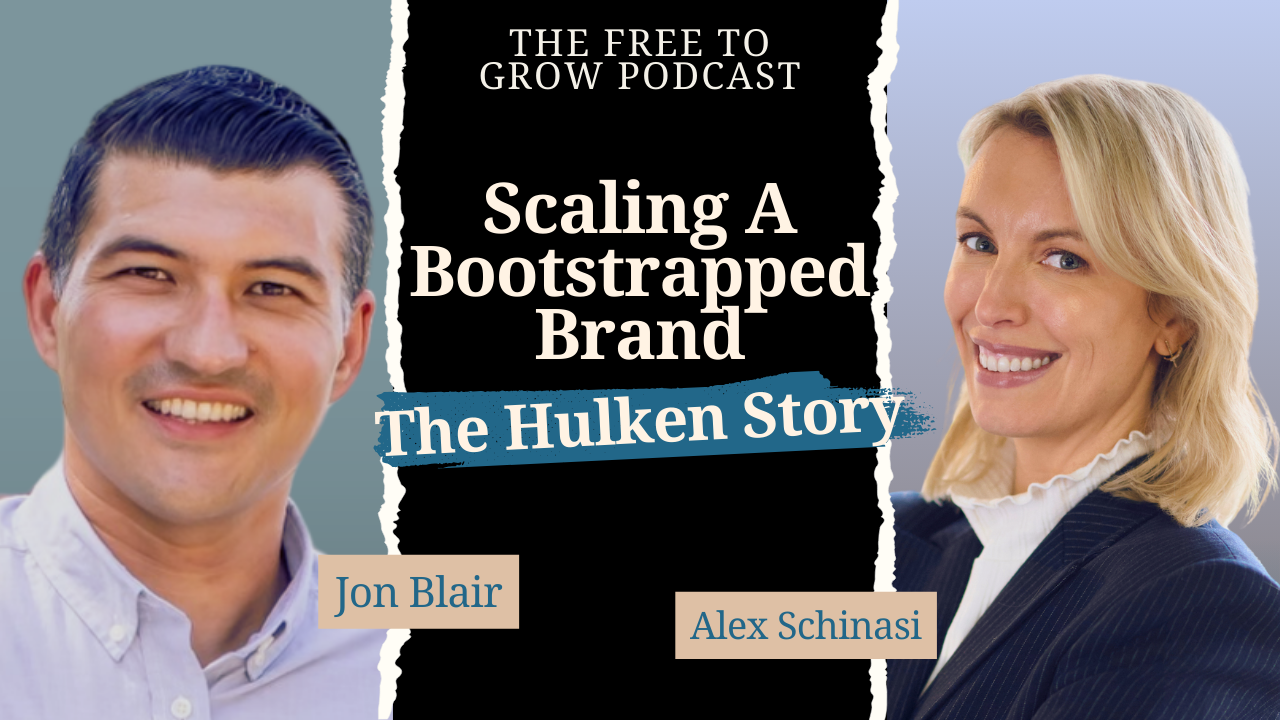
In this episode, Jon Blair interviews Alex Schinasi, co-founder of Hulken, discussing her journey from software startups to scaling a bootstrapped e-commerce brand. They explore the unique challenges and strategies involved in building a consumer product, the importance of product development, and the decision-making process in a bootstrapped environment. Alex shares insights on marketing strategies, the significance of community engagement, and the balance between work and personal life as a business owner.
What You’ll Learn
Product development should be prioritized before branding.
Listening to customer feedback is key to product improvement.
Defensibility in product design is essential for long-term success.
Building a strong team with outsourced experts can drive growth.
Episode Links
Jon Blair - https://www.linkedin.com/in/jonathon-albert-blair/
Alex Schinasi- https://www.linkedin.com/in/alex-schinasi-16b6abb/
Free to Grow CFO - https://www.freetogrowcfo.com/
Meet Alex Schinasi
Alex Schinasi is an accomplished entrepreneur and co-founder of Hulken, Ivy, and Clay. Ivy, a software platform designed for home remodelling professionals, was successfully sold to Houzz in 2018, while Clay, a childcare software solution, was acquired by Kangarootime in 2024.
Known for her ability to create innovative, user-friendly solutions that blend technology with design, Alex has established herself as a leader in the entrepreneurial space. Her latest venture, Hulken, continues to reflect her passion for functional design and practical elegance. Hulken created a new category of products and has grown to mid 8-figures in less than 5 years, without outside funding while being profitable from day one.
Alex is also recognized for her dedication to empowering women in business and her strategic approach to growing brands in competitive markets. She is a mom of 3, married to her Israeli husband Yoni who runs Hulken alongside her.
Transcript
~~~
00:00 Introduction to Alex Skenazi and Holken
03:04 The Journey from Software to E-commerce
06:04 The Unique Appeal of the Hulkin
09:08 Bootstrapping vs. VC Funding
11:57 Growth Marketing Strategies for Holken
14:52 Product Development and Defensibility
17:55 Decision-Making in a Bootstrapped Environment
21:01 Building a Team for Growth
23:45 Advice for Aspiring Brand Founders
26:47 Conclusion and Personal Insights
Jon Blair (00:00)
Hey everyone, welcome back to another episode of the Free to Grow CFO podcast where we dive deep into conversations about scaling a profitable DTC brand. I'm your host Jon Blair, founder of Free to Grow CFO. We are the go-to outsource finance and accounting firm for eight and nine figure DTC brands.
Alright, today I'm joined by co-founder of Hulken and beloved Free to Grow CFO client, Alex Schinasi Alex, welcome to the show.
Alex (00:25)
Thank you, Jon for having me. I'm so excited.
Jon Blair (00:28)
Yeah, well, so today we're gonna talk about scaling a bootstrapped brand, which you know very well. I actually follow the content that you put out on a regular basis about your story and your journey, which I think is really cool because I think a lot of, one of the things that I really wanna make sure we do on this show is expose what it's actually like to scale a brand, not the sensationalist version of, like sensationalist social media version.
Alex (00:47)
Okay.
Jon Blair (00:54)
of what it appears to look like, ⁓
Alex (00:56)
Yeah, yeah.
Social media, especially on platforms like LinkedIn, I feel like it's all about success stories and putting on milestones. And you know, you have every investor on the market kind of eyeing what you're doing. So it's a place to kind of brag a little bit. ⁓ But it does take a lot of hard work. And it doesn't have to be an overnight success, which is also a misconception that we get, especially in the VC backed world of CPG brands.
Jon Blair (01:11)
Totally.
totally agree and you've, you're not a first time founder, right? So you have been there before so to speak in terms of like growing and exiting a brand. So before we get into talking about the Hulken story, can you give the audience just a brief background about who you are and where you came from?
Alex (01:30)
Yep.
Yeah, of course. So I've always been in software and B2B SaaS for about 15 years. I was the founder of two software startups. The first one was B2B backend tool for the home remodeling space that I sold to another unicorn called Houzz in 2018, which was an amazing journey. stayed at Houzz for about three years, left their B2B offering at the company.
And following that, had another software startup called Clay that was in the early education space. And that one I ran for about three years before exiting last year to another software startup called Kangaroo Time. So I've always been a software gal. saw all...
what it's like to run a VC-backed business, to have your eyes on growth and on cost and do that whole spiel. And ⁓ in parallel, I was starting a side gig with my husband, Johnny, who you know, that started taking off in 2020 very slowly. It was very much a nights and weekend thing for me for fun.
And when I sold my last business last year, I decided to go full in because the success was what it was and I thought it was a great opportunity to try something new.
Jon Blair (02:48)
I love it, I love it. Side note, Johnny and I both have, we have something in common. We both were touring musicians. He was much more successful than I was in a more popular genre than the thrash metal band that I was playing in. I wanna get into that in a second, but before we do, you coming from, there's actually quite a few brands that Free to Grow CFO works with where it's headed up by a founder or co-founder.
Alex (02:56)
Right.
See?
Yeah.
Jon Blair (03:14)
who isn't a first time business founder, but his first time in e-comm, right? And so you...
Alex (03:16)
Yeah.
Yeah, because I see the opposite quite a bit, right? There's a lot of e-comm founders that then are like, screw that, I'm done with the consumer space, I'm done with hard products, I'm going into software. Like the scale is easier, you know, there's no inventory to manage. So I see a lot of these stories. So it's interesting that you see the reverse because it feels kind of lonely to be that software gal in e-comm.
Jon Blair (03:25)
Hahaha
So what's been, and you're going from software to e-comm consumer goods, what would you say is similar and what is different?
Alex (03:44)
it.
So yeah, it's interesting. So a lot of my day to day is similar to what I've always been doing, growing, scaling, digital marketing, conversion optimization, funnels. mean, it's a lot of the same lingo. All of my previous businesses have scaled through Meta as well. So it's kind of my bread and butter and what I'm very familiar with. So it's still within my comfort zone when it comes to growth and marketing. What's very different is obviously the entire ops side of things, the production cycle, then the iteration process is much more complicated. It's very hard for me as a software founder to think, okay, if I want to launch a new product, actually need to test it. I don't have a way to really iterate and test it before cycles and cycles of production. So things like that are a little bit frustrating. What is actually very refreshing is kind of the very simple
and ⁓ business model in many ways. know exactly our cogs and exactly our margins. We know exactly what we need to make money with profitable from day one. We don't have to reach for scale as much as we have to reach for profitability. So that's one aspect of it that I love. And the fact that it's very tangible and we see this love from the community on social media is just unlike anything I've experienced before. Like having a consumer product that people adore so much.
and share about so much to that extent is just unbelievable. Just so much fun.
Jon Blair (05:02)
Yeah.
Yeah, can they can they can take photos of it and videotape themselves using it right and post like their user experiences?
Alex (05:12)
Yeah, and it's prime
for that, right? The Hulken is, if you don't know, the Hulken is this shiny, bright, rolling tote bag on wheels. So it's really prone to be shot on social media. It's a product that people just find really fun. It's a little bit absurd almost and funny. And so for that, I think we're lucky because it means you can't ignore it. If someone walks with a Hulken down the streets of New York City, you're going to notice it. And I think
Jon Blair (05:25)
Totally.
I was just gonna say
As you know, my business partner, Jeff, he recently moved to the suburbs of New York, but he's been in New York City for a number of years. And I go out there a few times a year, and when you see a Hulken going down the street, everyone's like, what is that thing? And I mean, that's huge for ⁓ awareness and market. It's not something that, it's something that people are they're asking, like, what is that? it's a Hulken, right? And that's huge, because not every,
Alex (05:41)
Yeah.
Yeah.
Yeah.
Jon Blair (06:02)
physical product begs that kind of like response.
Alex (06:03)
Right, think, you
know, exactly, not only that, but I think of, you know, underwear brands or brands that you don't see, perfumes, lotion, things that you wouldn't see on someone necessarily that wouldn't have the same virality. You said is exactly right. It's a big shiny bag that you see rolling down the streets of New York City. It will turn heads. It will be creating questions. People will stop you on the streets.
to ask you what it is. And we invented an entirely new category of products. I mean there were no rolling tote bags. And it's interesting when it comes to CPG specifically, because when we talk to retailers, they don't know where to put us. Are we fashion? Are we travel? Are we storage? We're of a mix of all these things, because it is a product that was never there before.
Jon Blair (06:39)
for
Okay, so I'm curious, you have a VC-backed startup background or experience with your SaaS startups. Why bootstrapped for Hulken?
Alex (06:56)
I think we got lucky because of my family's background in packaging that we had the manufacturing piece figured out and funded from day one. So we are bootstrapped, but we also didn't need to raise any capital for our first batch of production. So I think that's really important to note. But I think what this highlights is that there are many ways to fund a business, right? We've seen other CPG brands partner manufacturers as a funding vehicle.
Jon Blair (07:13)
for
Alex (07:23)
And I think that's a great way to go about it. What I like about not having a VC right now is that we don't have the pressure of reaching certain targets within certain timeframes. I like that it's making us think a little bit more creatively when it comes to marketing, hiring. I mean, every step of the business, we just have to really think hard before spending any dollar. We have to think more creatively about creating content, about doing anything because we don't have the luxury
of endless capital to do these things. So I like that it's a little bit uncomfortable. It's actually a sweet spot that I personally love as a founder because I like the early stage hustle. I don't want to get to the point where, you know, we make so much money that we're not even thinking about how to crack that nut. So there's a lot of benefits of having a VC-backed business, one of which is investors, if you find the right investors, they're incredible and we had amazing VCs in the past and great relationships with each of them. I'm just really enjoying this right now. I'm enjoying the freedom. I'm enjoying being profit first in my mindset and not to say we will never raise capital because I think there might be a time and place at certain stage in the business. It's just not where we're at right now.
Jon Blair (08:33)
Okay, there's several things that I want to dive into from that. The first one is I actually personally understand how freeing can be to go from venture-backed to bootstrapped. That's my story at Guardian Bikes. We were venture-backed the entire way. And I think by necessity, based on what we were trying to do, we now have a factory in Indiana. We had to build a factory. We have our own warehouses. It's a huge undertaking. Definitely needed outside capital, right? ⁓
Alex (08:48)
Yeah.
Wow. Yeah. Yep.
Jon Blair (09:00)
But starting Free to Grow, CFO, when I started this, was like, we're going to be bootstrapped the whole way through as we scale. And there's actually, oddly enough, there's a lot of firms in our space that are taking VC investment right now ⁓ for various reasons. A lot of it is tech enablement. But what we found, or what I found about six months in was like, we also want to focus on working with bootstrapped.
Alex (09:12)
Yeah. Wow. Interesting.
Jon Blair (09:25)
brands because when we ourselves are a firm that has that same ethos and we're working with brands who have the bootstrap mindset, it's the constraints that get placed on your thinking that drive, it's just different conversations. You've been in the boardroom or at the leadership table with a VC backed brand and it's always like, what's the story? How do we get to the next milestone? How do we get to the next raise at the higher valuation?
Alex (09:26)
Okay.
Yeah.
Yeah.
Jon Blair (09:52)
And I'm not saying that's a good or a bad thing. I'm just saying now it's like, hey, what's the payback we're gonna get on investing these dollars and hiring this person or in buying this inventory or launching this product or scaling this ad campaign? So I'm curious, being that you guys came out at Bootstrapped from kind of day one, what was the first major growth marketing channel or channels that worked for you guys?
Alex (09:59)
Yeah.
Yeah,
so it's interesting what you said about the boardroom because I myself have to still detach myself from the mindset a little bit. I still have this hundred million milestone in my head from the VC back ruling that I've had all these years. Like I still want to get to that milestone as fast as possible. And it's just an interesting observation I did by myself. But in terms of growth channels, Hulken was kind of an accidental business, meaning I was not, you know, I was doing the marketing for it.
Jon Blair (10:28)
For sure.
Alex (10:41)
on my weekends. so initially it was very organic, much users sharing it on social media. We launched early 2020 and when COVID happened, one of our buyers, very early buyers, and they did very little meta advertising at the time, know, maybe one or $2,000 a month. And she actually was a writer for The Strategist.
and which was a huge milestone for any CPG brand to be mentioned on The Strategist. So a couple months in, we get this dedicated feature on the Strategist naming us as an alternative for these journey carts at the supermarket. So that was kind of like one big first viral moment for the brand when we saw that first spike on Shopify. And from there, we just really capitalized double down on UGC's
of user generated content, micro influencers, we realized that the product was getting a lot of attention from different niches, very specific niches on Instagram, like thrifters, interior designers, chefs, photographers, professional organizers. We came across so many crazy communities, like professional mermaids. Apparently there's a whole mermaid community that needs to transport wigs and tails and whatnot. So doubling down on these niches and
doing collabs with these micro influencers, I'm saying, you five to 10k followers, but highly engaged following was super instrumental to us because we became a must have for their business. And as such, you know, they were excited to share about it. And, you know, one, I would say 18 to 24 months into
launching Hulken, that's when we started investing a little bit more in Meta, and that's when we started seeing that true hockey stick growth. But it started with a lot of focus on the product, making the product incredible, and a lot of focus on these Instagram niches that were really powerful.
Jon Blair (12:23)
Yeah, okay, so here's what's interesting. Now having the benefit of, you know, grown Guardian bikes and then, you know, having run Free to grow CFO for four years, we've worked with, you know, 65, 70 brands. And what I'm starting to realize is that there's like this catch 22 with starting an e-comm brand, right? On the kind of positive side of things, it's really easy to bring a product to market, right?
and get a Shopify store set up or even an Amazon store. You can go source product from kind of wherever for the most part to get started. But the flip side of that and why it's catch 22 is that means that there's a low barrier to entry. There can be a lot of competition. And so what you tend to find is the e-comm sales channels getting flooded with brands where product wasn't such a priority on the front end.
It wasn't, and it wasn't seen necessarily as the driver of everything. It was like, Hey, let me just find something that I think people need and let me go start spending dollars on meta. And I've seen lots of brands get started and even get to a decent scale and profitability, but because they didn't really focus on nailing product on the front end and really building something defensible, the brand eventually dies or really start struggling out of nowhere. What, what, are some of the things that like,
Alex (13:28)
Yeah.
Mm.
Yep.
Jon Blair (13:42)
on the product side, the front end, you guys did to just really make sure you build a really great product that can give you some defensibility over time.
Alex (13:51)
Yeah, so it's really interesting you say that. It's what people ask me for the first two to three years. only team was a product development team. was, the factory like testing the product, making the wheels less noisy, making the strap a little bit longer. You know, making the experience of using a Hulken really optimal. And especially as we were getting popular with these professional nations.
Jon Blair (13:58)
Mm-hmm.
Alex (14:14)
we realized, okay, can't just be a grocery bag, right? It needs to be something super sturdy. It needs to ⁓ handle the streets of New York City as much as it can handle other types of streets. And so we really were hyper-focused on making an incredible product for the first two to three years. And by the way, we're continually expanding that too. We're continuously making it better as we speak.
But it much is at the center of everything we do is the bag, how it rolls, how is the experience, how is its durability. And I think that served us because we listened to customer feedback so intensively for the first few years that we became an essential for so many people. And then came the marketing and then came the virality and the flywheel that came with that.
Jon Blair (14:56)
Totally.
Yeah, no, I mean, I don't want, I want to make sure that the audience hears that, the sequencing, because I have seen this time and time again. Nailing the product is almost kind of like the tail that wags the dog. Now, let me be clear, it doesn't mean you don't have to be a good operator. When you take a really great product, right, and you marry it up with great operators, right, in all the major functions of the business,
that builds a great business, but you can't just have great operators with a mediocre product, right? That doesn't, I haven't seen that withstand the test of time for any brand who has done it that way. And it sounds, the other thing is being obsessed about your product continuously, right? Like people will see Guardian Bikes today, nine figure brand, factory, incredible product. We started that business in 2009 in business school, right?
Alex (15:35)
No, exactly.
Yeah, crazy.
Jon Blair (15:54)
I mean, that's 16 years ago and the original founder and CEO, Brian Riley, who's still with the business, he is so obsessed with the product, right? And has been for 16 years and will never stop trying to make it better. And that is just so key, you know?
Alex (16:03)
Yeah. How amazing. Yeah.
Yeah,
that is so true. you know, Johnny a little bit, but that's exactly his whole point because we're always, know, I think like a VC founder sometimes I'm like, okay, let's make this one more expensive. We're adding this bells and whistles. He's like, no, the core Hulken the Hulken that everybody loves needs to continuously improve and be better. So it's not like we're launching new skus trying to make more money. We're trying to improve the existing hero product because it is the one that everyone
loves and and raves about. So it's it's very much key to our ethos. It's key to our success and it's key to creating that flywheel of virality because it creates the best experience our users can have.
Jon Blair (16:49)
Okay, so being bootstrapped, what are some of the things that come to mind with how you guys make decisions on what to invest in when you have scarce capital dollars? There's product, there's team hires, there's marketing. How do you guys go about making those decisions?
Alex (17:08)
think we're the perfect example here. We kind of wait until we're barely, you know, head above water to make decisions. Like we're in this position now, we're really under so much pressure on the ops side that we're finally hiring a head of ops. So I think it takes growth until we realize we really just don't have the bandwidth anymore to then decide what we invested. We're also realizing that
Jon Blair (17:16)
Hahaha.
Alex (17:35)
We're starting to see a lot of copycats and dupes out there. So the power of our brand is super important more than ever. So in addition to obviously investing in the product development, which we do naturally, and that's, think, will always be the case, but we're also investing in brand marketing more so than we have in the past to kind of make sure Hulken becomes this legacy name that it needs to be in order to stand above the noise.
Jon Blair (17:56)
mean, the name itself is a great name. Who came up with it?
Alex (17:59)
My dad, so my dad invented the product. I don't know if you know the story, but he designed the product for his own use case. was, you know, shopping in Paris and wanted to have an easy way to roll his stuff home. And, and through that, he just came up with a very strong name. My mom is from Sweden and so Hulken means the Hulk in Swedish. And it's easy to say, easy to spell and pretty memorable.
Jon Blair (18:00)
The... Okay.
So good.
Okay, so you mentioned you're head of ops, but have there been any other key kind of team members, insourced or outsourced, that you guys have added along the way that have instrumental to helping you guys continue to scale?
Alex (18:38)
Yeah, mean, obviously, Free to Grow has been a addition to the team. We work with a ton of freelance teams and we really believe in scaling with outsourced teams. Actually, we have just a team of five internally currently and the rest is all external.
Jon Blair (18:51)
Amazing.
Alex (18:53)
And we love it because we have the best of the best. Like, at Free to Grow you're experts in what you do and having experts in finance. are also experts in ecom was instrumental to us and is key to us reaching the next stage of growth because it's not just about growing that understanding the business and understanding the nuances of what it is to run a CPG brand on all levels, including finance.
Jon Blair (19:15)
Yeah, you know, so like, let's see, when did we launch Guardian Bikes? I it was 2015 is when we launched the brand. We were working on our patented brake system for like six years before that. But again, product development before scaling, But 10 years ago, there were a lot of the DTC like darlings, right? Like the early mattress companies, Tuft & Needle and Casper. Where like you could...
Alex (19:24)
Hmm.
Yeah. Yeah. Yeah.
Jon Blair (19:40)
You know, it's interesting. We hired a bunch of people from Tuft and Needle at Guardian Bikes once they got acquired and kind of the early team started leaving. And what we learned that was really interesting is that they were able to scale the nine figures just on Google because people were already searching for mattresses, but no one was selling them, which is such a different game than creating a brand new product category where you got to do top of funnel, like get people aware of something that they were definitely not searching for before. Right. And so
Alex (19:44)
Mm.
Good.
my gosh. Yeah. Ugh. So different. Yeah.
Yeah.
Jon Blair (20:09)
The reason I'm calling that out is because those brands, was so cheap to scale. It wasn't even about meta being cheaper, though it was. It was that if you were the first brand or the first couple brands to bring a product to market on e-comm and people were already searching for that, you could just spend money on Google and soak up that traffic that was already there. And so the margins were so high, you had these massive teams. mean, like, ⁓ Tuft & Needle had like dozens and dozens of people.
Alex (20:14)
it.
Yeah.
Yeah, yeah. It's amazing. Yeah.
Jon Blair (20:37)
in-house full-time in a huge office in Phoenix really, really quickly. But the modern ecom brand is not set up like that. I mean, we work with several brands. We work with numerous brands who doing 20, 30, 50 million a year in revenue. And they have very small in-house teams, but they're leveraging the right freelancers and like kind of firms or service providers that are needed for the phase of growth that they're in. And I just want to
Alex (20:40)
Great day.
Yeah.
Yeah.
Jon Blair (21:05)
I wanna just say that to the audience because most of the brands we work with, that is their makeup and if they aren't when they come to us, it's one of the first things we tell them like, hey, this is not how it's done these days. I just, it's really important for people to understand that because I think that is going to continue to be the trend that's not gonna go away. Do you agree?
Alex (21:14)
Yeah.
Yeah.
I agree and I'm also wondering because the makeup of your client base is also primarily bootstrap businesses and I'm wondering if that has to do with it but also I am talking to VC backed businesses, CGP brands, maybe raise a little bit, not crazy amounts but raise a little bit to get going and then will have a small internal team and a team of freelancers essentially, agencies to support them along the way. mean as a founder it's incredible, you don't have to worry about the overhead and everything that comes with HR
in all that pressure, but also just that you have access to the best of the best. So you have access to every agency has expert in this and that and brings the kind of knowledge you wouldn't get in a single person as a higher your team. So we're a family, love them at all. And we think it definitely helps us scale.
Jon Blair (22:13)
So brand founders listening to this episode, right? And they're listening to you and your story aspirationally, right? Serial entrepreneur, you've founded several businesses, exited a couple of them, now you're scaling a bootstrap brand to eight figures and beyond. What?
would be one thing that you wanna leave that listener with from your story that you think would impart some helpful wisdom upon their journey.
Alex (22:39)
So I think definitely hyper-focus on the products early on. Before you think crazy about marketing, a lot of brands will start with branding. I mean, we didn't have a brand book until we were at 15 plus million in revenue. We didn't have, we just had a simple Shopify site. We only redid it last year when we're approaching 30 million revenue. So I think things like that, we for later, like understand that you have an amazing product, some defensibility, strong very early on.
Try to get some organic virality going and then amplify that with some ad dollars is the key to do it.
Jon Blair (23:12)
love that the sequencing that you just went through is key. Doing things in the wrong order is what kills a lot of brands. So, I always like to finish up with a personal question. And for you, this is a question that's kind of near and dear to my heart because I grew up in a household where mom and dad ran a business together. And still do to this day. And so, yeah, they're still married and they still run their business together. I'm trying to get them to retire now. But, you run a business with your husband.
Alex (23:31)
They do? Okay. Are they still married? That's the question. Okay, good.
Yeah. It's fun. Like I'm always wondering, is it going to be a problem one day? So far, it's amazing. We do such different parts of the business. I I handle growth and marketing. He's very heavily involved with ops and production. Sometimes we'll sit next to each other the whole day and not really engage with each other and still feels like we each have our own jobs in a way.
Jon Blair (23:40)
What's it like?
Alex (24:02)
So far it's been Sometimes of course when we go on date nights we talk about work but we love it so much. I think it'd be different if we're doing something that we hate it and then it would kind of come into our personal lives but this is so much fun. We have a brand that people love, we have a brand that's growing like crazy. It's exciting and so even if we have to talk about it at home we love it and our kids love it and they embrace it. They know that we work together and they love the product. They want to be involved already so it's a lot of fun.
Jon Blair (24:10)
for sure.
love it. Well, Alex, thank you so much for coming on, sharing your story, sharing some of your wisdom. The Free to Grow CFO team, we love working with you and we're really looking forward to helping you guys take the business to the next level. And just thank you for joining and yeah, I can't thank you enough.
Alex (24:46)
Thank you, Jon.
Jon Blair (24:48)
Don't forget, if you like today's episode, please hit the subscribe button wherever you're listening and leave us a review. It helps us reach more people like you. Also, if you want more tips on scaling a profitable DTC brand, follow me, Jon Blair, on LinkedIn. And if you're interested in learning more about how our CFOs and accountants can help your brand increase profit and cash flow as you scale, check us out at freetogrowcfo.com.