A Founder's True Story: Scaling and Selling a DTC Brand
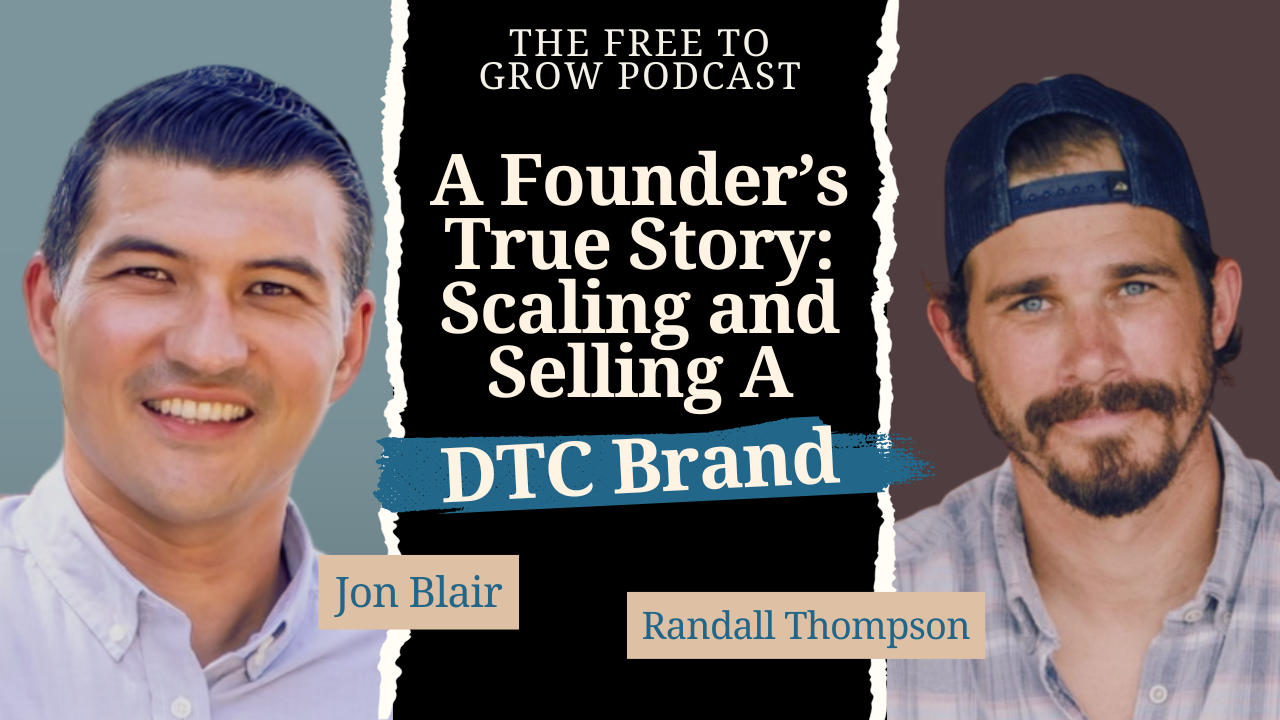
Episode Summary
In this episode of The Free to Grow CFO Podcast, Jon Blair interviews Randall Thompson, co-founder of Dugout Mugs, who shares his journey from professional baseball to building a successful e-commerce brand. They discuss the challenges of scaling a business, the importance of understanding marketing and inventory management, and the role of faith in entrepreneurship. Randall reflects on the lessons learned during his journey, including the significance of hiring, risk management, and the emotional aspects of exiting a business.
What You’ll Learn
Why over-ordering inventory is far more dangerous than stocking out
The real impact of long lead times and overseas manufacturing on cash flow
How to think about risk-adjusted bets instead of emotional growth decisions
Why most marketers struggle without understanding unit economics and financial relationships
Episode Links
Jon Blair - https://www.linkedin.com/in/jonathon-albert-blair/
Randall Thompson- https://www.linkedin.com/in/randall-thompson-rt-03466a6b/
Free to Grow CFO - https://www.freetogrowcfo.com/
Meet Randall Thompson
Randall Thompson is a former Toronto Blue Jays player, patented inventor, and founder of a three-time Inc. 5000 company—once ranked #30 among the fastest-growing U.S. manufacturers. His products have driven eight-figure sales in e-commerce and retail, including Dick’s Sporting Goods, Scheels, and MLB stadium shops, earning features in Entrepreneur and Forbes. In 2023, after selling his company, he set his sights on his next venture, fueled by a passion for innovation, team building, and go-to-market strategy.
Transcript
~~~
00:00 The Journey of Dugout Mugs
03:06 From Idea to Execution
05:52 Navigating the Challenges of E-commerce
08:50 Marketing Strategies and Evolution
11:46 Understanding Numbers and Inventory Management
14:46 The Dilemma of Inventory Management
22:34 Navigating Risk in Business Growth
28:16 The Importance of Financial Awareness
33:45 The Role of Faith in Entrepreneurship
36:45 Surprises in the Exit Process
Jon Blair (00:00)
Hey everyone, welcome back to another episode of the Free to Grow CFO podcast, where we dive deep into conversations about scaling a profitable DTC brand. I'm your host, Jon Blair, founder of Free to Grow CFO. We are the go-to outsource finance and accounting firm for eight and nine figure DTC brands.
Alright, I'm stoked for today's conversation because I am joined by Randall Thompson, co-founder of Dugout Mugs. Randall, what's happening, man?
Randall Thompson (00:26)
Hey, what's up?
Jon Blair (00:27)
Appreciate you coming on. I'm excited for the topic today because you have a unique experience in scaling and successfully exiting a brand. There's a lot of brand founders that Free to Grow CFO works with that that's their aspiration, scaling and exiting a brand. And what I'm excited to hear today from you is what it's actually like, not like the rosy social media version.
Randall Thompson (00:33)
you
Jon Blair (00:53)
of what it's like scaling and brand, the real grit and persistence and faith that it took to do so. So before we dive into your story, can you give the audience just a quick background of who you are and where you came from?
Randall Thompson (01:06)
Yep. Born in Orlando, Florida. I grew up in Orlando, Florida.
played college baseball, played professional baseball, got released from professional baseball, kind of tinkered around with stuff and then ended up founding a company by the name of Dugout Mugs where we converted the barrel of a baseball bat into a drinking mug. 95 % of our sales were e-commerce. The lifetime of me being there before I left in 2023, we did about $60 million of sales and that was split between e-comm and major retailers like Dick's Sporting Goods and...
all the major league baseball team stores. yeah, so the end of 2023, and then I've kind of just been whatever that thing's called where you like, you don't do anything for a while and you kind of like try to discover yourself. There's a technical term for that. I don't know what it is, but that's what I'm on right now.
Jon Blair (01:58)
Well, okay, so take us back to the beginning. Where did the idea for dugout mugs come from and what were kind some of the first moves that you made to figure out like, is this a viable business option or not?
Randall Thompson (02:10)
The idea came from, I was in a dugout in 2014, I was coaching college baseball.
The hitting coach was cutting wooden baseball bats in half with a hand saw on the dugout. He was creating a training tool. There was a bunch of loose baseball bat barrels just sitting in the dugout. I examined it. Anybody that knows anything about baseball bats, there's a natural cupping that's at the top of a bat. And I just thought to myself, if that cupping continued to go down, could you drink from this?
you turn it into a mug? And so that was where the original idea came from. I didn't pursue it right away. Went into my back pocket maybe about a year later, started pursuing it. And quite honestly, I didn't know anything about anything. So I just thought that my life was in a place that I just wanted to do something creative. I wanted to own a business and this product seemed simple enough to, I could do it. And I didn't think about gross margins.
I didn't think about anything. I just said, I'm going to just bring this product to market and see what happens. And so I did that. And then it just so happened it was a success.
Jon Blair (03:10)
Okay, so that story is so common, man, in the space. know, my firm, I formerly was on the founding team of a brand called Guardian Bikes, started Free to Grow CFO after about seven years in the e-comm game. When we started Guardian Bikes, me and the other two guys on the founding team, we didn't know a lick about e-comm. We were, you know, on the early days of Shopify and Amazon and did some physical retail. And we're, you know, we're flying the... ⁓
We're building the plane as we're flying it, right? And so many founders that my firm, Free to Grow, works with, they start the business out of passion for the product. They're usually product guys, maybe they're marketing guys. There are some guys who come in who are like savvy e-comm marketers already and they're just looking for products to bring to market, right? But I would say the vast majority of founders that we work with, they have some passion around the particular product that they've developed and
They're figuring out e-comm for the first in their life as they're working on launching and scaling this brand. So you go from professional baseball player to e-comm brand founder. Talk me through a little bit of what that transition was like.
Randall Thompson (04:19)
It was difficult and it was difficult because I worked a couple full-time jobs to save up enough money to take that money to then funnel it into making an inventory purchase, sell those and then take the proceeds from that and then buy more and then sell more and then buy more and then sell more. But to get to like the first batch of a hundred mugs
It's crazy. It would...
I wish ChatGPT was around back then because I was asking all the wrong questions. All I needed in my life was a woodturner, you know? And I didn't know that. And for whatever reason, I couldn't get anybody to tell me that. But if somebody would have just said, hey man, go see a woodturner. They'll be able to prototype this. And then what ended up happening is I said, okay, in order to make a product like this, you need a billet. Who sells billets? And billets just a fancy
Jon Blair (04:51)
Hahaha
Randall Thompson (05:15)
he
wanted to say like a block of wood. And I was like, okay, so this company up in Maine sells billets. And I'm like, hey, do know somebody that could potentially make something like this for me? And they're like, yeah, this person could make it for me. So I kind of reverse engineered out of the materials. But what I put a period on this, but I think what I learned along the way is
taking your thought process and whenever you come across something that you don't know the answer to, just stick on that one question until you get an answer that you're satisfied with. So turn I don't knows into I gotta knows.
Jon Blair (05:47)
For sure,
I love that. That is the key in my experience to all innovation and learning, but honestly, innovation is honestly just a series of, it's just like compounding learning and getting different outcomes over time until you look back and go like, wow, we've really innovated, right? And a key component of this is like, you know what, Elon Musk talks a lot about like thinking from first principles. And a lot of that is like just asking why.
Why, why, why, how, should, is there any, what's the next question that I could possibly ask to break this down into a set of fundamental truths and then reverse engineer those fundamental truths to try to get to the outcome that you want, right? And that's why, one of the reasons why I'm personally so addicted to being an entrepreneur is because building a business is just one of those things where that part of your
Randall Thompson (06:24)
you
Jon Blair (06:38)
and your creativity, right? Just asking questions that you don't know the answer to and following that thread until you create something new or learn something new. It's just like, to me it's like the essence of like using your whole self as a human, right? And so I love that. What was the hardest thing for you, not formally having been an e-comm operator before you started Dugout Mugs, what would you cite as like the single
challenge or skill or thing that was the hardest for you to like pick up and kind of internalize as a founder.
Randall Thompson (07:10)
probably hiring was probably like one of the first hurdles for me to get over is, I'm a miser. Like, like, I love to save money. love, uh, thinking that I can just do everything. And I never really understood. This was probably in 20. My first employee was probably in 16.
And the idea that, and I was still doing customer service and my business partner was, we were splitting days. He would take one day, I'd take the next day. And he's like, Hey, we need to hire somebody to do customer service. And I'm thinking to myself, well, 3000 bucks.
And this is pre COVID obviously, because $3,000 to hire an employee now would seem crazy. But I'm like 3000 bucks. I'm like, I don't know. But then you start thinking about where can you allocate your time when you get yourself out of those weeds. But I would say that the first thing that was kind of a harder concept for me to understand is that essentially you could remove yourself from the business and kind of like the more weedish area. And you can put somebody that's maybe more
qualified for that to move yourself into an area in which you could get more leverage out of your time. And in the beginning, was hard for, that was something that was hard for me to grasp because I just wanted to save every penny that we made.
Jon Blair (08:24)
It's hard, man, that is literally the hardest, in my opinion, that's the hardest part about being a founder who starts something, you know, themself or with a co-founder or co-founders and then starts to scale and needs to multiply and actually build a business that operates without them. That's the hardest thing and I've actually found, like to take that a step further, I've found the hardest things to delegate, things that I'm still good at.
but at that point in the business's life cycle, I shouldn't be doing them anymore. I feel like it's easy to delegate stuff that you're not good at and you don't like and you're just like, I need to get this off my plate and it's so clear someone else can do this better than me, but some of the harder ones later on down the line in my experience are like, hey, I've already delegated away all the stuff I don't like and that I'm not good at. Now I've actually got some stuff that I'm good at and maybe like a little bit, but I'm no longer the one that should be doing them and those ones are really, really tough.
Randall Thompson (09:17)
Yeah, I can I can relate with that in a big way
Jon Blair (09:22)
So
what was like, what did the marketing playbook look like that worked for you guys? And I mean, I'm sure it evolved over time, but like, you know, I think obviously in this day and age of Ecom, marketing profitability is like, you know, the talk of the town, so to speak. What were some of the things that worked for you guys as you scaled from a marketing perspective?
Randall Thompson (09:44)
Well, think anybody that operated within e-commerce from a long enough time horizon kind of understands that there was pre-COVID and post-COVID. And you can't really have the same conversation about what worked in marketing and what didn't work in marketing when you're talking about pre-COVID and post-COVID. And then even in COVID, so pre-COVID, in COVID, post-COVID.
Jon Blair (09:57)
for
For sure.
Randall Thompson (10:04)
So I was fortunate enough that I was creating products that were our USP. So was like, we weren't really competing against anybody. And there wasn't any sort of secret sauce that had to go into what we were doing. We were relatively early to Facebook. I mean, not like crazy early, but relatively early with a unique product. And...
It was priced decently and I would say before 2020, all we really had to do was just share the product with anybody that was consuming anything on social media and especially in Q4 during gifting times. Just things just kind of converted and things just kind of worked. Of course you have all your fundamentals of like email flows and SMS probably didn't show up until I don't know 2019-ish.
But yeah, you have all your fundamentals. And then COVID showed whatever I just said, just put it on steroids. like, like, it like, it like really worked. And it wasn't until probably 2021 to
Jon Blair (10:53)
Yeah, for sure. I know. I know.
Randall Thompson (11:03)
when I actually sold that I feel like I didn't actually know what I was doing. And I think, I think, you know, there's that psychological thing that like, the more you know, the more you realize you don't know. Um, I don't think I really started learning what was working on the marketing side until I really had to figure out how to actually like make the marketing work. Um, so I would say in between 21 and 23, what
Jon Blair (11:14)
Mm-hmm.
Randall Thompson (11:28)
What was actually the single best marketing tactic that I had is actually understanding how all the numbers work within the business. And I think that's kind of like the missing ingredient for most marketers. Launching a Facebook ad and like diversifying your creative. I don't really believe that you should diversify your traffic sources until you get up to a much bigger number.
Really, would say like one of the biggest unlocks is just understanding the relationship that all your numbers have with each other.
Jon Blair (11:59)
Totally. Yeah, and I mean, I'll even take a step further. It's funny that you brought the discussion to this, because the next question, which we'll dive into in a second, but it was that I had prepared beforehand and not told you about, was did you ever feel like you knew what you were doing? Because, the reason why I'm saying that is because, I have been a part of a founding team, again, where we had a background, a formal background in school and business, but never scaled an Ecomm brand before and we were pre-COVID, during COVID and post-COVID went through that same evolution as you did. And it's funny that you mentioned the kind of 2021, 2021, I spent that entire year, even though was the CFO, spent that entire year with our VP of marketing, trying to figure out, like really try to understand how our acquisition and retention really worked.
Randall Thompson (12:49)
Yeah, what the hell is going
on?
Jon Blair (12:51)
You know, no, I'm not even joking. So
I had the exact same experience as you, but going a step further when you're talking about like how all your numbers work together for us, and I'd be curious to have you chime in on this as well. It's like for us, it's not just understanding the unit economics, like the margin, the economics of an order. It was also the cashflow side of things. Like, because you can technically turn, there's this kind of rule in finance that like you can afford to live on a lower margin.
right, per order or per unit, if you turn your inventory really fast. So like the higher your margin per order, the lower turns you can have on your inventory and vice versa. That's why grocery, like grocery, generally speaking, grocery retailers, super low margins, but they keep their inventory turns are like crazy fast. So it's actually not, you can't look at the cash, you can't look at the profit impact without looking at the cashflow impact. And when you have marketing sitting in the middle of that,
right, of like how much are we willing to pay in marketing dollars to turn a unit of inventory. You really have to understand all of those. Do you agree and like do you have anything to add to that?
Randall Thompson (13:57)
Yeah, so dugout mugs, it started out with the barrel of a baseball bat turned into a drinking mug. A wooden barrel of a baseball bat turned into a drinking mug. The supply chain to get it to us was super simple and we could turn it up really fast we could turn it down really fast and it didn't really hurt to do either of those.
And then we introduced a product where it was the metal barrel of a baseball bat turned into a drinking mug or like a tumbler. And we were ordering those from China and we had to get predictive on how much inventory we're going to, it was, it was a disaster. it changes, it changes everything. I'm like, I never want to do this ever again in my life.
Jon Blair (14:29)
Totally.
That changes everything, right? That changes everything.
Randall Thompson (14:37)
And so that's when you start to realize that the cash allocation to inventory, when you can turn it up really fast and turn it down. And especially when you're selling 95 % of your sales are online, you you're getting your cash quick. You're getting your cash back quick. The one thing I, I learned the hard way is just.
relying on the fork, relying on what was going on in our business in 2020 and 2021, making big bets on Chinese manufactured goods, and then just having a bunch of inventory sitting there and being like, okay, well, this isn't moving anywhere like we thought it was going to. And then, yeah, then you take another step out of it and you start saying, okay, do we liquidate this inventory? Do we kind of sit around and just wait for something to happen? Do we come up with offers? we come up with promotions? Do we go to retailers and slash?
it.
So yes, there's a whole other calculus and this is kind of the point I'm making is that you're sitting at in 2019 with a good product and you're just sharing it with people on social media and it's doing well and you're making great money and you think you just know stuff but then you just don't know anything you know.
Jon Blair (15:46)
For sure.
I've seen that story play out so many times. Okay, so I'm curious your take on this. Because I have a pretty strong opinion that I've formed over the years of seeing this exact dilemma again and again and again with the, you know, I think Free to Grow has probably worked with, we've worked with like over 65 or 70 brands over the years. And then plus my own experience at Guardian Bikes.
I'm starting to have like a pretty strong opinion about like whether I'd rather, if given the choice, would I rather stock out of inventory and figure out how to get inventory back in, like back in stock as quickly as I can or like place a big bet and order way too much and get stuck with it because I'm trying to like maximize sales or maximize margin dollars. You looking back, like what is your, what is your take post exit, right? On like, how a frayed brand should be to stock out versus the alternative of being in way too high of an inventory position.
Randall Thompson (16:42)
I've lived both pains and I think that the over overstock of inventory is a far greater pain and There's a longer tail on it and the end of that the end of that tail Turns into a spiral versus like when you when you under order the best thing I mean
Jon Blair (16:51)
that's a great point. That's a great point.
Randall Thompson (16:59)
Best case scenario is you just slow down your spin and you get more efficient and your profit goes up. You're not going to have nearly as much volume. But in 2020...
It was the opposite for us. We didn't realize the power of what was ahead of us. And we underordered, but it still created this unbelievable scenario of like we were in like the beginning of November and we're like, Hey, we got to slow down or we're going to be out of inventory in like 20 days. And then we're not going to even reap the benefits of the first 15 days of December.
So yeah, in my experience, looking back, I would always want to place more conservative bets. don't want to say safe bets, but more conservative bets.
Jon Blair (17:43)
For sure, well, the long tail that you just mentioned is a really important point, because I have helped numerous brands who got overstocked coming out of Q4, right size their inventory over time, and the long tail is a real thing. It takes 12 to 24 months, or at least in my experience, I've had inventory turnarounds take 12 to 24 months, and it's painful, and it's painful, it's slow, it...
keeps you from moving in other areas of your business, right? That you would like to move, it like kind of almost turns off the ability to innovate, because you're just worried tactically on getting inventory back to where it needs to be. And so the alternative, I mean look, let's be honest here, like we're humans, there's emotion involved in this, there's cognitive bias involved in like the fear of missing out, right? And the fear of lost sales. But as I've seen,
Randall Thompson (18:19)
That's right.
Jon Blair (18:36)
is I've been through numerous Q4s, if I multiply that across all the brands that I've served during Q4, it's dozens, right? And like, I would rather a brand run out of inventory than have an overstocked inventory position. Keep in mind, if you have a CFO or like someone sophisticated with finance that can help you think through the real risks, right?
There are ways to get creative with what kinds of capital you use if you structure it the right way, but the most risky bet that you could take is a huge bet with a big order size because you're trying to say get per unit cost down, right? Which usually means probably another country you're ordering from long lead times, you gotta get predictive like you said, but then if you finance that with short term debt, which so many of these brands do, that's like the riskiest combination, right? And so there are less risky
combinations to place bets. In fact, I think you and I were going back and forth on LinkedIn earlier today talking about like the concept of placing bets. I've been trying to talk a lot of my content about how scaling is really just a series of bets that you're placing because none of us have it all figured out. We don't know what's going to happen, but the key is factoring risk into the bets, right? So like, again, looking in hindsight, you scaled a brand, you went through
pre-COVID, during COVID, post-COVID, exited. When you think about like risk adjusted bets, what's some of the advice you have for a founder who's currently trying to scale their brand right now?
Randall Thompson (20:03)
Oh man,
Risk to me is not the same as risk to you. You know, I was highly allergic to debt. Never took on debt the whole time that we ran Dugout Mugs. We just funneled everything, all the profits back into what we were doing. And advice that I would give for people that are placing bets, you know,
I don't know if you can really, like, advice people to logic.
You can obviously, can look at the numbers and you can play a number out one way or the other way and then kind of meet in the middle of those two numbers. I was writing about this the other day that there's essentially a heartbeat to your business. There's some sort of pulse to your business. And when you're in it every day, you can kind of feel that pulse and you can kind of understand where the business is going. You can definitely use Historics.
I think that's what screwed everybody up during COVID. Everybody just kept relying on these historical that just like were not realistic. And you can rely on historic numbers. You can kind of look at trends within a 90 day window. You can even look at a trend on a month to month basis. You can look at it, back it up a year, back it up year, year over year over year. You can kind of just kind of see what the trend line is. But I think.
Jon Blair (20:50)
Totally.
Randall Thompson (21:12)
as much as there might be like mathematics that you can put into it, there's also just kind of a feel that you have to have kind of understanding where your business is going. And I think that's kind of rooted in logic. And I think it's kind of hard to just give, I guess, blanket advice to somebody that might not have that logic. I would say probably.
Probably, get yourself surrounded around, around people that kind of keep you grounded because it's really easy to drink the Kool-Aid whenever you feel like everything's going up to the right. And, the more you can stay grounded, the more you can kind of zoom out, zoom back in, zoom out, zoom further out, zoom back in, kind of really look at every angle, say here's best case scenario. Here's worst case scenario. Where's the middle and kind of just model a bunch of different things out. Have good conversations with people that.
Jon Blair (21:43)
Totally.
Randall Thompson (22:00)
understand
the pulse of the business, have conversations with people that don't understand the pulse but understand business, and just talk through it a bunch and then just in your gut, whatever feels right, just go with it and maybe just shave off like five or 10 % just in the opposite direction just to make yourself a little more safe and just go for it.
Jon Blair (22:22)
I think that's great advice, And to build on that from my perspective, I think it's a lie for people to think that there's like a perfect number or calculation or threshold for any decision. Doesn't matter if you're talking about profit, cash flow, marketing, whatever, right? It's more about understanding.
conceptual frameworks that can have, like there's, there's this finance, kind of content creator I listened to. works at Charles Schwab, like investments actually. And she just always talks about, look, directional trend of a given framework or is more important than where it's at. Like I will never attempt to forecast right. Where a KPI for the economy or a market is going to go, but the trend usually leads me in the right direction. like.
up or down direction is important, but then what are just some of the other indicators that indicate really where risk and reward might lie? But the reality is an entrepreneur makes decisions with incomplete information, always, right? And all the, I think you really, you gave good advice about like having the right people on your team, whatever, in your network, in your circle, whatever you want to call it, that can help you see conceptual frameworks that
you don't see as the founder, right? Because we all have blind spots. We all have strengths and weaknesses. like, so anyways, I think that's very practical advice, because that's the reality. one unique angle I think our firm is taking on finance, and I try to talk about this a lot, is that like, it's not about, like, I'm so, I'm actually tired of like CFO firms that are like, I will forecast what's gonna happen. No you won't. Rule number one of forecasting is every forecast is wrong.
Right? CFO does not exist to help you forecast what's going to happen. They help you understand the cause and effect relationship between if this is true on the input side, this would be true on the output side, and here's where the risk is lurking. Right? And if you can make the team aware of that, they can make imperfect but better decisions. I'm curious to get your thoughts. Like, where was finance and accounting
How important was that to you guys as you scaled? and what are some things that come to mind about the importance of finance and accounting as you're scaling a brand?
Randall Thompson (24:40)
Yeah, it became incredibly important as things were down sloping. You know, when everything is working, it kind of just works and you kind of just allow it to work. And then as things kind of go down, you kind of go, okay, I need to really understand this. Definitely from a daily snapshot. I think that's what changed the most as things kind of started to down slope is plugging your numbers into whatever tool it is you use to really understand on a day to day basis what's actually going on in your
business and then that kind of helps you with the heartbeat of your business and then that allows you to make decisions in real time of what makes the most sense. And I think, let me go a little bit higher level real fast on like placing bets. I think what...
The Kool-Aid that I drank when I started this business, when I started Dugout mugs, I was 25 and I was like, I'm going to sell this business for 50 million bucks. You know, and, and I looked back on that. Well, and I kind of operated with that mentality until I had my son and I slowed down for the first time in probably like eight years and I was just rocking him in the middle of the night. I'm like, what am I doing? And, uh, and I think, I think
the real conversation you should have with yourself on how much bets you should place is like, how much is enough? ⁓ then model for that. And so anything that I start next, I have the number in my head that I wanted to get to.
Jon Blair (25:56)
Hmm.
Randall Thompson (26:04)
And I know that like my life of $50 million is not going to be like, I'm not, uh, I'm not somebody that needs a yacht or, know, I don't need, I don't need these things. I kind of know where I want to go. I know what the number I want to, I want to get out of it. And I just want to structure things accordingly. And so when you don't owe debt to people and you don't have people that invested in your business and you don't have to do certain things, you can just say, here's my bet. And I know if I hit this and it's going to be relatively easy to hit it.
me and my family are gonna live a great life. And I think that's kind of the sweet spot of all this is place the bets up what you need or what it is you need, what number do you need, what number do you want and place those bets. But yes,
Jon Blair (26:50)
amazing.
Randall Thompson (26:52)
That's part of it. You're obviously familiar with four quadrant accounting. Just being able to move the numbers into each one of these quadrants and just understanding how each one of these numbers works together in order to get to the profit number that you need is like the thing in my mind.
Jon Blair (27:08)
love what you were just saying though about aligning your bets. And I would even say it another way, I'm big on the guiding principles of business. Personally, I'm a Christian, and part of the reason I started Free to Grow CFO was to be able to lean in more into building a business that does good in the world. And one place that I...
I thought to myself, like, where has God placed me that I can make the most positive impact? And like for now, it's finance for Ecom brand founders who are not finance savvy and focused, they're product guys, they're marketing guys, whatever, right? And so I can come make their life better, impact their life in a positive way. And if they scale, in fact, impact all the customers that that brand serves over time, right? And so the kind of aligning your
bets or your growth strategy or just like what your day to day looks like as an operator and entrepreneur with your why, with your purpose, with what you're actually trying to get out of life. That is actually truly what it's all about. It's funny you mention that because I don't talk a ton about exits, not because I don't want brands to figure out how to monetize their business, but because I think that's sensationalized.
in the business world and definitely in the e-comm world. And I don't want people to feel like they should sell their soul to try to get a big payout that might happen but might not happen, right? And instead, enjoy the journey. That's the reality is like we're on a journey here and like there's no guaranteed outcome for any of this. But at the end of the day, right, like life's gonna come to an end and we gotta have enjoyed the journey. And I think, I think,
business owners and entrepreneurs are uniquely positioned to make, to like create a really awesome journey for themselves and the other people that join the ride with them. So I actually, I actually wanna, I wanna talk about something really quick here that I see you talk about in your content a lot, is the, which is faith. I see you a lot say, keep your faith. And there's a lot of faith inherent in some of the kind of like,
advice and concepts you've brought up here that like, you don't really know the answer, you gotta keep the faith, I hear that in what you've been saying to me. Why is that so important to you? And what do you want the audience to hear about the faith of being an entrepreneur as they're scaling their businesses?
Randall Thompson (29:29)
I don't know if it's like just me, but I just know that like any time I've worried, shouldn't have worried. Ray Dalio says if you're worried, you don't have to worry. yeah, it's a good quote. But essentially, I don't know.
Jon Blair (29:43)
That's great.
Randall Thompson (29:47)
Everything's always just worked out the way that it needs to work out and you kind of need, you need that reminder.
when you feel like you're maybe underwater in a business or like you feel like everything's not going to work itself out and you kind of just need that daily reminder that it all works itself out. so, yeah, faith could be God-based. It could just be like, you just have faith that it's just going to, that everything's going to work itself out.
And if you don't have that, then you don't really have much. And for me, it goes faith and then fitness, so taking care of my body and my mind.
If you kind of live in this perpetual hamster wheel of just everything's going to kind of fall apart. So what would be the point of me taking care of my body? And then, you know, the next is family and you can just keep going on that if you just don't have this steadiness within you that no matter what's going on right now, whether bad or good, no matter what, it's going to be okay. If you don't have that steadiness within you, nothing else really matters in my mind.
Jon Blair (30:32)
for
Yeah man, I couldn't agree more. And furthermore, as an entrepreneur, you make so many decisions in... Well, you never make a decision with 100 % certainty. So every decision you're making is with some level of faith. I mentioned to you before I hit record that the book Think and Grow Rich, which is like a classic, I read it for the first time recently. This is why it's so fresh. I read it a couple months ago. And one of the...
One of the 12 core tenants that Napoleon Hill talks about in there of building wealth is actually faith. And he talks shortly thereafter about persistence. And the thing is you can't have persistence in anything without faith because you don't actually know while you're in the middle of it that it is working out. It doesn't always, it oftentimes doesn't feel like it's working out. You can usually only see it's working out in hindsight, right? And so what keeps you moving along the way
is faith, so I love that man. Look, I wanna ask you about one more question, and that's you decided to exit. What I want to hear from you is like, what was surprising about the exit process that you were not expecting, that you think would be helpful for our audience of e-comm brand founders to hear about?
Randall Thompson (31:58)
Like while in the process of selling or like post like coming out of it.
Jon Blair (32:03)
In any of it, yeah, yeah, I mean either man. Like what was surprising? What was something that you like thought it was gonna be a different way and you got there and you're like, man, I did not expect this.
Randall Thompson (32:08)
Yes.
Well, you know, I'm I was obsessed with my business and I'm saying that I'm very much a family man. I'm always there for my family. But hobbies now don't have any.
Friends not not really, you know, I loved my business. I love my family And I probably worked in my business ten hours a day Early mornings is what I love to do and then just kind of be done by by five in the afternoon And every once in a while check in on Saturdays and Sundays. It was just something that I love to do and You don't really realize how much? Passion and direction that gives you as somebody that
you know, sinks their life into something, you kind of get to the other side of it and you go, what the hell am I supposed to do now? And so you don't really realize that until it's like...
you're not doing it every day. So I would say that that's probably been the most interesting part of this process is, and people tell you that, a lot of people tell you that, if you sell for a relatively significant amount of money, you're gonna kind of look at it you're gonna go, okay, now what? And I'm 36, I sold it when I was 34.
So yeah, just a man needs a vision and a man needs to wake up and attack that vision every day. And I think ideally a man as he's attacking that vision, it provides for his family in a big way.
And I think all those components, if you can wake up, go after a big vision and that big vision provides for your family. I think it provides, it just gives you a whole, just a light inside of you that can't be replicated through, through much, not, can't really be replicated in my mind through pretty much anything. So, yeah, I would say that just having, not having that would probably be one of the weird parts of this process.
Jon Blair (34:02)
For sure, that makes sense, man. I know as a, know, having been in the e-comm brand space for, man, going on like 12 years now, it just starts to become ingrained in you being an entrepreneur and just what it takes, being an operator, you know, on a day-to-day basis. So I appreciate you sharing that, man. I gotta say, today's conversation was fantastic. A lot of just like real takes from you.
And that's honestly what I was hoping for, man, because I think scaling and exiting a brand, again, it's sensationalized out there in our world. And it's a great thing and congrats to you. And it's like such a cool story. But at the same time, we're all people, right? That are on a journey. And I love that that came out in this conversation. And I think you just like provided a lot of like real, like just real advice for people. So I appreciate you coming on, man.
It was great to have a chance to chat with you and look forward to hopefully being able to get to know you better as we continue to rant on each other's content. Before we land the plane here, I've been following your content. That's how we met was on LinkedIn. Where can people follow you LinkedIn or otherwise? How can people get in touch with you and follow your content?
Randall Thompson (35:13)
Yeah, it's just LinkedIn. Randall Thompson's my name and LinkedIn's the only place really.
Jon Blair (35:18)
Awesome. RT. Well, thanks, Randall. I appreciate you coming on, man.
Randall Thompson (35:21)
Yeah, thank you for having me.
Jon Blair (35:23)
Don't forget, if you liked today's episode, please hit the subscribe button wherever you're listening and leave us a review. It helps us reach more people like you. Also, if you want more tips on scaling a profitable DTC brand, follow me, Jon Blair on LinkedIn. And if you're interested in learning more about how Free To Grow CFO can help your brand increase profit and cashflow as you scale, check us out at freetogrowcfo.com.