Podcast: Why Growing Sales Can Actually Hurt Your Profit
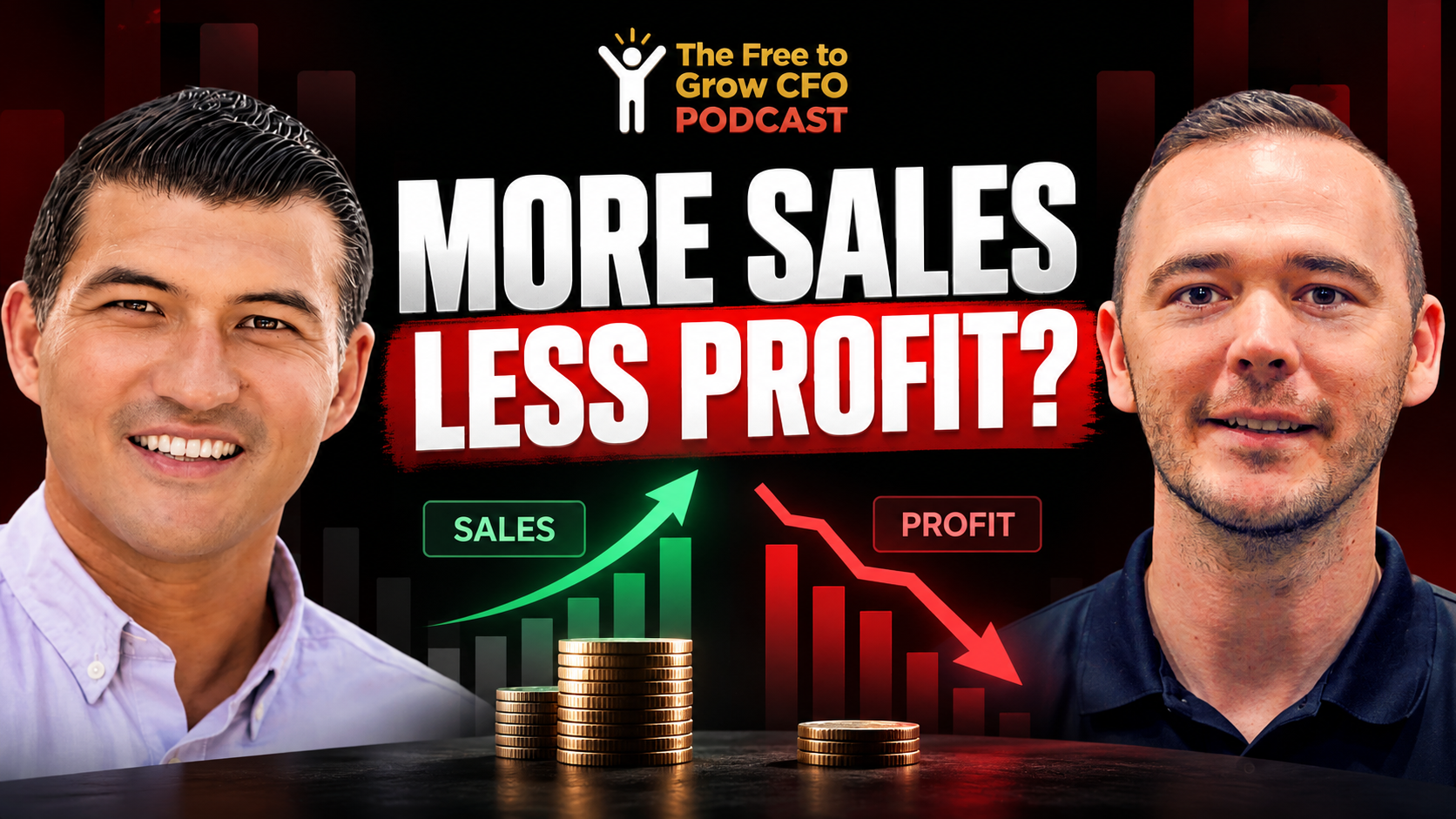
If you think shipping and fulfillment costs during BFCM are just a fixed cost of doing business, this episode will show you how much control you actually have.
In this episode of The Free to Grow CFO Podcast, Jon Blair sits down again with Tony Runyan of Red Stag Fulfillment to break down how brands can control shipping and fulfillment costs heading into Black Friday Cyber Monday 2026. Tony explains why proactive, continuous communication with your 3PL — not perfect forecasting — is the real lever for cost control, from year-over-year volume comparisons to flagging hot SKUs and bundles early enough to pre-kit them. Jon and Tony dig into the hidden costs of bundling, like location load balancing across warehouses turning a single order into two shipments in different carrier zones, and the customer experience risk of split shipments during an already tense holiday season. Tony also breaks down exactly how carrier peak surcharges work in 2026 — both the flat per-package demand fee and the volume-based multiplier fee that stacks on top of it — and why diversifying carriers, even at a worse rate, can be worth it as a margin-protecting backup plan.
If you're planning your BFCM shipping and fulfillment strategy and want to control costs instead of getting surprised by them, this one's for you.
Episode Links
Jon Blair - https://www.linkedin.com/in/jonathon-albert-blair/
Tony Runyan- https://www.linkedin.com/in/tonyrunyan/
Free to Grow CFO - https://freetogrowcfo.com/
Key Takeaways
Proactive, continuous communication with your 3PL is the single biggest lever for controlling peak season shipping costs.
Diversifying carriers, even at a less favorable rate, can be worth it as a margin-protecting backup plan if your primary carrier has issues during peak.
Carrier peak surcharges in 2026 include both a flat per-package demand fee and a separate volume-based multiplier fee, both worth modeling into unit economics ahead of time.
Transcript
~~~~~~~~
00:36 Intro
01:18 Proactive 3PL planning: best practices for peak season
03:47 Why your forecast should be a living, continuously updated plan
05:23 How bundling and kitting change fulfillment workflows
06:03 Location load balancing across warehouses
08:12 The margin trade-offs of promotions, ad spend, and shipping
09:32 Hidden costs: refunds, customer experience, and repeat purchase risk
10:22 Carrier diversification and setting customer delivery expectations
12:38 Treating your 3PL as a true strategic partner
16:00 Why proactive, continuous communication is the biggest lever
16:25 2026 carrier peak surcharges explained
20:06 Final thoughts
Jon Blair (00:36)
All right, we are back, and I've got my buddy Tony Runyan again on the show. This might be a three peat. Is this the third time, Tony?
Tony (00:43)
I think
this is my third time, yeah. So hopefully this is the charm or something. I don't know.
Jon Blair (00:46)
Yeah, third times the charm. Exactly. Exactly. Well, I
I'm pumped for today's conversation. We've talked about a bunch of stuff in your last two visits on the show, but today we're gonna specifically zero in on talking about controlling shipping and fulfillment costs during Black Friday, Cyber Monday 2026, which is fast approaching, right? It's August 2026
Tony (01:06)
It is.
Jon Blair (01:07)
as of this recording, but we're gonna be there before we know it. And so we're gonna start, we're gonna jump right in, Tony, and I wanna talk about.
Proactive planning with your 3PL. What are the most
Tony (01:18)
Yes.
Jon Blair (01:19)
important best practices that brands need to be thinking about today when it comes to planning proactively for peak season with their 3PL?
Tony (01:27)
That's a great question. I like and I think this is gonna sound really simple, but the first one is just the fact that you do it at all. and I I just mentioned that because that is in terms of saving, you know, on fulfillment costs and shipping costs as well as
Making sure you're set up for success to get all your orders out for the holidays, like the number one thing you can do is just talk to your 3PL, you know, or or whoever is doing your fulfillment. what we typically do is if we have had a a client who was with us in a previous peak, the best thing for us is how will this year compare to last? Because we have real
Jon Blair (02:00)
Mm.
Tony (02:01)
data that we can look at and understand. And what we have found is that is the best way to to plan for labor, to plan for shipments.
Shipping, all those things is let's look at last year. Is it gonna be up? Is it gonna be down? Is there gonna be something different? So that that's a big one. if it's a client that we have not shipped with before, so if you're a brand and it's your first year with a 3PL, I think it's just trying to overcommunicate. And like your what your projections are today are not going to be the same as what they are in late September and mid-October. So it's continue to tweak those numbers as you get those. and I would say kind of and
Add on to that as a bonus is
There's a really big difference between, hey, we'll do around thirty thousand packages during peak or during peak season versus hey, fifteen thousand of our packages come between Black Friday and Cyber Monday. Like it's one thing that you know what I mean? It's a it's a huge
Jon Blair (02:51)
Yeah. Totally.
Tony (02:53)
difference in terms of labor planning. So that's a big one. And the last piece I'll say is do you have specific SKUs that we'll consider, you know, hot SKUs that you're gonna run sales on or any sort of bundles? that's a big one. Or if you
require any kiting, it's good to get that stuff in early because number one, we'll be able to pre-kit, you know, a lot of that, or your partner will be able to. But the other is if there are specific SKUs that are maybe really hot, and it might be your typical top sellers, or it may be that you see SKUs move that don't normally move because you combine them with a a sale, you bundle them or something.
communicating that, you you might not think that's super important, but what we can do is actually stage inventory in racks that are closer to outbound or closer together that that allow for a lot more efficient packing and to get that stuff out, which which can be a benefit to everybody involved.
Jon Blair (03:42)
It's interesting. I'm I'm I'm having flashbacks to Guardian bikes and me having my forecasting calls
Tony (03:46)
yeah.
Jon Blair (03:47)
with you guys at Red Stack Fulfillment before peak season. But it really one thing I wanna kind of elaborate on and call out that you mentioned is the forecast, the forward looking plan of how much you expect to ship to your three PL and how much you expect them to ship out is a living breathing plan, especially in e comm, right? It's always changing. And
Tony (04:06)
Yes. Absolutely.
Jon Blair (04:09)
so
It it's it's about being in a continuous a rhythm of continuous planning in coordination with your 3 PL and just being honest. Like it's okay to say, Hey, we're gonna order 50,000 units, right? We feel really
Tony (04:23)
Yeah.
Jon Blair (04:23)
confident we're gonna sell at least 25. We feel decently confident we're gonna sell 35. The other 15, we're not exactly sure, right? And being being that prescriptive is really, really useful. And again,
kind of playing back into the point that you made about the SKU level plan, what SKUs are you trying to move? If you're a single SKU or a single hero SKU store, not necessarily that big of a deal, but if you have a decent you know, catalog size, it's really, really important
Tony (04:54)
Yes.
Jon Blair (04:54)
to make sure that you understand that like I think sometimes it can be easy to think about a 3PL as this like virtual thing that kind of almost happens in this digital world. And in reality
There's real people grabbing real boxes, packaging them
Tony (05:08)
Yeah. That's right.
Jon Blair (05:10)
up, slapping labels on them, and putting them in a real trailer to get shipped. And so you gotta think about what kind of workflow changes may need to happen. It's interesting because you mentioned about bundling or kitting. I I think that's a really,
Tony (05:22)
Mm-hmm. Yeah.
Jon Blair (05:23)
really important point because I know right now brands are thinking through their promotional plan. And a lot of times they're thinking about how to build out these bundles where
There's this play of like trying to get AOV up by bundling multiple products into one order and in exchange for a discount. And kind of the the AOV lift pays for the discount, right? But if you your 3PL doesn't see that coming and they're used to shipping out one SKU per order and then all of a sudden there's two, three, or four, there's a lot to
Tony (05:53)
Yeah.
Jon Blair (05:53)
think about there. And and actually one thing that comes to mind, I was gonna talk about this third, but I think I might wanna skip to this.
Is location load balancing. I see
Tony (06:03)
Mm.
Jon Blair (06:03)
a lot of challenges when you switch from your normal kind of SKU assortment that goes out on any average order to these bundle offers and you not having the same this every SKU in a given bundle in the same location, right? How how how
Tony (06:15)
In both locations, yeah. Absolutely. Yeah.
Jon Blair (06:19)
often do you encounter that and and like what should brands be thinking about as they're thinking about load balancing?
Tony (06:25)
And again, that's a that's a really important conversation to have, I would say, too, with your 3PL in terms of what's coming. So like obviously you when you're shipping a container, if it's coming overseas, right, you want to optimize the space you have there. So what we see, and we ship a lot of big and bulky, is you know, if you're shipping something that takes up a lot of space, maybe you can fit 300 items on a on a container, like with Guardian bikes. Yeah, I can't remember, you know, how many it was, but something like that.
Jon Blair (06:49)
For sure. It was like yeah, three hundred and fifty
bikes or something like that. Yeah.
Tony (06:52)
And
and then you may be able to slide in some accessories and things like that, you know, as well. So we do have clients who maybe typically throughout the year, they have their anchor products at our two locations, East Coast, West Coast, but maybe they put all their accessories in a in one of the other locations. And part of that be can be because, you know, you don't have to worry about speed, you can pick the cheapest method, like whatever it is. But if you're talking about the holiday season where somebody is bundling or buying things together, all of a sudden someone
You know, order something in California, your West Coast maybe ships the larger item, but from the East Coast, you've got the accessory and now you're shipping two different packages and one's going to a zone eight. It can really increase your cost. So I I think it's really just a matter of ensuring, okay, there's inbound costs associated with do we want to send
you know, accessories or smaller items to both locations. If we do, what's the cost per unit? I mean it really does come back to unit economics and
Jon Blair (07:47)
Totally.
Tony (07:48)
like, yeah, do it can I do it in both? And it could be that you even target a cell to a particular region, if if you only have it in one location. But what you don't want to do is once you sell out, you know,
of a particular SKU in one location. You might change, hey, pull the bundle down, you know, or shift or or either that or you're doing something to increase the price point, because those shipping costs can really get out of hand quickly.
Jon Blair (08:12)
Well, yeah. And so you're already playing this delicate dance. Every brand we work with at Free to Grow CFO is already playing this delicate dance of like, we're going to take a margin hit by offering some sort of a promotion, right? There may be
Tony (08:26)
Sure.
Jon Blair (08:27)
another there may be another margin hit on the ad spend allocation or the acquisition cost of those orders, depending on what the ad spend strategy is. Then you then if there's bundling involved and you're shipping products from
Suboptimal locations, that may be another margin hit. Now, I do want to like bring this down to earth from like ideal to practical and and like
Tony (08:47)
Sure.
Jon Blair (08:48)
say it's really hard to be perfectly optimal. It's it's impossible, right? The the the more
Tony (08:52)
It is. Yeah.
Jon Blair (08:54)
volume you have, the more likely it is that you can get closer to optimal. You do need to make a judgment call, right? And you I I think in my experience, you also have to factor in the customer experience standpoint of like, you know.
Tony (09:08)
Yes.
Jon Blair (09:08)
Customers are a little edgy during the holidays. If they get one of
Tony (09:11)
They are.
Jon Blair (09:12)
two items separate, you know, first and it's several days for the other one, it's not uncommon for a customer to think that their order got misshipped. Right? And and
Tony (09:19)
it's lost totally. Or they're gonna you're gonna get
the where's my order email, you know, for sure. Hey, where's this? Yeah, absolutely.
Jon Blair (09:24)
Totally. So there's
there's these other, I guess the point I'm making is we're talking about these explicit variable costs, but there's also
Tony (09:31)
Yeah.
Jon Blair (09:32)
these other indirect or downstream costs that could refunds could go up. There's also additional burden on your customer experience team. There's also this like implicit cost of like if the customer felt the experience was suboptimal, maybe they don't come back. Maybe they don't suggest your brand to someone else. So like the point is.
There are these actual unit economic costs, which you have to understand and know cold, but you also have to think about the customer experience as well. And so, really, really important. I'm curious, like the other thing is I know that we got creative. we've gotten creative working with Red Stag Fulfillment, both at Guardian and with some other brands that we work with, of thinking about what carriers to use for
Tony (10:13)
Yeah.
Jon Blair (10:14)
specific types of items or sized items.
Where does that play into the strategy as a brand is preparing for BFCM twenty twenty six?
Tony (10:22)
So I'll I'll answer that and address what you said as part of the customer experience and what we see in this is setting the expectation.
is is everything, right? So for your if you're a customer at checkout and you're purchasing and you get some sort of message in the cart or even like some sort of follow-up right from from a brand that says, Hey, you you may receive these as two separate packages. One you know, they may be coming from two different locations. Like something like that just to set the expectation can go a really long way and at least, you know, help in some ways. but to your second point
Like the the d diversification is is big because if you're s obviously solely dependent upon one carrier, and there are any issues during the holiday season, that can be, you know, a a big issue that you're leaning into that.
But what it also does is if if you're shipping one item with one carrier and another item with another and and it is the same order, you're absolutely gonna have two different experiences with with for a customer with that. Now, most of us are used to that sort of thing. I have like four different deliveries that show up, like drivers from different companies every day at my house. and it's
Jon Blair (11:28)
Yeah.
Tony (11:29)
just like, you know, I like I I kind of expect it and I know but but if you're
If you're kind of creating that as the full experience of a single order, like you have to take that into account. Now, as part of that, you know, what we see is our carriers like FedEx and UPS, which FedEx has already announced their peak surcharge as of today, their demand surcharges as they call them, 24th. UPS still hasn't. they're still still waiting, but we anticipate it's going to be very similar. And what you see is they actually
disincentivize you using their cheaper methods during this time. And so their economy methods, they will bump that fee up pretty high. And part of that's that it's a low margin product for them.
Jon Blair (12:11)
Mm-hmm.
Tony (12:11)
and some of those then also require a handoff to the US Postal Service. Or they don't basically they're a lot of times that volume is used to help fill in the network
to help things go, right? And make it more efficient. They don't need that during peak. Like all all the volumes there. That's
Jon Blair (12:23)
Yeah. Yep. Yeah, d totally. It's a the the theory of constraints. I was just thinking like if you
have constrained capacity, you don't you fill every unit of capacity with the highest margin, you know, like service or product that you
Tony (12:37)
Yes, one hundred percent.
Jon Blair (12:38)
possibly can, right? And the other thing I was thinking about is like I r it it's really key to you just have to
You have to treat your 3PL as a partner. And when I say that, like you gotta inform them about your business even beyond the forecast. You have to, you have to help, you have to get with them on understanding new products that are going to be developed. We've already talked about promotions, but the more you can inform them, the more that your 3PL can, you know, start thinking as a, you know, an extension of your business and say, hey, you know what? This happened at one point at Guardian, where we we
You went to bat in partnership with us to negotiate some specific rates with UPS, which was not our primary carrier at the time, right? And it wasn't for them
Tony (13:22)
Yeah. Yeah.
Jon Blair (13:23)
to become our primary care carrier. It was so that we had a legitimate backup where if we had
Tony (13:29)
Yeah.
Jon Blair (13:29)
to switch, it didn't totally destroy our margin. Were the were the rates as good as FedEx at that time? They were not, right? But did
Tony (13:37)
Yeah.
Jon Blair (13:37)
it give us a viable plan B? It it totally gave us a
viable plan B. That's super important what the but the point I'm making is you that it takes a lot of, you know, conversations and and working more and more and more closely with your 3PL over time for you to even be able to get on that kind of level of like strategy together.
Tony (13:58)
I I mean you nailed it. And what I'll say is like it people talk about the 3 PL and brand relationship like it's a marriage. and I laugh sometimes because like I think about miscommunications in my marriage where I'm like, I assume
Jon Blair (14:09)
Ha ha.
Tony (14:10)
like my my wife should know something or like or sh you know, she she thinks it's very obvious that she feels a certain way and I'm, you know, completely aloof. Like I think
Jon Blair (14:19)
Yeah.
Tony (14:20)
that w we see that sometimes and it's not it's not intentional. A lot of times what you have in a brand is you've got the marketing team, right?
And their job is, let's figure out and the product team, like let's figure out the promotion, let's figure out how to sell. That communication is oftentimes delayed to the the folks in operations on the brand side who who actually need to figure out how to execute, which then means it's delayed to the 3PL. so all what we find is then everything's an emergency, right? Like we're you're two weeks before peak and you find out something completely new. we're by the way, we're gonna run this bundle.
you know, okay, that's that's good to know. We have to move product or we have to go do a kitting project or you know, that sort of thing. So we try to communicate. I mean, to be transparent, we start meetings, you know, regular meeting cadence in April, internally to talk about peak. We're already on a weekly meeting cadence now to talk about peak, to understand, you know, what's coming, what are the plans, and it helps us all basically just it's part of our conversation. When we're doing a weekly
Jon Blair (15:22)
Totally.
Tony (15:22)
check-in with a client or
a monthly, you know, business review or whatever it is when in the midst of that conversation, what do you think of for peak? How are how's it gonna look last year versus this year? Are you guys gonna launch a new product? and and just having that dialogue makes all the difference terms of preparation
Jon Blair (15:38)
Totally.
Tony (15:39)
because going back to what you said we are literally planning how many people need to be in our warehouse
to move the number of boxes that need to be moved. What kind of boxes are they? How big? How small? Like all those things go into what does our head count need to be, right? So without having that information, it it makes it impossible. You're kind of shooting at a at a moving target.
Jon Blair (16:00)
Totally. So I think one of the big takeaways for brands here is like, look, so much of cost control from a shipping and fulfillment standpoint is actually proactive communication. Proactive and continuous.
Tony (16:11)
It is, yeah.
Jon Blair (16:12)
And so super, super important takeaway. Now, I want the last thing I want to talk about is actually getting a little bit more nitty-gritty into maybe like per order shipping cost management during peak
season.
Tony (16:24)
Sure.
Jon Blair (16:25)
Before we talk about
you know, kind of some tips or tricks or best practices you have. Can you just explain to the audience really quick what is different from even just a fee structure standpoint with the carriers during peak season every year?
Tony (16:39)
Yeah, sure. And I'll try to break it down really simply. Like first, let's just talk about a a standard package. And when I say that, I mean it's not big enough or heavy enough to get hit with any special fee, right? We'll just we'll kinda no no additional surcharge. We'll just set that to the side first and say for a standard package, what carriers do, they they they have two charges that
that they have introduced up to this point. One is just a flat fee on top of every package you ship. and that that fee is going to start in October and it's going to go through, you know, typically right after Christmas time. And it is going to it typically peaks. They'll start at this level, then it pops up and then it comes down. Sometimes they just do a flat, you know, across.
The way that you see that is it's a certain fee for ground or home delivery packages, which is just your standard, right? there's that fee. And then it's going to be a higher fee if it's an express shipment and it's gonna be a higher fee if it's an economy shipment.
kind of like we talked about before, because those that's their lower margin shipment. So they're going to try to push it towards ground home delivery. So that's one fee. They also have what they call peaking fees or or demand peaking fees, where they will actually look at the volume you ship in June, use that as a baseline, and then say, during this time of year, we're gonna look at that and multiply it by some multiplier and say, Well, if you ship 200% more.
volume during this time compared to June, then there's this fee on top of it. If it's 300%, there's this fee. it's you got to have a degree to like even be able to think about calculating
Jon Blair (18:14)
Ha ha ha.
Tony (18:15)
it. But that's why it's really important to have a a partner who can talk to to to the carriers, can negotiate with the carriers and and and also help you just understand, hey, how's this going to actually impact, you know, my per package? What we know now is this is going to happen. It's going to happen every year.
from this time to this time. And and as you you plan that into your cost, right? Your your unit economics. And whether you, you know, spread it across the entire year, or you say, hey, during this period of time, we're gonna have some sort of buffer in there, you know, that's really important. So
Those are like the two flat fees. If you ship big and bulky, there's add-on fees. So if if you pay an additional handling surcharge for for a package because of its because of its weight or because of of its length or cubic, then there's gonna be an add-on fee on top of it. And those actually start September twenty-eighth. so it's interesting because the whole
The whole communication from carriers has been we're gonna try to incentivize people to start sales sooner. that way we're not, you know, just completely hammered during this really intense time. But they have started that early and earlier now to
Jon Blair (19:22)
For sure.
Tony (19:23)
where it's like, Am I buying Christmas presents you know, in September? Probably not, you know. Yeah.
Jon Blair (19:26)
Yeah. Yeah. Back to school back to school plus Christmas presents. No, I mean, it's
funny because I see the same thing on the promotion side that brands are start talking about starting sooner and sooner every single year. I wonder, you know, now that so many brands do start in October or run they definitely almost every single one is trying to run a promotion for a good bit of November, right? And not just Black
Tony (19:49)
Yeah, yeah.
Jon Blair (19:50)
Friday, Cyber Monday. it it
Yeah, it is it is kind of crazy. And then, you know, you even look at like Amazon having more than one prime day every single year. Like when does it end? I have no at some point are we just in
Tony (19:59)
That's right. Yes.
Jon Blair (20:02)
peak all year round, twelve months a year and it's it's
Tony (20:04)
Yeah.
Jon Blair (20:06)
wild, man. Well, man, this was chalked full of like tons of wisdom. what what would be your final takeaway? What's the single thing you want brand founders listening to this episode to take away from our discussion today?
Tony (20:19)
It's twofold. One is really just
Have like communicate, right? Just have conversations with whether it's a 3PL, even your in-house, warehouse, like who whoever it is, just just talk and know that it doesn't have to be perfect. I think a lot of times we can be paralyzed by perfection and and really we just like start with something directional and then tweak as you go. Everybody knows it's the best you got, right? and then we plan accordingly. So the the communication piece is one, and then it's keep communicating, right? and then the second is like peak surcharges.
shouldn't be a surprise. We we know now or will demand surcharges. I'm still conditioned to call them peak, but these demand
Jon Blair (20:55)
Yeah.
Tony (20:56)
surcharges, right? They are coming. Like they're gonna be there. So like planning for that, knowing, you know, around what they're gonna be and how you're going to achieve that, you can think about that all year, right? And and plan for that. And that's gonna keep you from being just totally shocked, you know, when it comes to that really busy time.
Jon Blair (21:13)
Absolutely, man. well, Tony, I appreciate you coming back on the show and chatting through this. If anyone wants to find any more information about you or Red Stag Fulfillment, where can they go?
Tony (21:23)
Just go to redstagfulfillment.com. you can also find me on LinkedIn, either of those would be fine.
Jon Blair (21:28)
Awesome. Well, I appreciate you coming back on, brother. And before too long, I'm sure we're gonna have you on for the four Pete.
Tony (21:33)
awesome. Thank you. I I appreciate you having me. Always a pleasure.
Jon Blair (21:37)
All right, Tony. Have a good one, man.
Tony (21:38)
You too. Take care.