How to Actually Measure CAC to LTV for a High-LTV DTC Brand
Most founders of consumable DTC brands understand the basic idea behind CAC to LTV.
Spend money to acquire a customer today. Lose some money on that first order if necessary. Then make that money back as the customer purchases again and again.
Simple enough.
But there's a big difference between understanding the theory and actually knowing how aggressively you can scale ad spend.
And one of the biggest problems we see is that brands aren't even measuring LTV correctly.
Here's the six-step process we use to properly analyze CAC to LTV and turn it into something you can actually use to make growth decisions.
Step 1: Start With Your Cohort Data
Start by exporting your monthly customer cohort data from Shopify or whatever customer analytics platform you use.
There are dozens of metrics you could analyze, but for this exercise, start with one:
Average net revenue per customer by month.
This allows you to see how much revenue the average customer from each cohort generates in month one, month two, month three and beyond.
But here's where an important distinction comes in.
Step 2: Convert Lifetime Revenue Into Lifetime Value
If the average customer has spent $200 with you, that doesn't mean the customer has generated $200 of value.
You still had to pay for the product cost, fulfillment, shipping, merchant fees and other variable expenses required to generate those sales.
That's why at Free to Grow CFO, we distinguish between LTR and LTV.
LTV is the actual margin dollars generated by that customer, excluding advertising costs.
To calculate true LTV, take the revenue generated by each cohort and apply the appropriate contribution margin (before ad spend). Now you're looking at the dollars actually available to recover your acquisition cost.
That distinction matters enormously when you're deciding how aggressively to scale.
Step 3: Calculate CAC for Each Cohort
Next, calculate what you paid to acquire each new customer.
The formula is straightforward:
CAC = Total Ad Spend / New Customers Acquired
If you spent $100,000 and acquired 2,000 new customers, your CAC was $50.
Now we can compare two numbers that actually belong together:
CAC in ad dollars versus LTV in margin dollars.
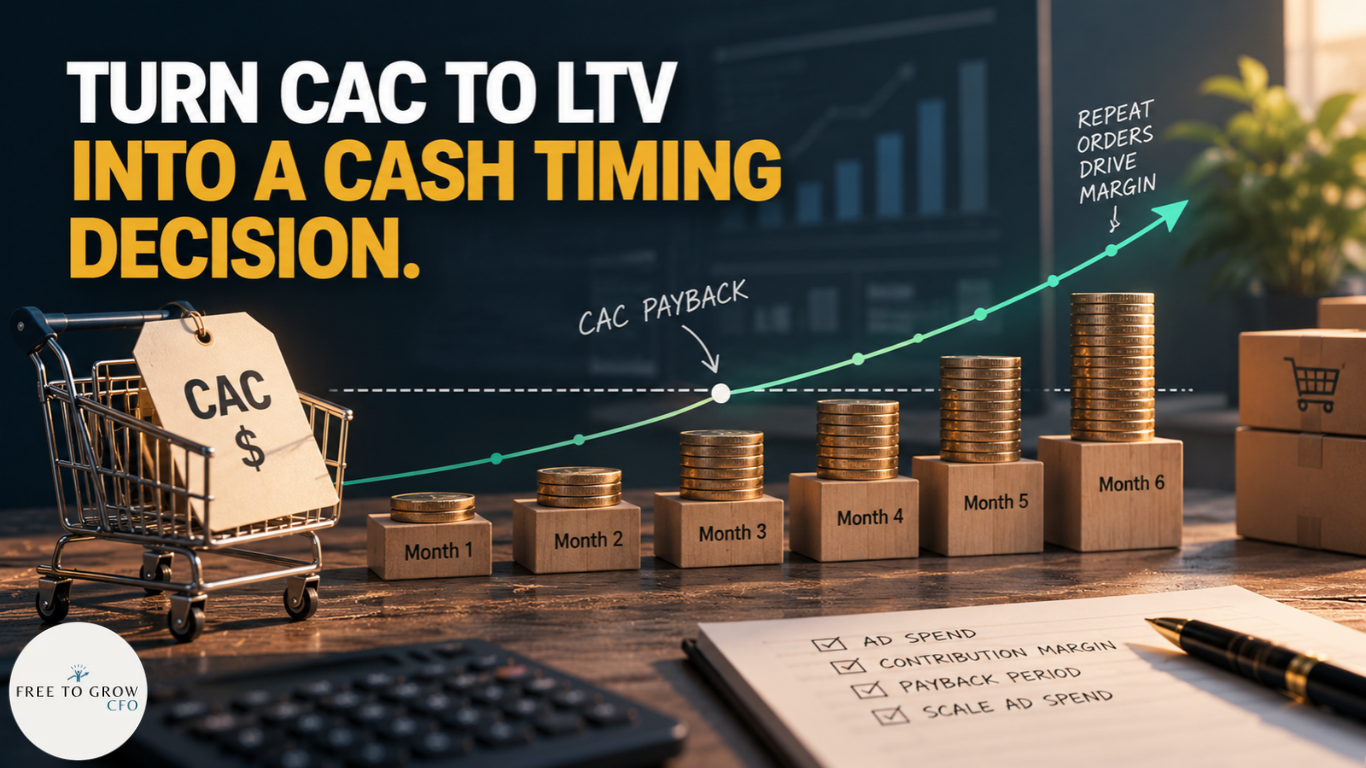
Step 4: Calculate Your Payback Period
This is where the analysis becomes useful.
Let's say your CAC is $50.
You then look at the cumulative margin generated by that cohort and determine when it reaches $50 per customer.
If that happens in month three, you have a three-month payback period.
In other words, you invested $50 to acquire the customer and recovered that investment three months later.
Now you have something far more actionable than a generic "3:1 LTV-to-CAC ratio."
You know how quickly your acquisition investment comes back as cash-generating margin.
Step 5: Use Payback to Decide How Hard to Push Ad Spend
This is where CAC to LTV becomes a growth strategy instead of an analytics exercise.
As you scale ad spend, CAC will often increase.
That's not automatically bad.
A higher CAC can be perfectly acceptable if the customers you're acquiring still generate enough margin quickly enough to justify the investment.
For many high-LTV brands, we generally want to explore how aggressively we can scale while maintaining roughly a three-to-four-month payback period. The right target, however, depends on the economics and financial position of the individual business.
The question stops being:
"How low can we get CAC?"
And becomes:
"How much can we spend to acquire customers while still producing the profit and cash flow we need?"
That's a much more powerful growth question.
Step 6: Repeat Forever
Your cohorts change.
Your CAC changes.
Margins change. Retention changes. Inventory requirements change.
So CAC-to-LTV analysis isn't something you do once and put in a board deck.
You repeat it every month.
At Free to Grow CFO, this is exactly why we've built our proprietary DTC growth marketing framework into our fractional CFO service.
We help $10M to $100M+ DTC brands connect marketing performance to contribution margin, forecasting, inventory and cash flow so founders can understand exactly how aggressively they can afford to scale.
Because the goal isn't simply to spend more.
It's to know how hard you can press the gas while continuing to build a fast-growing, profitable and cash-rich business.