The Playbook For Scaling Apparel Without Killing Cash Flow
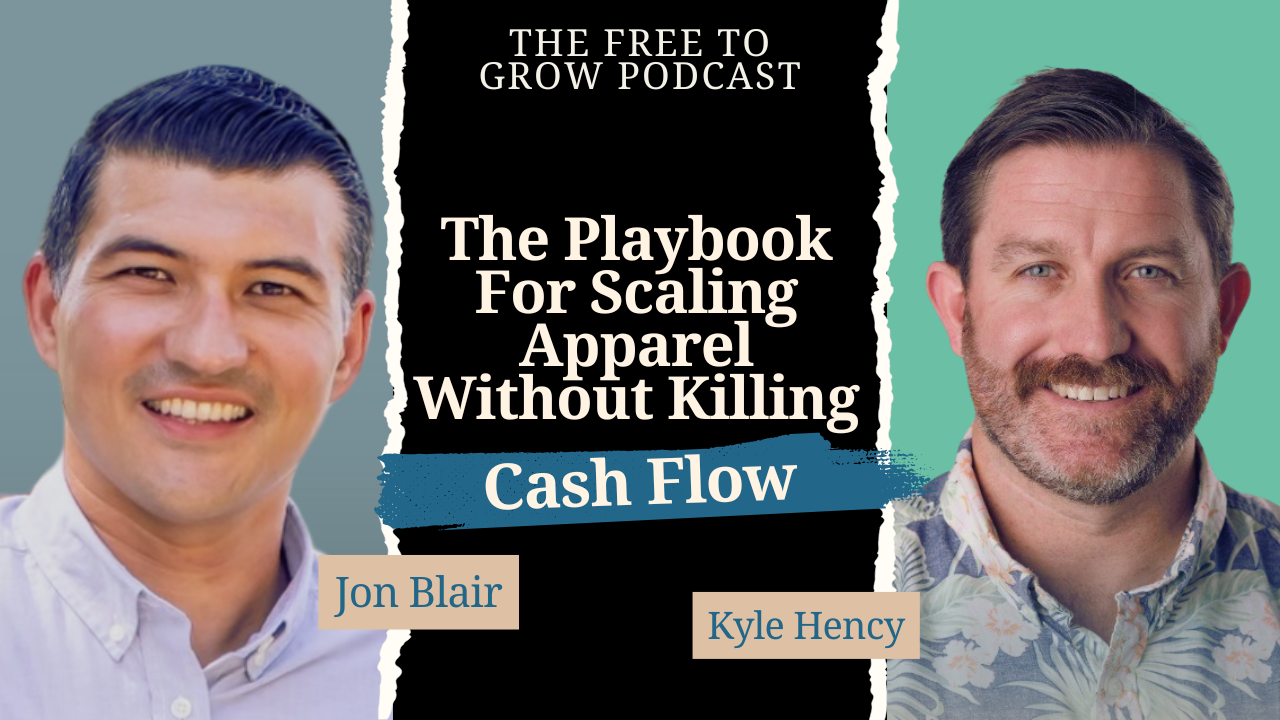
Episode Summary
Most apparel brands don’t struggle because of bad ads—they struggle because they don’t understand the economics of the game they’re playing.
In this episode of The Free to Grow CFO Podcast, Jon Blair sits down with Kyle Hency, co-founder of Chubbies and now CEO of GoodDay, to break down what actually drives profitable growth in apparel. They unpack why acquiring customers at break-even is often the right move, how real profit is made on repeat purchases, and why new product drops are the engine behind your P&L. The conversation goes deep on inventory—how it can quietly drain your cash, why most brands overcommit too early, and how to think about risk when launching new SKUs.
They also get into the operational reality of scaling: SKU complexity, seasonality, and what happens when you expand beyond DTC into wholesale, Amazon, and retail. Each layer adds more opportunity—but also more risk, more capital requirements, and more ways to get it wrong.
Throughout the episode, the focus stays grounded in one thing: cash flow. Because at the end of the day, the brands that win aren’t the ones with the best marketing—they’re the ones that manage inventory, capital, and decision-making the best.
Key Takeaways
SKU and channel complexity compound quickly, and without systems, they will break your operations.
Profitable growth in apparel isn’t about scaling ads—it’s about managing cash, inventory, and risk together.
Inventory is the highest-leverage decision in the business—and the fastest way to destroy cash if you get it wrong.
Episode Links
Jon Blair - https://www.linkedin.com/in/jonathon-albert-blair/
Kyle Hency- https://www.linkedin.com/in/khency/
Free to Grow CFO - https://freetogrowcfo.com/
Good Day Software - https://www.gooddaysoftware.com/
Transcript
~~~~~~~~
00:00 Intro to The Free to Grow CFO Podcast
00:00 Introduction to the Apparel Game
03:19 Understanding Customer Acquisition and Retention
06:08 Navigating Seasonal Challenges in Apparel
08:37 Data-Driven Inventory Management
11:21 The Importance of Visual Appeal in Marketing
14:20 Balancing New Product Development and Financial Health
17:02 Managing Complexity in Sales Channel Expansion
21:42 Navigating Multi-Channel Complexity in Apparel
24:23 The Shift from Digital to Physical Retail
27:23 Leveraging Technology for Operational Efficiency
29:37 Harnessing AI for Business Management
35:36 Embracing Change: The Future of Brand Operations
40:11 Final Thoughts
Jon Blair (00:38)
Alright, today I'm joined again, coming back on the show. Kyle Hency, Kyle, what's up brother?
Kyle Hency (00:43)
Not too much, thanks for having me, Jon
Jon Blair (00:45)
Yeah man, so those of you who don't know who is, former, one of the co-founders and CEO of Chubbies, and now co-founder and CEO of Good Day, coming back on the show to get deeper into the apparel game. Ecom's hard enough, ecom times apparel even harder, and we're gonna chat a bit about how to do so profitably and cash flow positive.
we dive in though, Kyle, for those didn't listen to the last episode that you're on, can you give like a brief background of, you know, who you are and what you're doing a GoodDay ?
Kyle Hency (01:18)
Yeah, absolutely. So co-founder CEO here ⁓ at Good Day, we're building Good Day as a direct response to a lot of what we learned in the Chubbies journey. And it's effectively like we can build back of office operating tools that will help smaller and smaller brands scale like the big boys. And it doesn't have to be insanely expensive and you don't have to spend a year of your life implementing these tools. Like we're in this like coolest.
Jon Blair (01:40)
Ha
Kyle Hency (01:42)
time ever as it relates to being able to build a lean profitable business, like just genuinely the coolest time ever. I just consider Good Day one of the pieces of infrastructure that can help you do
Jon Blair (01:50)
Totally.
Okay, so let's talk about the apparel game. So the apparel game is something I talked about before on this show and the other podcast on that I'm a cohost on, the e-comm scaling show. There's a specific playbook in my opinion when it comes to profitable growth marketing and the apparel game as I like to call it. Generally speaking, look and everyone there's nuance to this, but generally speaking, you acquire customers at
break even-ish or a small profit and where you really drive your contribution margin every single month is returning customers buying new fresh product drops. Because of inventory is paramount, right? New product drops are in large part driving your P &L, but there's a constraint or there's a risk, there's a trap.
balance sheet management, inventory can get out of control. When we start talking about variance and sizes, SKU count can explode through the roof. So we're gonna talk about the ins and outs of this, talk a bit about how Good Day can help you manage this. But to start, Kyle, maybe you can draw a little bit on either the Chubbies days or maybe some of the clients, some of the brands you work with at Good Day. Do you agree with my take that like generally speaking when you're scaling an apparel brand,
on ecom channels, you're roughly looking at break even-ish or small profit to acquire a new customer and you're making all of your profit on returning customers through launching new products.
Kyle Hency (03:19)
Yeah, I would generally say that that's accurate. And I would also generally say that it's been evolving over time. And as these brands have been in many ways forced to get more self-reliant and more capital efficient, it's become more and more obvious year after year after year that you have to get really dialed on the repeat game. And it's not just an acquisition game. If I was going to be critical of all of DTC commerce five to eight years ago, I would say we were just in the customer acquisition game.
Jon Blair (03:32)
for sure.
Totally.
Kyle Hency (03:48)
and we were all doing some pretty foolish things in all of the ad platforms. Now today, I would say most of the ecosystem is pretty sophisticated top to bottom on the P &L. Now, like you said, I completely agree, there's a lot more that goes into being profit oriented in this acquisition and repeat game. And there's an entire other lever, which is how do you manage your business?
to the right levels of cash at the right moment in time throughout the year. And that's particularly hard in a seasonal apparel business.
Jon Blair (04:18)
Well, the word seasonal, I've yet to find ⁓ an apparel business that isn't seasonal. They're all seasonal and there's like seasonality in whatever product category you're in already introduces financial risk and cash flow risk. But I have seen time and time again that if you're an apparel brand that is seasonal, which is basically all of them, there's an additional risk because there's this seasonal obsolescence.
to your product, right? If it's summer wear or warm weather wear, when that warm weather evaporates, even when you try to liquidate that stuff in like fall, winter, people aren't buying. You gotta wait till the next year. I see the same thing happen with like winter apparel. So like ordering the right quantities at the right time and not getting stuck coming out of a season with too much is like really, really key.
Do you have any lessons from Chubbies related to that seasonal obsolescence that you can like share with the audience?
Kyle Hency (05:15)
Well, I'll start with the first principle that was very non-obvious to us. And this is like an upfront strategy question. the strategy around inventory positioning and revenue and profits be to be less seasonal? Right? Like it's logical to say, we're super seasonal. I want to be less seasonal. What we found is that if you're a men's shorts business selling predominantly swim trunks,
and you try to become something that's not that, it's gonna be really expensive to do that. So actually it was the most profitable thing to figure out how to be really good in those peak time periods. So that was like a little, like we did that wrong for some amount of time. So I always share that. Like if there's something core about your category or your brand that is like, yeah, you're like really your economics are gonna happen in these months. I would really get dialed in those months and then figure out how to optimize the other.
Jon Blair (05:41)
Yeah, yeah, for sure.
Absolutely.
Kyle Hency (06:07)
So that's one. Two, often times, especially for young brands, you can get married to your concepts beyond what they are. This is really, you really have to listen to the customer and they vote with their dollars every day. And you might be really married to a concept. double up and say, was a little bit off on the concept, I didn't quite deliver.
what I thought would work or didn't resonate with the customer. And by the way, I only have a three selling window. You might have years of inventory on hand at the end of that period. And so, and so I think it's like, basically just like increases the risk when your windows are tighter. ⁓ And then like the question is, what do do with that? Right? Like for us, we invested in inventory investment philosophies. We had a way that we operate.
Jon Blair (06:36)
For sure, for sure.
Totally.
Kyle Hency (06:54)
we would never buy more than four weeks of supply of something we knew nothing about. Like that was a philosophical thing we decided, right? Now that meant we left dollars on the meant we didn't find ourselves sitting on a year's worth of this product very often. And so we had a system that would say that was a winner. Now we'll start to plan to eight weeks of supply for that or 12 or whatever the strategy is from there. And so I think that's really important. And then you need to invest in the resources. If you have a...
Jon Blair (07:09)
No, I-
Kyle Hency (07:20)
If you have 5,000 SKUs and a seasonal business and you have zero people planning your inventory, I think you're asking for trouble.
Jon Blair (07:28)
Yeah, well, okay, so you said a number of really important things there. One is, you mentioned like, philosophically, we will not purchase more than four weeks of stock of anything that we know nothing about. What are you saying when you say, we know nothing about this? What you're saying is like, there's more risk inherent in this decision, right? In the finance world, we call placing risk-adjusted bets, right? So you're saying, hey, I'm assessing.
high risk, because we know nothing about this. One way that we like to talk about this with our clients is like, the more uncertainty there is, the less you know, the more risk is inherent in said decision, right? We don't know the outcome. And so you're resizing your bet to align with the risk involved. But then you're saying, the more data we have, then we're willing to place eight weeks of stock orders, or 10 weeks, or 12 weeks. Super important concept that everyone has to realize here.
But I wanna draw this back to maybe where, like what you guys are doing at GoodDay or certainly some connection to this. Where do you get the data from, right, to assess risk in such a high SKU count, complex, know, inventory-based business?
Kyle Hency (08:37)
Yeah. So there's a couple exercises in the inventory planning process. And it's worth acknowledging, we actually do inventory planning for some of our customers at GoodDay. We utilize our systems and we automate a lot of things, mostly through Google Sheets. We're doing that because we're also building agents that will do this stuff for them in the future. We're dogfooding how we're going to actually build out these more autonomous agents. But the reality is,
Yeah, you can have all the conviction you want in the design process and you might be exactly right. You still don't know truly what the consumer is going to do with that product until it's on the site and they're comparing it to everything else on your site and everything else in the world. And so we were pretty strict with like, we're not going to take any sort of large, large existential risk to the enterprise based off of these like concepts that were brand new, right?
Jon Blair (09:15)
Totally.
Kyle Hency (09:29)
along the lines that you were just talking about. Now, what we would often do is say, hey, this concept is pretty similar to this concept here that we launched two years ago. And so that's the analog concept. And what happened when we dropped that product into the market? Let's study the mechanics of that. man, it engaged our repeat really healthily, but it was actually not very good for new customers. Right? Now, if that was true of the analog,
Jon Blair (09:37)
Mmm. Got it.
Kyle Hency (09:55)
launch from two years prior, I would say don't bank on new working. You're going even be more conservative than the four week principle. Now, we would get into it in the design process. We would say, hey, is this product meant to engage new audiences of people or is it specifically built for the million or so customers we've acquired over time? And the answer needed to be were
Jon Blair (10:00)
for sure.
So key, so key.
Kyle Hency (10:22)
We think it will work for both. We actually never saw something that was electric for new fall on its face for repeat. I thought that was an interesting idea and in reality.
Jon Blair (10:31)
Yeah, that's interesting. That is
super interesting. The other podcast that I co-host, Ecom Scaling Show, my co-host runs a growth marketing agency and he talks a lot about going through logically with your team on is this an acquisition SKU or is this a retention SKU? Now it doesn't mean that there can't be crossover. It's very product category specific, it's brand specific, but
The thinking exercise, right, is what matters, which is like, how would we, like, it actually, you have to start thinking about then what tactics are you gonna use in your marketing mix to use this SKU to drive returning customer sales versus new customer acquisition, because they're not the same things. A lot of brands, ad spend, right, paid media, top of funnel paid media is what's driving new customer acquisition.
That may spill over into returning customer sales, but in large part, you're doing other retention tactics like email and SMS and things of that nature. so asking yourself the question of how you're gonna use this SKU to drive new versus returning is really, really important because there are different marketing tactics that drive each of those.
Kyle Hency (11:42)
click down into something that is analytical at its core, because we studied the data to figure this out, but is actually kind of like a soft creative thing, right? We figured out that for us to really drive, scale, and get the leverage of our networks and our community, if we were pushing ads through Instagram, Facebook, it didn't really matter across any of these things, the product needed to be visual.
Jon Blair (11:52)
for sure.
Kyle Hency (12:06)
and it would be even more powerful if the product itself was visually compelling. So think like this is a pair of swim trunks and it has a really wild, fun print on it. Like it will catch your eye in an ad, literally. And the same way if you were walking through a store and there was something bright in the corner, it might catch your eye a little bit differently than something that was bland, right? Our argument there was like these networks are incredibly crowded and like you better have something that's really gonna stand out.
But even better if that same thing could visually communicate functional use case. It was visually looked soft, which would tell you comfortable, right? And so we had a lot of debate around like, we think this is gonna unlock leverage in new, because we're gonna be able to photograph it and do videos of it in this very specific way, that's gonna unlock a couple of these mechanics that are so important for you to get leverage in these ad platforms. And then that would end up being the most
Jon Blair (12:35)
Mmm.
Kyle Hency (12:58)
profitable way to scale those products.
Jon Blair (13:01)
Well, I will tell you this, I was at Dick's Sporting Goods on Saturday and the Chubbies was very obvious to me when I was walking through, right? And I couldn't tell the difference between Patagonia and North Face, but I for damn sure was like, that's But I wanna draw out something important related to success in scaling the apparel game profitably. You're talking about very...
Kyle Hency (13:02)
No.
The wall. It's called wall.
⁓
Jon Blair (13:26)
intentional effort, right? From multiple angles on solid, consistent, new product development, right? It's so essential and it's not, it cannot be taken lightly. It's not like, we're just going to launch this. You got to listen to your customer. You got to mine data and you have to be really, really thoughtful. It will make or break your P &L as you scale. And if you start thinking about the financial economics of paying for your ca-
paying for your ad spend per new customer. In large part, I've seen hundreds of brands, P &Ls and a number of them apparel. The way that you do that and continue to reach higher and higher revenue and contribution margin dollar levels is that you have enough returning customer margin to pay for that rising CAC or at least partially fund that rising CAC. And you can't do that if you don't have phenomenal new product development and new product launches. But.
The trap is the balance sheet side of things. like talk me through a little bit of like some of the stuff that you've learned about managing the balance sheet side of new product development and even a little bit about how Good Day might help with that.
Kyle Hency (14:34)
Yeah, yeah. Well, I think even going back to the core of like, you know, Kyle, you left Chubbies now four or five years ago. Why are you spending your time going at the inventory problem so deeply? It's the one thing that you get if you get perfectly right, can unlock everything else in your business. It's also the one thing if you get perfectly wrong, will make everything else you're trying to do a complete waste of time. Right?
Jon Blair (14:53)
Totally.
Totally.
Kyle Hency (15:01)
And
so that right products that resonates at the right moment at the right price and at the right cost, all are the things that allow your business to have the opportunity to hum. Now, when you think about now we're getting into the balance sheet, we're talking about cash and how aggressive are we going to be going into a year? Right. Like for me as the CEO of Chubby's, would always start at a macro question. I don't know. Seems like there's coming into 2026, there's quite a bit of uncertainty.
In labor markets, there's a bunch of tariff conversation. We just found ourselves in a war. Like, I have a lot of reason this year to be conservative on top line expectations. And I would literally start at a macro that's like almost that simple. And maybe your beliefs are different, but it would be something like that. And then I would go work with my team to figure out like, what are all the things that are unique to us that might combat that kind of broader trend? Where's our unique edge, right?
And then inside of that, we would be saying things like, okay, if the overall revenue growth this year is gonna be more modest, let's make sure we mix it heavier into repeat so that the profit dollars are heavier, right? We're gonna have a heavy profit harvesting year this year, as opposed to a year where we're going full gasoline on new acquisition, right? Like that is an end-to-end strategy that combines everything from the macro.
to what you think you can reasonably achieve with your customers, to the margins of the inventory that you're betting on, to the types of products you're betting on because you're trying to engage repeats of deeply in a year, right? So I would say what brands get lost in is they don't connect all those dots, end to end.
Jon Blair (16:31)
Yeah.
For sure.
Well, and I think to that point and in the apparel game specifically, which is almost always high SKU count, tracking landed cost across or let me say it another way, tracking rapidly changing, potentially rapidly changing landed cost over a large SKU catalog, larger than other product categories that are outside of apparel is like,
one of the hardest things to do if you don't have the right system and have the right data.
Kyle Hency (17:08)
Yeah, and this is the unique utility of Good Day. would Kyle and team spend now $15 million and three, four years of our lives to make these tools really accessible to smaller and smaller brands and more self-service? It's because if they don't have these tools, they literally cannot operate day to day to actual profits and margins inside of their Now, if we take the tools typically reserved for, let's say, 100 million revenue and up brands,
Jon Blair (17:28)
Totally.
Kyle Hency (17:34)
and we make them so simple and easy that they can be moved all the way down market, now we have a more level playing field. It's not that these brands don't want to manage like that. It's just incredibly hard to do so. it is one of the areas, like, look, I'm a former brand operator. We spent half of our time in spreadsheets. I'm a pro spreadsheet guy. This is what you just articulated as one of the very core things that you just will not get there. You will not get there.
Jon Blair (17:44)
Totally.
Yeah.
Kyle Hency (18:01)
We have a whole nother layer that's arriving right now, which is like, I don't know, what about my spreadsheets and Claude? And, you know, I can get a lot more done than I couldn't get done before. And so, you know, we're working through taking a lot of the centralized, unique COGS information that we have in distributing it to unique ways that brands can get leverage. The easiest one is just take those COGS in a dynamic format, push them back up to Shopify every day. So.
Now your triple whale numbers or marketing platform managing the contribution is accurate. The COGS number is changing every single day without your marketing team or your merchandising team going in there and changing it. So we think that there's pieces of leverage like that that we can provide that could be really powerful, not just for the big brands we work with, and we work with a ton of them, but for like, we're implemented with teams of three, four, five people.
And as I look at the future of all these agents running around, we're gonna be a huge part of it. We're gonna build some very cool agents. But man, we wanna enable these brands. If that's how they wanna build, they wanna be extra lean and extra profitable. I think that's a pretty sound way to think in brand build.
Jon Blair (18:48)
Yeah.
For sure, for sure. So I wanna take us now to another layer of complexity. We've talked a lot about the new product launch, high SKU count, right? And when you account for all variants and sizes and things of that nature. then we talk about sales channel expansion, right? Like inevitably Chubbies goes from D T C to more the channels than just direct to consumer.
So you now have the complexity that was already inherent in just being a pure D T C brand, now multiplied across X number of sales channels. Talk to me a bit about how things become, I think, exponentially more complicated when you start doing that.
Kyle Hency (19:43)
There's two things I always tell people. If you've already built a massive dearth of SKUs you I think at Chubby's we had a peak of something like 6,000 active SKUs, which was far too many. When you begin to layer in these other channels, matrix complexity is pretty wild. I would just say, if you're trying to and you're trying to grow channels because it's the right thing to do for your brand,
Jon Blair (19:59)
Yeah. Yeah, for sure. Exactly.
Kyle Hency (20:08)
consider getting a lot more simple on the SKU base. Really study what's the 80-20 on where our economics are coming from and let's get back to that. In general, what I experienced is our widest assortment was our e-comm assortment. So it was not actually necessary to grow the assortment to get into the channels. will say one of the most profitable things we ever did was go incredibly deep in the 20 % of our SKU base.
that was driving 80 % of our economics and then expand that into wholesale and Amazon and the next and the next and the next. And if you were then monitoring on a per SKU basis where the profit dollars were coming from, you would see it just really slide into these heavily profitable SKUs, right? Using distribution. So when you start to think about you're a single channel brand and you're gonna add wholesale, right?
Jon Blair (20:51)
Yeah.
Kyle Hency (20:59)
it's easy to be like, yeah, now it's like twice as complex. Well, it's like, well, actually there's multiple business models inside of wholesale. These big box retailers like to work like this. These mom and pop shops like to work like this. So it's actually like maybe three or four times more complex. And then the big question that the learning that I had was our own retail stores. You're like, yeah, and also we do retail stores, but we have five of them. And you're like, well, does that make this?
Jon Blair (21:06)
Yeah, totally. Exactly.
Kyle Hency (21:25)
twice as complex. It's like, well, no, you need to study every single one of those locations by the week to know what's happening in those local markets and make sure you're relevant all the time to have successful stores. It's like, whoa, now we just we just multiplied our complexity, not to three, but one to 20. Like it's a it's a compounding complexity that sneaks up on you. And that's what I like. If you do that without systems in place, you're going to it's not going to get
Jon Blair (21:42)
Yeah, for sure.
Oh no, it's just like,
it becomes completely, you can kind of like, you can grind it out D T C only, single channel. Although again, in apparel, I don't recommend it because like the thousands of SKUs thing is very common and maybe not 6,000 SKUs, but like a large SKU catalog is generally necessary in apparel compared to other product categories, right? But like once you get to multi-channel, trying to grind it out in just spreadsheets is crazy. Furthermore,
Let's talk about there's additional dimensions of complexity beyond the SKU count and then like kind of the, the, the, I don't know, some of the operational models, the financial model changes, right? You might have receivables now. And like you mentioned, some of those subcategories of wholesale big box retail, they have certain average days to pay. The mom and pop shops have a different average days to pay. They all have different
operational complexities in terms of like how do you deliver things? How do they need to be barcoded, palletized? And guess what? If you don't do it right, big box retail just charges you back or just sends the shipment back to you. How much does that cost, right? And then you start talking about the order routing, the inventory planning where you're like, you actually start going like, I have a demand plan for my D T C store, right? And I'm purchasing specifically for D T C.
but then I've also got ordering for these big box retailers and I've got ordering and routing for Amazon. And then you start going, but I also need some buffer for each one of those in case I, you know, beat the projections and they all have different data sets of varying reliability, right? For doing your demand planning. And so you actually, at that point, you'd have the right systems and the right team members who know how to manage multi-channel complexity.
And I will also say too, there's a science to managing sales channel level P&Ls but you have to also remember that it is all connected, especially if you're digitally native and you're still spending a lot of ad dollars, right, on top of funnel digital media channels. That's gonna benefit Amazon. That's gonna benefit physical retail. And you can't get so myopic that you think, and in fact I think Preston,
⁓ One of your co-founders, talks a lot about this stuff, That like, yes, it is important, there's a place to analyze everything separately, but you also have to have the ability to take a step back and go like, is the tide rising for the whole business? Because these things are all interplay with one another.
Kyle Hency (24:07)
Yeah, we will.
Yeah, mean, well, one, completely agree. Like, ⁓ I would say the point of view with Good Day is like one massive educational experience from the Chubbies experience and what Preston and Tom are attacking is the other big one, which is exactly what you talked about. well, CPMs and Facebook are going through the roof consistently for almost a decade. How do we reduce reliance on this thing that's making it really hard to be profitable? Right?
literally move out of the digital environment into the real world environment and don't pay that tax anymore as a percentage of total was the answer. Now, what was pervasive and sneaky is that, okay, now you've just introduced the brand to like hundreds of thousands of more people who found them at the Chubbies wall at Dick's. Like, what does that person do the next season when they're thinking they want to get some fresh swimwear? I'll tell you, a large number of them go back to Dick's. And a really large number of them go back to Chubbies.com.
So like, like, like both of those happen. Both of those happen like clockwork. And it is really like a way that that is the win win of the wholesale channel. Now, the thing I always tell young brands is they're getting into more of these channels is more operational complexity means you need more time in the event that you're wrong. Right, you're going to take up a complexity, you're just more likely to be incorrect about some things.
Jon Blair (25:14)
Yeah, exactly. Exactly.
for sure.
Kyle Hency (25:37)
It is more operationally challenging, et cetera. And like, now you need the ability to be wrong and it can't take down the whole ship. Like you need more capital to be able to be wrong from time to time as you start to layer on this risk. And so that whole strategy also needs to be aligned, right? Like, you know, you're doing 20, 30 million in revenue and a dick sporting goods. You can't, you can't be burning your cash cycles down to zero.
Jon Blair (25:48)
Totally.
Kyle Hency (26:02)
⁓ in your off season to be able to find that. So you have to really like look at the entire pie top to bottom and you have to incorporate all of these businesses, right? What we found is the B2B business was by far the most profit driving, right? Thing we could do incrementally after we had built a really successful e-commerce business. Now you get into the cash conversation and it's a little bit less clear, right? ⁓
Jon Blair (26:03)
Totally.
Yeah, yeah, for sure.
Kyle Hency (26:27)
I know this is GoodDay, right? But the cash cycles on that business aren't quite as tight, right? Because you're partnering with these retailers. so you just have to make sure you're understanding each of those pieces. I tend to say both the systems and people, you need to make educated investments in allowing these business units to thrive independently. And that does require investment. It is not.
Jon Blair (26:44)
Absolutely.
Kyle Hency (26:52)
The mentality of just bolted on, bolted on to my e-comm business, bolted on is really, really dangerous. It's the only thing that I've consistently seen not work.
Jon Blair (27:01)
So, you know, fast forward to today, You guys are building, continuously building at Good Day. You've got, I think, more than 50 brands you're working with now recently announced what, $7 million ⁓ additional round of equity fundraising. What have you guys, what are some of the cool things that you guys have accomplished recently and where are you headed?
Kyle Hency (27:15)
$7 million.
Jon Blair (27:23)
with that fresh tranche of capital and that 50 plus brands that you're currently working with.
Kyle Hency (27:28)
Yeah, so one, I would say just thank you to all these brands that have built with us from day one. mean, being a former brand operator, I take a lot of pride in building a lot of urgency to support these brands. And I would just say our brands are matching that and saying, hey, we're going to show you some cool stuff or some cool ideas. We think all of the brands can benefit from this. So we're just supercharging that like very cool cycle. We're really appreciative for these brands. Now, you can't ignore this like incredibly amazing last 60 days of like
technology turning up to like an anxiety inducing fever pitch around AI and like all that stuff, I've been talking with my team and also folks outside of Good Day. This is like opportunity driven anxiety. There's so much opportunity coming that people are having stress. That's actually the GoodDay form of anxiety, Now the question is, what do you do, right?
So at GoodDay, we're looking at the entire infrastructure. We have this incredibly wide product that's really complex. It houses the entire supply chain, items, POs, SOs, all of the inventory events, actions, et cetera. And now we can mobilize that data more simply than ever. We can expose our data in every action you would make inside of GoodDay into Claude. This is actually in a month, we're gonna be demoing this product at Shop Talk. I mean,
Claude, review my 6,000 SKUs and tell me what my trouble SKUs are so that can begin to work against those inventory positions. I mean, that's a pretty simple question. That doesn't require an inventory analyst anymore. That's one query. It will use all of Good Day's data to isolate that. And now you have this set of 100 SKUs you need to build strategies could also say, what is a good strategy?
Jon Blair (28:55)
Yeah, for sure.
Kyle Hency (29:09)
it might say, you ⁓ need to discount products. It might say, hey, you're actually short on some really fast movers. And in that case, it would say, hey, you need to buy more of these 10 units. And you would say, cool, do it in GoodDay And it would literally write a PO back to GoodDay like, these systems, like we're getting to a place where these systems are just very powerful. The information's at your fingertips. You need to have good quality data that you trust go into these systems. But man, you're just gonna be able to get a lot more done.
Jon Blair (29:34)
for sure.
Kyle Hency (29:37)
quickly in this world. So that's like first shooter drop. That's like pretty much here in my mind at GoodDay that's we're here. The second shooter drop is okay. Now can GoodDay help me build autonomous agents that help me manage my business? And the answer to that's yes. We're in the product. There's a lot more going into that. To me, that's exactly where we're going. I think we're really well positioned to go do that. But
but you can't lose track of like, gotta do the foundational work early. Our 50 brands that have committed to doing the foundational work when their team is going in and moving everything around has a great infrastructure to add more resources to, right? And that more resources will be people, of course, and it'll also be some of these agents that are assisting them. And so that's the world that we're creating. That's why we're so excited. It's why we brought in more capital. think that's why our brands are excited to build with us.
Jon Blair (30:02)
for sure.
Definitely.
Kyle Hency (30:25)
To me, this is the true linking of like, are genuine former brand operators. We are looking at your exact pain points and saying, man, if I could get this agent to help them with this, that'd be pretty powerful, right? And so we're getting in the trenches and to me, this is a 2026 delivery window. And it's not just me, it's gonna be others, right? And so on the brand side, I think the brands just have to be kind of like geared up for a lot of their day-to-day processes to evolve.
Jon Blair (30:36)
Heck yeah.
For sure. Yep.
Absolutely, absolutely. there's the key, like what I love about what you guys are doing is, you're building this that not only has like the rich data repository to do some of this AI driven or assisted analysis on, but also transactional, you can push it back through the transaction infrastructure to go get those things done. Cut a PO, right?
get it to a vendor, get that received and actually go get it sold to a customer, right? And so the interesting thing is like AI, I don't know, I'm sure you guys have heard this ad nauseum like SaaS is dead. I mean, maybe SaaS in its current form is it needs to evolve. I wouldn't say it's dead. would say SaaS that is managing complex systems of data.
end governing disciplined business transactions that need to happen to run your business, right? Cutting POs, you know, receiving and fulfilling sales orders. Those things don't go away. AI doesn't make that go away, right? But can AI enable that stuff to get done in a more streamlined manner or even I think more importantly, glean insights that take forever.
for a human to try to figure out, right? Or historically you've had to pay a data scientist to extract that insight for you, right? So it's like, it's really the right SaaS with AI combined can be supercharged. It's the same thing with, with, with free to grow. Like we see it the same exact way. Like we help manage very complex systems of, of data. And we can now use AI to help us.
extract insights very quickly, come up with potential courses of action, but then we can bring in the human strategist, right? And say, let's model this out together and let's talk about the advantages and the drawbacks of going this way versus that way and the risks associated with doing this versus that. I actually see a place where we're gonna get a lot more involved in the finance front is on the operations side of the businesses, right?
Not that we're gonna be cutting POs, but that we're gonna be able to go further upstream faster to say, we see this result that we really don't like financially, and it's being caused by this subset of SKUs, right? And be able to get to that insight very quickly, and then start coming up with strategies to improve the financial outcome of how those SKUs are managed.
Kyle Hency (33:05)
clear.
Yeah, I think the way I'll share with you the way I talk to my team about it. And again, I'm not like sitting here doing some like analytical exercise that you don't have access to. This is me using my intuition as a multi-time entrepreneur. My intuition is that our opportunity pre this and post this went up by between 30 and 50 percent.
Jon Blair (33:34)
for sure.
Kyle Hency (33:34)
Well, three years ago, I set out with a small group of people to go build this really special thing. And we were incredibly motivated and excited to go do it. Well, now overnight, that opportunity set has gone up by 30 to 50%. But newsflash, the way it's going to come together is completely different than you or anyone else was imagining. So you're going to have to traverse quite a bit of new thinking. That's everybody, though, right? And so the question will be, how well do we do that?
Jon Blair (33:51)
Yeah, yeah, exactly.
Kyle Hency (34:00)
And to me, at the end of the day, I don't think we should be talking. I think we should be talking about who's providing genuine value to merchants and what are they doing. Because if they're building technology, to me, you just described a lot of technology. It doesn't have anything to do with SaaS. It's a technological solution to driving value for these merchants to help them scale their business. If you're still doing that, the dollars I can charge merchants is just the function of how much value I can derive.
Jon Blair (34:08)
Yep. Yep.
Kyle Hency (34:28)
And what I know in my soul is that value just went up pretty, the potential value just went up pretty significantly. And so, so for us, it's driving a lot of urgency and a lot of speed to market. We're also using all of these tools, right? Like our engineers are end end coding using all of these tools. So like our ability to drive value back to these merchants is even higher. So it's this like really cool virtuous cycle that we're operating in and it's absolutely chaotic. It's chaotic exactly how you would imagine it is.
Jon Blair (34:28)
100%.
Kyle Hency (34:57)
Right? But like no different than free to grow, like our entire, the center of our, you know, focus is on actually solving complex merchant problems. And we have the depth of data and the domain knowledge to actually execute that. Now I think there's gonna be a lot of people who try a lot of these things and it doesn't work. And we just have to iterate through it.
Jon Blair (34:58)
Yep. Yep.
Yeah, yeah.
100%. So I'm curious, like, in talking about this apparel game, right, which has been the focus of this conversation, what final thoughts do you have for the brand founder who's listening on this particular topic? What's the most important thing you want them to take away from this conversation?
Kyle Hency (35:36)
I think anytime a really like world-changing piece of technology shows up, you just have to commit to learning. And you should have zero time between the day you recognize that this is world-changing and you begin to learn. Every day is gonna cost you. And so the only thing when I'm talking to entrepreneurs, and it's really easy to be kind of doom-ery about a lot of this stuff.
Right? Like there will absolutely be some level of job loss associated with this over the course of this year, in my opinion. Right? Like easy to be do-merry about, right? But like, if you're an operator, you better be learning how to use these tools because your competitors peers are going to be doing that. we've already seen that encoding in software, completely evolved how software works. Right? Like to me, is that going to come to the operational people inside of brands?
Absolutely. Zero doubt in my mind. Are you going to be able to build a brand more leanly and more profitably than you've ever even imagined? Absolutely. Absolutely. And so like, man, I think there's a lot of opportunity in this. Even if I'm starting a brand from scratch today, I think you can, with a very small team, can operate at the leverage of a team of 30, 40, 50 people.
Jon Blair (36:37)
Totally.
Kyle Hency (36:51)
you manage the business correctly and you have the right brand and the right moment. And so to me, it's just like a new wave of innovation and a new wave of opportunity. And the folks who will have a hard time in the future are the people who are ignoring it and trying to act like it's not there.
Jon Blair (37:04)
Yeah, for sure. was listening to a podcast recently about and the whole kind of like the crux of the conversation was like, listen, if you're freaking out about AI and you're learning about it every single day and you're just figuring out how to integrate it into your stop being afraid. You're the ones who are going to use it to figure out how to drive value and make money off of it.
it's the large swath of the population that's just like not doing anything. They stand to be at pretty large risk of something potentially upending their ability to make money the way they know how to make money today. And so like my advice is like just get started and just use it where it makes sense, right? You don't like and just, don't stop. And over time that the value starts to compound and it just starts to become.
way of life and eventually one day using AI across all areas of life is just gonna be a way of life like our kids and grandkids I just I'm like I think about that sometimes because I have three little kids I'm like what is my three and a half year old son gonna be doing with AI when he's my age it's gonna be something crazy that I can't even I can't even fathom in my brain right now
Kyle Hency (38:16)
Yeah,
I'll give you a couple of anecdotes because I think it's helpful to get like real examples. I was at an investor summit for three days last week with a very small group of really, really great multi-time entrepreneurs, some of whom have been inside of these large tech companies in the research labs, et cetera. One of them was talking about somebody had asked, should we have our kids learn how to code? have a junior in high school. Should we be all about that, getting them to code?
And the analogy you use that I found useful is like, that would be being adamant about your kid learning Latin. It has utility. not going to have the utility for where we're going, right? So I thought that was a really interesting mental model. But the other one that I want to share is just a real life personal. I'm non-technical. I'm the CEO of a software business. And this is a big deal for every software business.
So over the last three weeks, I've been building an AI Chief of Staff on Claudebot And it's the most captivating, interesting educational experience I can think of over the last three years. two things are at play there. One, I'm committed to learning about it. And that's really the driver here. It's not like I have a lot of extra time. I'm also raising three kids, right? But man, I'm just fascinated, too. It's fun and wild.
Jon Blair (39:19)
Yeah. Yep.
Yeah, it is wild.
Kyle Hency (39:30)
Like, holy cow, three, I'm a startup. I have real resource constraints. I can't afford a person to go do that. So I'm building it with my extra hours and I'm going to get the leverage of that if it works. Right. And so like that, I share that because I think it's like a really little tactical thing. It's like, okay, ask yourself, you're a startup. It's 10 people and you feel like your arms are being stretched in every direction. You literally can't get to every email or every opportunity. Um, it's like, well.
Are you thinking about the problem set right? Should you be thinking about getting leverage in more unique ways now that these tools are here? And so that's where like examples like that for me, I'm just like, just commit to the learning process right now. Find some one thing you're not getting done well and just experiment. It's totally fine if it fails. It's likely to fail, right? But you'll learn a lot.
Jon Blair (40:07)
Yeah, yeah, yeah, 100%.
Yeah. Yup.
One more thing I'll say is that this podcast that I was listening to, there was this one thought in there that has just been going through my head every single day and I'm thinking, where is this true for me? He's like, listen, pick the constraint. Pick a constraint and apply AI to that constraint. When you do, you'll get leverage, right? Because systems, the theory of constraints says,
you apply resources to the bottleneck, you open that bottleneck up, and then what does it do? It shows you that there's a new bottleneck, and then you go apply resources there. So he's like, if you want to get excited about AI, it's like, a constraint that's driving you crazy, and just start finding simple ways to apply AI to that constraint, and pretty soon, you'll not just see the leverage, you'll get some momentum, and the momentum gives you energy, and the energy gets you going further into that thing, right?
So that's what we're thinking about. We're going, what's the most annoying thing that we do when it comes to bookkeeping? We know exactly what it is and for the last four weeks we have been applying AI to that constraint and we are very close to unlocking this thing that used to take four hours, take in about 15 minutes. And what's exciting about that is, yeah, is it saving us time? Yes, but you know what I'm really excited about? Our controllers on our team are like, yes!
I don't have to spend four hours doing that for every client anymore. And you know what they're excited about doing instead is actually reviewing and analyzing the end result of the financials a bit more. Applying their brain to something that is not only more valuable to our clients, but is more valuable to them. They're more excited. So that then breeds energy inside of their job and it starts building momentum for them. And so that's the exciting thing is when you really do use it to like, to
You apply AI to your constraints, your constraints are probably the things that are actually annoying you the most and actually pulling your energy down and the people in your business. And so you can actually unlock great human capital, great human potential by applying AI to your constraints.
Kyle Hency (42:21)
100 % and the the reason to be reluctant is that you're stepping into a world of unknown and you don't know if it will work right and it's easy to be fearful of being wrong or off and so I would just say if you find yourself if there's a hundred people my instincts would be probably 70 % of them aren't even trying to learn so be in the 30 % that are leaning into it earlier and are getting that flywheel going right like
Jon Blair (42:45)
for sure.
Kyle Hency (42:50)
Remember, this like any other technological advance is gonna have a compounding nature to it. The earlier you start, the more you compound, the more you compound and compound and compound. So just like getting an early start on this, I do think is pretty important for every startup, not just brands. And in giving yourself the grace to be wrong. I mean, man, like just let your like OCD perfectionist self just like fade into the background and get out there and try this.
Jon Blair (43:08)
Yeah.
Kyle Hency (43:15)
and just know that it's a two-way door. If you get out there and you don't like it, stop. All right?
Jon Blair (43:21)
100%, 100%, well, man, this is a fascinating conversation. Didn't see it taking a turn and ending it with a conversation about AI, but this was super insightful, man. I appreciate you coming back on the podcast. I'm excited for what you guys are doing, a GoodDay In fact, I was just interviewing one of our mutual clients. He's one of the founders coming on the show, and that episode will be out a few weeks from now, and he uses GoodDay day, and he was telling me at the end of that conversation how,
Good Day has been a life changer for them and really, really helped them with scaling their apparel brand. So thanks again for coming on, man. Where can people find more information you and Good Day?
Kyle Hency (43:57)
Yeah, absolutely. The easiest place to have the most comprehensive information is just www.gooddaysoftware.com. You can also follow me on LinkedIn. It's just khency6. And I'm doing my best to put everything I'm learning out into the open for everybody to get benefit.
Jon Blair (44:12)
Well thanks again for coming on the show man, this has been an amazing conversation and maybe we can do a three-peat sometime soon.
Kyle Hency (44:18)
Let's do it. Let's do it. Thank you. All right. Love it.
Jon Blair (44:20)
Alright man, have a GoodDay.