How to Build a Consumer Brand That Actually Lasts
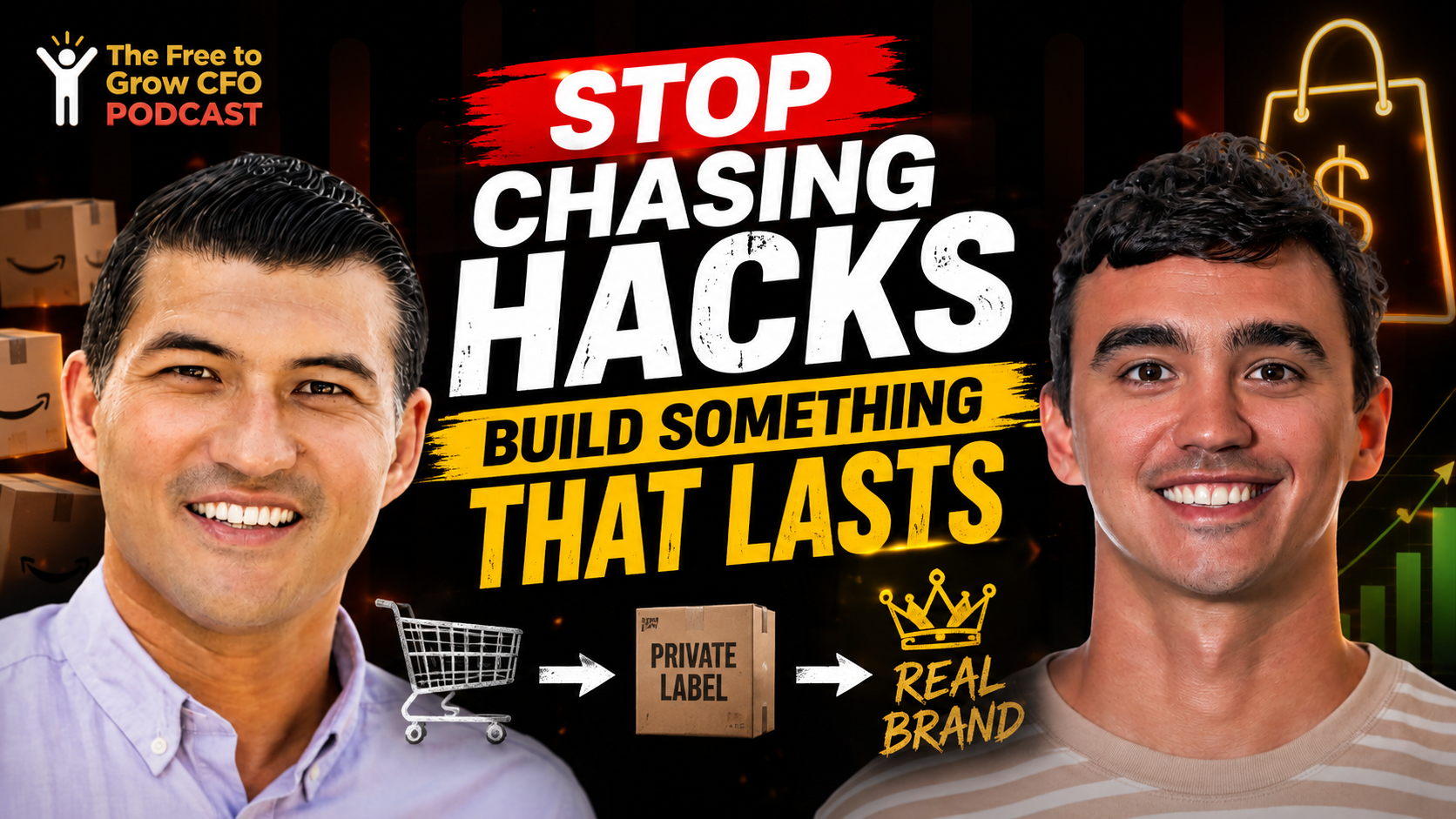
If you've ever wondered whether "reselling arbitrage" or "private label roulette" can actually build a lasting brand, this episode will hit home.
In this episode of The Free to Grow CFO Podcast, Jon Blair sits down with Max Abreu — co-founder of Mouthology and a 13-year e-commerce veteran — to trace his journey from Amazon reselling, to private label across a scattered mix of products, to finally building a single, durable, omni-channel brand. Max breaks down why arbitrage opportunities eventually run out, why he believes brand — not just traffic or reviews — is what makes a consumer business durable, and how a clear thesis around product quality (down to a specific fluoride-alternative ingredient) became the foundation for Mouthology's growth. Jon and Max also get into why unit economics get "baked in" at the product development stage and are brutally hard to change later, and why channel strategy (DTC, Amazon, retail) has to be modeled out financially before you expand into it.
If you're a founder trying to figure out whether you're building a business or a brand — and what it takes to make the leap — this one's for you.
Episode Links
Jon Blair - https://www.linkedin.com/in/jonathon-albert-blair/
Max Abreu - https://www.linkedin.com/in/abreu-max/
Free to Grow CFO - https://freetogrowcfo.com/
Mouthology- https://mouthology.com/
Key Takeaways
Unit economics get locked in at the product development stage and are extremely hard to change after launch.
Brand is the core driver of durability for consumer goods businesses, more than marketing polish or ad spend.
Staying in the game long enough, surrounded by the right peers, matters more than any single tactic or shortcut.
Transcript
~~~~~~~~
00:43 Max Abreu's Journey in E-commerce
04:57 Transitioning from Reselling to Private Label
09:12 Building a Brand: The Shift to Act Three
13:17 Product Development Challenges and Successes
17:41 Financial Strategy and the Role of a CFO
21:05 Advice for First-Time Founders
Jon Blair (00:43)
Alright, I'm excited for today's conversation. Today I'm joined by Max Abreu, co-founder of Mouthology. What's up, Max?
Maximiliano Abreu (00:52)
How we doing? Thanks for having me.
Jon Blair (00:55)
Yeah, man, I'm excited for you to join. Man, you've got a real dense background that I really wanna kinda tease out here for the audience, because I think there's gonna be a lot of learnings. Why don't we just start high level? Give me like a brief story of who you are, how you got to this point, high level, and then we'll start diving into the details.
Maximiliano Abreu (01:15)
Yeah, I've been in ecom my whole life. haven't had I've never had a job. So I started around 2013 2014 in college started flipping things that got me into the game per se started flipping toys and Shoes and met somebody that was doing it full-time That was my light bulb moment at the time. I decided to go all in post college partnered with my roommate. We grew that
And then at some point we pivoted over to private label and we were focused on just launching our own brands on Amazon mostly. And then kind of the third act is where we're at now, which is just true brand building, single focus, try to go omni-channel, build something, a legacy brand, if you will.
Jon Blair (02:12)
Okay, so you talk about kind of your history, your journey in these three acts, right? I just, we won't camp too much on this, because I definitely want to get into like the brand building that you guys are doing right now. But, so I started an e-comm on Amazon 2015, so a couple years after you. But back then it was so different than it is today, right? Like completely different beasts. I call it like the e-comm heyday.
Explain to everyone a little bit about your kind of act one and act two of like Like reselling and and then and then moving into private label
Maximiliano Abreu (02:49)
Yeah, yeah, I'd be happy to. So started with reselling. Like I said, I met somebody that was doing it full time. That was my aha moment. Partnered with my roommate. We went all in. We were the guys, you know, filling up trailers. We had a warehouse with employees and we would, you know, go down to Orlando. Orlando is about three hours from us. We'd hit up all the Nike outlets, fill the trailers up with hundreds of thousands of dollars of just
buying Nike shoes in the stores and then turn around and send it to Amazon. And we did that for a couple of years. It was great, know, but at some point we realized it was just a hustle, right? No matter how big you got it, was, you're only as good as your last deal and you got to keep going. And then at the same time, we joined a mastermind where people were doing mostly private label and we were seeing them exit for multiple.
seven, eight figures just after a couple of years. And that was another light bulb moment of, Hey, you know, what we've got going is great, but we're never going to be able to exit, you know? And, so we decided to, to start going in that direction and then finally kind of pulled the plug on everything and then dove into private labeling on Amazon. that's, that's kind of where act two comes into play.
Jon Blair (03:59)
Mm-hmm.
Jon Blair (04:15)
So walk the audience through like what is private labeling? How did that work and how did you kind of get that off the ground?
Maximiliano Abreu (04:23)
Yeah, yeah. So private labels just, fine. We would first work backwards from the opportunity, right? So we'd find, something that we'd want to sell, something where we'd feel we'd be able to be successful at. And then we'd go find a factory to try to make that for us with the, with our brands, with our changes to it. We'd always try to iterate a little bit on the product and then, try to launch it mainly, mainly on Amazon. Our, our thesis at the time was that.
The customer on Amazon was brand agnostic, you know, only cared about reviews and pricing and great images. And so we, we were selling, we were selling things under the same brand. You know, we we'd had things like vomit bags, period panties, skincare line. what else? Travel accessories. I mean, you name it. We were just trying to sell, and it worked. It worked for a really long time.
It was great for cashflow not being limited to what you're going to launch. And I'll say it worked until it didn't. You've got the aggregators, the Amazon aggregators that kind of came in the space, and Amazon valuations ballooned, and then it all collapsed. And then it became evident that, if you really want to unlock some enterprise value, you need to think
Jon Blair (05:29)
Mm-hmm.
Jon Blair (05:37)
Yeah.
Maximiliano Abreu (05:51)
a little bit beyond that and build a build a true brand that's that's Omni channel. And so that's kind of what led into Act 3, if you will. There's a there's a story there about us getting sabotaged and just real, real, some real dark trials, you know, that come with just building a business. But we don't have to get into that if if you don't want to.
Jon Blair (06:20)
So here's what I'm curious about. from Act One, your time spent in Act One and Act Two, right? Being a reseller, doing private label. What are some of the more general business principles that you learned that caused you to kind of conclude it's time for us to start building our own brand? Like what were some of those timeless business principles that you learned that caused you to go into Act Three?
Maximiliano Abreu (06:42)
Yeah, and it. to go into Act 3. Yeah, to go into Act 3 it was just just looking at the exit multiples, right? It was evident and then we'd also had like. I want to say secondhand experience, but very close of some some peers, some brands that were able to do it right so so once.
Jon Blair (06:47)
Yeah.
Jon Blair (07:04)
Mm.
Maximiliano Abreu (07:05)
That's huge. Once you have, at least for me, it's always been, once you have something like tangible, someone that you know, that's done it, all of a sudden it feels very doable, right? Especially if you get to know them. Like some of these guys are geniuses, right? But a lot of times it's like, you get to know them, you're like, oh, wow, if they can do it, I'm sure we can figure it out. So I had some of these examples kind of pave the way for us to give us the confidence of like, oh,
you know, if we really do unlock, say retail or DTC, and we're at a certain scale, could things can really happen for enterprise value and to build something that lasts, right? Don't want to just be so shortsighted with an exit or whatever.
Jon Blair (07:47)
for sure.
Jon Blair (07:53)
Yeah, so what's one thing that's interesting, I've been talking a lot this a lot about this on this podcast and another one that I co host, is this concept of like arbitrage versus durability, right? Like A lot of people get into ecom because there's low barriers to entry. Exploiting some arbitrage opportunity. whether that's, you know, whether that's like the reseller arbitrage opportunity that you guys had for a period of time or, you know, the private label one, but
building a real business requires building in durability into the business. And there's a number of different ways to build durability. But it sounds to me like you guys, over this long period of time, figuring out how to make a lot of money with these arbitrage opportunities, it's like, okay, the next thing we're gonna do, the next level of sophistication is to build something durable, right? Durable against competition, durable against other kind of shocks that can happen in the marketplace. And, you know,
That's why we always say like, we work specifically with brands. We don't work with e-commerce businesses. We work with e-commerce brands because the brand, what it takes to build a brand, that's at the center of durability. right? There are other things that help make a business durable, but for business that sells consumer goods, the brand is at the center of durability. So now you're moving on to act three and you're looking at leaning into brand building.
How did you guys begin to go about doing that?
Maximiliano Abreu (09:22)
Yeah, so a bunch of different ways, but I will say what we did was we took a look at our two bestsellers at the time. One of them was in skincare. One of them was in oral care. We said, okay, these are the two verticals we're going to play in. And then very quickly digging into oral care, we saw just a ton of demand. The space was growing and particularly with our hero product, know, it's toothpaste.
We saw a gap in the market. We saw this huge trend of people moving away from fluoride, and they're actually being a better alternative to fluoride and one that's been around just understudied maybe, developed with the help of NASA research, been used in Japan for decades, and not a lot of competitors, and not a lot of competitors delivering a product that we thought.
could exist. with the right amount of clinical strength in the ingredient, not a lot of junk and it also tasting amazing. Because that's one of the things that I think a lot of times people miss when they try to over index on the good for you, good for the planet, good for whatever you want it. Ultimately, if it doesn't satisfy, meet or exceed the customer experience to what's out there.
Jon Blair (10:40)
for sure.
Jon Blair (10:48)
100%.
Maximiliano Abreu (10:50)
you're going to fail. you know, and that's, kind of what, what Tesla has had to do with their electric cars, right? And so it took us about a year and a half or so to get our toothpaste right. And, and then we launched and it's been great. And now for us, it's just a matter of getting, toothpaste in the hands of our mouths of as many people as possible. So to answer your question, would say for us, it was the product.
Another thing that I also notice is that a lot of these DTC darlings that you look at and have just amazing marketing, beautiful photography, check all the boxes, they go on Amazon and they get exposed because there's no way of faking reviews at scale, at least not that I know of anymore at scale. And so all these end up on Amazon with like
less than four star reviews, know, and just basically faking it till they make it with cranking out ad spend and all that. And it works, you know, for them, maybe for the time being, but I think in order to build something lasting, you've got to have an amazing product. So, so it started there with us.
Jon Blair (11:51)
Yeah.
Jon Blair (12:06)
It's super important. Most of the brands that I see build durability into their business. And I mean, I'm kind of going to say the same word twice because I'm going say lasting durability and lasting are kind of the same word. like it, the center of their brand building is product development. Right. And it's interesting. I'm currently reading poor Charlie's Almanac right now about Charlie Munger, who's like a, you know, an investing genius.
He's crazy, like he's on a completely different level than the wavelengths that my brain can think about, but he thinks a lot about psychology. I'm actually reading his chapter right now about his principles of human misjudgment and also just thinking about how psychology plays into business. And what you're talking about with, you know, that there has to be this satisfying experience. You know, You need to have enough functional benefits to serve a logical and functional purpose, but if psychologically,
there's not a good feeling experience, right? Then there is not durability for that brand. It's always gotta be both. It's gotta be very functional and very psychologically and emotionally satisfying. One side note that is kinda funny, so I come from a dentist family. My dad's a dentist, my mom's a hygienist, and my grandfather's a dentist. My parents run a dental practice. That's the business that supported me as a kid.
So I'm, oral care is, the other thing I think is really important, like people don't realize how important oral care is. Actually, with it being one of the major entry points into your body, there's a lot of studies that link, you know, oral hygiene, good or bad, to good or bad health in other organs and areas of your body. And most people don't realize that how critical it is to maintain your oral health. I know more about that than I should because I'm kid of a dentist, but.
Talk to me a little bit about the journey on the product development side, because you just mentioned how important that is. Talk to the audience a little bit about how you guys found success developing your product, maybe where you ran into some roadblocks and how you pushed through them.
Maximiliano Abreu (14:13)
Yeah, first of all, just to echo what you said, I 100 % agree. So for us with Mouthology, we want to live at the intersection of science and self-care, because we believe exactly what you just said. The oral care is the entry point. It connects to the rest of the body. And yeah, so as far as the toothpaste goes, mean, all sorts of challenges. That's for dang sure.
We were actually, we outgrew our co-manufacturers. So we had to, we had to pivot. We had some issues getting some of the, the right sources, like the COAs and whatnot, where they were sourcing some of that stuff. So we had to kind of try to recreate it from scratch with a new co-packer. Then as far as getting the taste right, that was, that was also a bit tricky. I'm making sure that we didn't use any of the junk.
right, no SLS, no artificial flavors or colors. Those are often shortcuts that you can take, right, for a user experience. But we tried to make sure we checked all the boxes. We also tried to make sure that we included, like I said, the highest percentage or concentration of NHA that matches scientific studies out there.
And we tried to do that while keeping a very reasonable or approachable price point for customers. We tried to be also transparent in disclosing that, disclosing the concentration that we have with our customers. And yeah, what else can I say?
Jon Blair (16:02)
Well, yeah, it's interesting because like the a couple of points I want to draw out. One is building something or creating a product that's better for you, that's that has the psychological kind of satisfaction, but also considering the economics of building that out, right? It's like a really it's like this seesaw, this balancing actor constantly on trying to keep in play. And one thing that I harp on a lot in all my content and with the brands we work with is like, look,
When you're developing your product, you are baking in your unit economics. Like you can definitely adjust them over time, but I've been in the game now for, you know, about 12 years. I've seen very few brands significantly change their unit economics without a massive reformulation or reworking of how they make the product. And so again,
I don't ever say anything's impossible because I'm an entrepreneur and entrepreneurs were at the forefront of making impossible things possible. But you have to be so mindful of what unit economics you're baking into your business on the front end because it is not easy to change them after the fact. Do you agree with that? And have you learned anything about that over the years?
Maximiliano Abreu (17:14)
Yeah, no, 100%. It also matters what your go-to-market strategy is going to be. Are you going to be an Amazon only, Amazon in retail, Amazon retail D T C? Which ones are going to be the ones, the channels that are going to carry you? Which ones are just going to be ancillary ones? Pricing really matters there. Unit economics really matter there. So we're trying, we're still learning all this.
we're starting to get momentum on all fronts to where it's giving us the confidence that, hey, there's a path here for us, right? Because you hear so much around AOB and LTV and CAC and all these things for the DTC and then the DTC people. then you've got the Amazon people, you know, where there's a bunch of price anchoring, right?
Jon Blair (18:11)
Mm-hmm.
Maximiliano Abreu (18:11)
and value really matters. But to be able to check all the boxes or even find success, say you might not even need those two channels, right? You've got Dudewives, for example, a huge brand that didn't depend so much on DTC, right? Retail and Amazon crushed it for them. You've got examples across the board of people that have done it different ways.
Jon Blair (18:35)
Yeah.
Maximiliano Abreu (18:40)
I think I just saw Salt and Stone deodorant, know, $20 deodorant, yet they crush on Amazon and they crushed on retail. think they've done well in DTC also. So I guess those are just some thoughts there, but we try to be thoughtful about it and try to cater to everybody. We're still learning. You know, it's not like we've cracked all the channels.
Jon Blair (19:00)
Yeah.
Maximiliano Abreu (19:08)
but we think that we're in a good position to continue showing up for our customers basically across the board.
Jon Blair (19:16)
Yeah, and like, look, I don't ever want to represent that like people who build successful brands have it all figured out, because I know from working with dozens and dozens of them, we don't have it all figured out. But there is a different intentionality. When I think about like a first time founder versus someone who's done it several times or really long time, it's not that they know everything. It's like, hey, look, this time around, I'm going to think about, I'm going to do a thought exercise, maybe even a rough unit economic forecasting exercise of like,
if we sold it for this price point on e-comm, how would that play out in physical retail given the margins that we know we have to give to retailers? And would this be able to, does it look like we'd even be able to make this financially viable? Thinking about that on the front end is really important because I do see a lot of brands get, you know, let's say they launch in D T C, they've reached the ceiling of kind of their TAM in that channel sooner than they thought. And then they started thinking about Amazon and physical retail.
And sometimes they're lucky and the unit economics work in those other channels. But other times, I've actually seen this a lot with Amazon brands. They start on Amazon and they start facing a lot of headwinds on Amazon and their margins are getting compressed and they're like, dude, I wanna get on D T C. And I look at their unit economics and I'm like, ugh, this is gonna be a hard one to make work on D T C. And so being thoughtful on the front end, again, it doesn't remove all barriers or like all roadblocks that you're gonna run into, but.
just that intentionality can change a lot. I wanna ask you a little bit about the finance side because you've been working with Free to Grow CFO for a bit at this point and I'm just curious, you guys had a really strong controller before you started working with us but then you added on the fractional CFO piece. What has it meant to you personally or how have you seen it impact the business and what has it done to help you think through strategy as a co-founder?
Maximiliano Abreu (21:08)
For us, it's been a couple things. But one, for me personally, is a safety net of confidence, of expertise, where I can say, are we good with this decision? What do you think about this decision? To be able to have somebody ready to go there, that sole focus is the financial piece has been huge. But then another piece has been, hey,
The modeling side of things and let's talk about where we're going, what we're trying to do. We talked about, know, DTC retail, all function very differently, especially financially, right? So being able to understand that and be able to properly model those out has been super helpful because we're trying to...
Jon Blair (21:48)
Yeah.
Maximiliano Abreu (21:57)
maybe tackle two initiatives at once, you know, that have very different implications. And it's like, okay, when should we get some financing? How much? And to be able, like I said, to be able to have that layer of confidence is always really, really assuring for us as a founder.
Jon Blair (22:19)
Absolutely, especially when you're looking at different channels. The different channels don't just have different P &L economics, they actually have different balance sheet economics as well. You know, for example, the payout structure of Shopify payouts versus how frequently Amazon pays you out, that's a balance sheet item. Looking at how inventory levels are likely to change or receivables as you scale into physical retail, right?
So you have to be looking at just at the P&L the forecasted P&L impact, but I would say maybe more importantly, the forecasted cashflow impact, because a lot of times you're gonna find that maybe some piece of financing that worked when you were mostly an Amazon brand is not the piece of financing you need as you're like, you know, gonna scale mostly through physical retail from this point forward. So anyways, it's been a pleasure working with you guys and we look forward to continuing to help you guys take Mouthology to the next level.
I wanna ask you one final question, is, imagine you've got a first time founder listening to this podcast, which is a large swath of our audience. You've been in the game for 13 years now. If you could offer them one piece of advice, one piece of wisdom that you're like, hey, don't make this mistake because I did, what would that be?
Maximiliano Abreu (23:34)
So the first thing that came up when you said that isn't necessarily I guess it's kind of advice, but the thing that sticks with me For the longest time is is it's cliche, but it's not giving up I think that if you stay in the game long enough you're gonna get rewarded for it and You know in knowledge with with AI now
Right? It's everywhere. It's all abundant. So it's mostly what's going up in here in your belief. And then how long are you in the game? Another thing, I don't know if this is two pieces of advice, but another thing that has been huge for me, and I kind of alluded to it earlier, has been just surrounding myself with the right people. Right? You hear about this a lot, but being able to see peers that I know, that I've shaken their hands, spoken to, you know,
Jon Blair (24:06)
Totally.
Maximiliano Abreu (24:27)
being able to see them go out and do amazing things, that gives you so much confidence, or at least for me, to be able to say, they were able to do it, I'm sure we can figure it out too. And so always surrounding yourself, I've been a part of different entrepreneur groups everywhere, or not everywhere I go, but I've been in different, I make sure that I'm always in one, I guess is what I'm trying to say.
Jon Blair (24:40)
Totally.
Maximiliano Abreu (24:55)
just because you want to be rubbing elbows with the people for the confidence, for the tips, for everything basically. that's what I'd say.
Jon Blair (25:02)
Totally, man, that's great advice. And in my opinion, those things are really tightly connected. Because when you feel like giving up, getting yourself around the right people, for me, always gets me re-energized. And look, I echo that. I talk about this a lot in my content, because I'm tired of sensationalized content that's like, do these three things and your business is to be changed forever. That's not how it works in business. That's not how works in life. You got to just keep going. It's more about time in the game, not
timing the game. That's what I like to say. It's not about timing the game, it's about time in the game. If you stay in it long enough, you're gonna get it figured out. Before we break here, where can people find more information about Mouthology?
Maximiliano Abreu (25:45)
Mouthology.com or DM me on LinkedIn, DM me your address. I'll be happy to send you some toothpaste. You know, we're always down to give away some free samples. Our kids line is launched a couple months ago. That one's doing great. So, so kids and adults and we've got a lot more coming. So happy, happy to give samples to anybody who wants to try us.
Jon Blair (26:07)
Awesome. Well, Max, we appreciate you guys as clients. We appreciate you coming on and dropping some knowledge, dropping some wisdom, and look forward to chatting soon,
Maximiliano Abreu (26:15)
Awesome. Thanks, Jon.