Are You The Bottleneck In Your Business?
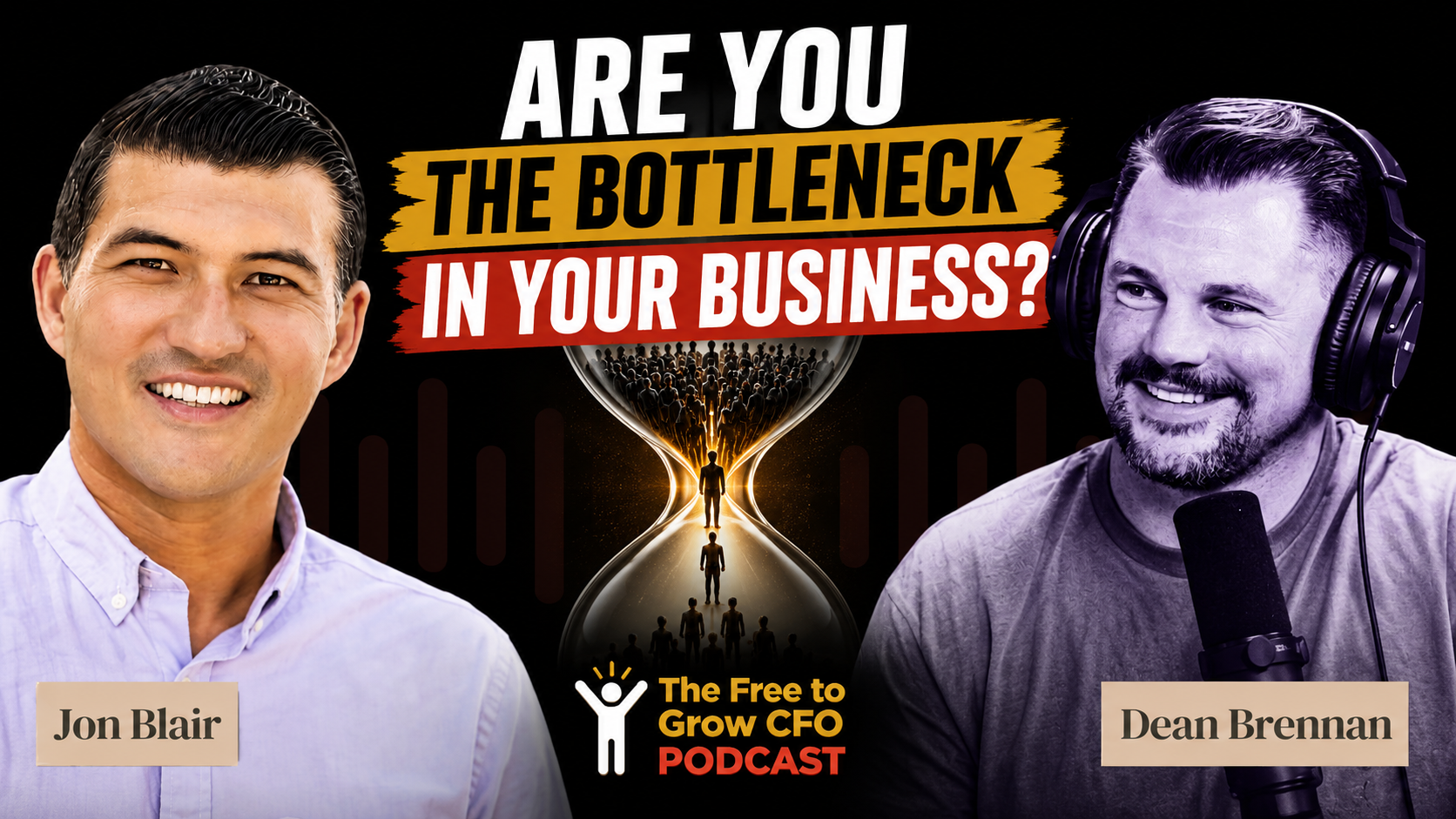
If you've scaled past $10M on the strength of organic growth and a loyal subscriber base, you're about to hit a wall — and most of it is about you, not the business.
In this episode of The Free to Grow CFO Podcast, Jon Blair sits down with Dean Brennan, CEO of Heart & Soil, for a candid look at what the $50-to-$100M journey actually requires. Dean breaks down how he stopped being the bottleneck by shifting from decision-maker to outcome-holder, and shares ELLIS — his AI-powered leadership insight system that grades his weekly performance using three years of Slack messages, meeting transcripts, and Asana data.
Jon zooms out to the financial side — how channel mix, retail expansion, and cash flow risk all change at this stage. Whether you're approaching $50M or pushing past it, this episode is a practical gut-check on the leadership and operational shifts that separate brands that stall from brands that scale.
Key Takeaways
The bottleneck at $50M is almost always the founder — moving decision-making down the org chart is a survival skill, not a luxury.
Mistakes are an investment in learning, but the environment you create around mistakes determines whether your team grows or freezes.
Holding leaders accountable to outcomes rather than micromanaging the how is a fundamentally different leadership muscle that most CEOs have to deliberately build.
Episode Links
Jon Blair - https://www.linkedin.com/in/jonathon-albert-blair/
Dean Brennan- https://www.linkedin.com/in/deancbrennan/
Dean Brennan - https://x.com/deancbrennan
Free to Grow CFO - https://freetogrowcfo.com/
Meet Dean Brennan
Dean Brennan, CEO of Heart & Soil Supplements, leads a pioneering brand in nutrition and health, with a focus on premium organ supplements. Under his helm, Heart & Soil has served over 200k+ customers and scaled to 50M in revenue in just three years, a testament to his vision and steadfast dedication to servant leadership with purpose. This commitment drives the company's mission to provide unmatched nutrition and lead a movement toward profound health and vitality.
Transcript
~~~~~~~~
00:00 Intro
00:56 Where Heart & Soil Is Today and How Dean Thinks About Growth
03:27 The Leadership Wake-Up Call: Becoming the Bottleneck Past $50M
08:30 Holding Leaders to Outcomes, Not Process
11:47 Managing High-Stakes Pressure Without Getting in the Weeds
13:25 Channel Expansion: DTC, Amazon, and Stair-Stepping into Retail
17:50 How Dean Is Using AI Internally to Make Himself a Better CEO
23:22 Keeping AI Context Portable — Why Local Files Beat Platform Lock-In
25:29 What It's Meant to Have a Fractional CFO Through the Growth Journey
27:28 Outro
Jon Blair (00:43)
All right, we're back and today's today's a huge day because whether Dean remembers or not.
He was the very first ever Free to Grow CFO podcast guest two years ago. So I've got my boy, Dean Brennan from Heart & Soil back on the show. What's up, Dean?
Dean Brennan (00:56)
Not much man, thanks for having me. I didn't actually remember that I was the first guest, but that's cool.
Jon Blair (01:01)
I just remembered that as I was preparing. was like, my gosh, two years ago, first episode, Dean Brennan, Heart & Soil, let's go. ⁓ A lot has changed. Yeah, it's been great. It's cool to see how it kind of builds momentum, as I'm sure you know, because I know you're a content creator or a storyteller, you're big into organic. It doesn't happen overnight, it takes time, but you just do it out of passion.
Dean Brennan (01:08)
And you've had a ton of guests on SunSun too. You've had...
Jon Blair (01:26)
you know, and for love of the journey and eventually some people are willing to follow you. But yeah, man, I'm excited to chat. When we chatted last time, we were talking about going from 0 to 50 million in 3 years and now you're on this journey of going from 50 to 100 and beyond. know, I'd love to kinda dive in and maybe we'll sprinkle in some talk about AI, maybe our mutual love for 7-string guitars and heavy metal.
catch the audience up like where is Heart & Soil at today and what are some of the big things you're thinking about as you're trying to take the brand to nine figures.
Dean Brennan (01:59)
love it. I mean, the first thing you need to do is play more seven string guitar, because do think as you grow, you need to try to take more time to get in a flow state and chill. And the guitar helps that. But yeah, where are we at today? Gosh, made this journey from zero to about mid 70s. And we're trying to break know, to this next phase. And it's interesting because
Jon Blair (02:02)
Yeah
Dean Brennan (02:22)
don't look at our journey like in phases of revenue numbers or whatever. It's probably because of just my past being a filmmaker and storyteller and somebody who's just really into helping other people with their health. I kind of look at it like the wave and momentum of radical health, what I call it, is that growing, is it expanding or?
Jon Blair (02:26)
for
Dean Brennan (02:44)
Are products getting into more people's hands? Are we helping more people on the front lines? Are our products more accessible? Are we creating content and doing things that are helping people remove barriers from their life? Are we learning more about those barriers, about our customers? So in my head, that's kind of how we're looking at it. And some of that is like expanding the TAM with products. Like we launched protein, a really great protein powder last year.
We're working on some other things that are a little bit different than your traditional beef organs. And that's because we just exist to help people achieve radical health. And we happen to make products and do that kind of thing. But yeah, don't look at it like a revenue phased approach, even though it's relevant.
Jon Blair (03:27)
Totally, well it's really important because the more and more that I help businesses grow and grow my own business, I really truly believe that like the journey and the impact, and certainly the impact is a part of the journey, but like the journey's all we really have, right? Like you never know what the end is gonna be, you never know how it's gonna pan out along the way, and there's something about caring about the impact and just having a group of people that are just trying to
not only expand the impact but sharpen themselves, right, along the way and become the best version of themselves. And that's why I think there's just like this beautiful thing that happens in business when like a group of people come together to make an impact on the world but at the same time make their life better and make themselves better. And when you're doing that, usually there's prosperity financially along the way and there's growth, right?
But I'm curious for the people that are listening, because I would say probably the vast majority of people who are listening are probably in the phase of like, I'm trying to go from 10 to 50 and they maybe have never gone beyond 50. What are some of the things that you as the CEO and like the top leader in the business, what are some of the things that maybe caught you off guard once you passed 50 and you're like, ⁓ shoot, this new round of scale, I've got to change my thinking.
And I've got to change the organization's thinking to kind of push through to the next level.
Dean Brennan (04:48)
Yeah, I love the question. It's, you know, the first part that I talked about there is about like our mission, what we're here to do, but there's certainly downside if you're fully on that and you're not thinking about the operational components and how all that works, you're gonna catch yourself in a trap. So some of the pressure points that I've really felt like moving into this next phase is
delegated responsibility and moving decision making down throughout the organization. I think, I don't know, I thinking about this kind of like the evolution of people if you think about like selection pressures and stuff of that nature. Businesses are almost no different to where you have a series of selection pressures that are being kind of forced upon you as you grow. And for us, since we grew organically,
mostly like very, very well. We didn't have a lot of selection pressure being forced against us on like, let's say our paid acquisition funnels or certain operational components where we didn't need to be excellent at it early, but now we do. And one of those things is decision-making. Before it was like really easy for me to have
Jon Blair (05:48)
Yeah.
Dean Brennan (05:56)
a grasp of every single thing that was going on across the business. it wasn't too detrimental to the team if I was making a lot of decisions like in the realm of finance, in ops with our COO, in marketing. But it kind of got to the point where I became a really big bottleneck and things that needed to move more quickly weren't moving because was the bottleneck.
Jon Blair (06:13)
Hmm.
Dean Brennan (06:19)
So that's one big thing that I realized. over the last probably six months or so, really a year, I've been very intentional and I've actually built some AI systems to help me out with this. I've been very intentional about recognizing that pattern when I might be interrupting something or holding a decision that really should be somebody else's to own. there's a couple other things related to that, but that's one big one that I experienced.
Jon Blair (06:45)
Yeah, so something that I was thinking about as you were talking about that is like, I've noticed for myself, as I've helped scale several businesses, when I start noticing I'm the bottleneck, there's a couple things that I try to force myself to do, and I'm usually too slow to do this to be completely honest, but like, one, become question asker versus decision maker, and we can kind of,
double-click into that a little bit more. But then the second one is ask myself what system is broken or missing or people issue do we have that's causing this decision to come to me instead of get done on its own. Because usually it's a people issue and or a process issue that's causing that decision to get pushed up to the CEO oftentimes. But let's go back to the question asker thing. I'm curious about this. So like at the beginning, right, you're the decision maker.
Yes, no, do it this way. But then, but then when other people are starting to make decisions, a key, I think I actually learned this from Dave Ramsey. Dave Ramsey talks about like delegating to his team in his book Entree Leadership. And I'm using different words, but he basically says like, first I do it and you watch, next you do it, I watch. And then like third is like, you're off on your own, right? And one of, as you let go of,
as you train someone up to make decisions on their own and you start letting go, you have to stop saying yes or no and start asking questions to kind of test their thinking, test their assumptions, test the why behind what they're trying to do so that even if they ultimately make the yes or no decision on their own, you force them to think about kind of the first principles that underlie that decision. Where does that come into play for you in this stage of the business?
Dean Brennan (08:30)
I have so many thoughts that are just like running through my is like really related to that. So I don't even know how to properly put this into words, but it's was asking a lot of it would still hold things up. And here's like one unlock that I had and that worked really well from like 20 to 50. It's like get into the conversations, get into the weeds.
from 50 to 100, you don't wanna be the one that does it first for somebody else to follow because you need a level of, I think, specialization sometimes and experience that you wanna be the dumbest person in the room, essentially, but you want to know, you have to understand how to get to the root of problems and to be able to ask the right questions. But the thing that I was thinking about that is really interesting is,
Jon Blair (09:05)
Totally.
Dean Brennan (09:17)
along with like moving decision making further down the org chart, I almost had to adopt just a relentless instinct to just question the outcome, to like hold people to an outcome, but not get into the details of the how. So I almost ask less questions now with certain key leaders.
Jon Blair (09:35)
Definitely.
Dean Brennan (09:38)
but I am relentless about bringing that outcome up. What is the outcome? What is the expectation? Are you confident? Are you not? If you're not confident, what, like, how are we getting there? And so I'm holding people account to outcomes rather than the how in a lot of ways, but that's been a growth experience for me because like, as a leader, you have to get really clear about what outcomes you actually are committed to and that you want for the organization. And I think,
Jon Blair (09:54)
Totally.
Dean Brennan (10:05)
It's easy to get lost in that because there's just so much, right? Like you've got a lot as a CEO anyway, you've got legal people and talent, HR, finance, marketing, ops, all of these things. And you have to get real clear for your team, more clear than you've ever gotten before. And you have to hold people to account to those outcomes.
Jon Blair (10:09)
Totally.
Yeah, and you've got to be willing to repeat yourself. It's like, it feels really clear to you, like, hey, we've already aligned on this. I can see the vision. I start to realize more and more that it takes several times of repeating. Instead of making decisions, you're more painting the picture of where the business needs to go and making that as clear as possible.
which takes a lot of work. starts becoming a full-time job in and of itself when you get to a certain scale. There's another thing I want to ask you about because, I've experienced this in every business I've helped grow. When you start delegating decision-making, you have to be okay allowing mistakes or sub-optimal outcomes along the way. Because in my opinion, that's the only way for someone to internalize the learning and go like,
Okay, this is how I'm gonna make this decision better next time. I'm seeing this a lot as a dad with my little kids. You know, at the beginning when they're infants, you do everything for them. And like they're starting to get a little bit older. I'm like, I've got to let them do this on their own. But my fear is like, they're gonna spill that milk all over the cabinets and all over the ground or they're gonna make this huge mess. But like I have to allow those mistakes so that they learn how to do it without those mistakes in the future.
Talk me through a little bit of your experience with that because I know that that can be hard.
Dean Brennan (11:47)
Yeah, I mean, I've always been the type of leader that embraces that to some extent. I don't like repeating mistakes over and over, but you certainly, I think for people to grow and for myself to grow, my team's been very forgiving with me when I make mistakes, because I do it as well. But I think so long as everybody has the mindset that generally mistakes are an investment in learning, but we don't repeat them. So yeah.
I try to allow that space. What is interesting though, sometimes when the stakes are high and you're like, for example, we kind of had this period of time where acquisition was slowing a bit and it was putting some pressure on, you you're seeing the decay from returning cohorts and you know, it's like, wow, we have to fill the sponge and get some new people in the business ASAP. Otherwise, you know, the next six months aren't going to look very well. And that's a different type of.
pressure I had to trust in the past, I would have like gone into the into the weeds and asked a ton of questions over and over. I approached that this time with like, I'm gonna, we're gonna come up with a number that we want to achieve. And I'm going to be relentless on calling that number every single day, sometimes twice a day.
Jon Blair (12:40)
Mm-hmm.
Dean Brennan (12:55)
How are we doing? How are we pacing? What's next? What's next? What are we doing today? What are we doing tomorrow? Applying that type of just pressure and visibility on it and trusting that the team would come through. And did. we didn't make any mistakes, which was great. So yeah, to your point, it's like you have to allow that and you can't...
Jon Blair (13:13)
Mm-hmm.
Dean Brennan (13:15)
I don't know if you create an environment where everybody's just fearful of making mistakes and I think you're just stunting your growth at the end of the day. ⁓ And you'll, yeah, you're gonna speed up probably you being exited from the company as well.
Jon Blair (13:21)
Yeah.
It's funny, I'm reading for the first time. It shouldn't be the first time when I'm 39 years old, but I'm reading poor Charlie's Almanac, Charlie Munger for the first time right now. And he's—I'm going through the longest talk in there which is about basically human psychological misjudgment. And they had this rule. He talks about the, doubt avoidance tendency and inconsistency.
avoidance tendency and they had this rule at Berkshire Hathaway about like good news versus bad news. And this saying was like, always share the bad news immediately because the good news can wait until tomorrow. And the point was, we make a mistake or there's an issue, all good, but we need to know about ASAP and we as a team need to figure that out. We'll hear about the wins later. Let's figure out what's not working.
that we need to adjust and let's do I'm curious, because this is something that we work with brands a lot at Free to Grow CFO and there's a lot of questions around this channel expansion, sales channel expansion. You start growing and as a general statement, we kind of see with brands and advise them that you have high LTV, your subscription business, like Heart and Soul, you can scale D T C and even just pure e-comm a lot.
generally speaking, for a lot longer than a brand that's new customer dominant, has little to no LTV, they've gotta expand channels sooner. Where has channel expansion fit into your strategy since we last talked, and what are some of the things you're learning about how to do sales channel expansion right?
Dean Brennan (14:59)
Good question. I mean, do you count D T C Amazon in that equation? Yeah.
Jon Blair (15:03)
Yeah, yeah, for sure. DTC,
Amazon, and physical retail.
Dean Brennan (15:06)
Gotcha. Yeah, so it's funny because we've generally not really like gone all in on Amazon even. we've been primarily, know, Shopify with some light kind of smaller health types of grocery stores around the country, like at Erewhon in California. don't know. I just bring it back to the back to the mission for us. It's like long term. How do I how do I guarantee
If I could just make such a bold, crazy guarantee that most people are going to go for beef organs over a synthetic alternative. At some level, you have to meet the customer where they're at. And you can kind of tell sometimes on DTC CAC starts increasing and you're doing everything possible. And it's like how we're kind of like not getting this out there as much as we want.
we're leaning into Amazon more, we're doing more top of funnel stuff like on TikTok shops, those types of things. But retail is very much a part of that equation. Now you got to balance for a product like ours, the supply chain, you know, we're literally sourcing from real farms with a real cattle. There's a lot of latency involved there. So, you know, you don't want to make such a bold intro into retail to where
you you go into like a Walmart or something like that, and then quickly they take you off the shelves and you're, you're like upside down and make a huge mistake there. So what we're doing is kind of seeing like, you know, what are really good fits like with audience? Where can we get in front of people that might not have heard about us before? Maybe they heard about us, but they don't shop online and they buy their supplements at let's say a Whole Foods or Sprouts, those types of things. And we're kind of stair stepping into, into those channels.
Jon Blair (16:25)
for
Dean Brennan (16:45)
And we had a Sprouts launch last year that went really, really well for us and some more plans this year. But it's absolutely part of the part of the plan because we want, you know, to make the we want to make the supplements accessible to people and not everybody shops online.
Jon Blair (16:59)
For sure. Yeah, I think one thing that you mentioned that's really important is like thinking through audience fit within specific retailers. Guardian Bikes never ended up going into physical retail. Maybe they will at some point. But when we were exploring that and we were talking to big box retailers, we actually if we were gonna start anywhere, it would be Target and not Walmart. Because if you really do...
the research on Walmart and the price points of the rest of their bikes. And you know, what we know about the overall demographic makeup of that particular audience, it just didn't fit with our value prop at the time. At that time, we had one very premium product, right? We didn't have our more entry level product that would fit in with the Walmart audience. And so we were...
laser focused on Target. we didn't end up doing it, but that was a big part of thinking And it's important for, it's really important for brands to think about that in any sales channel selection endeavor, even if it's an e-commerce channel. It's like thinking about what that audience might look like versus another channel.
Dean Brennan (18:03)
I think it starts there. I mean, at least in my head, it always starts with the audience and what we're trying to do. I mean, I see a lot of brands that just pride themselves on it. Like they talk about DTC like it is the only thing, but it's just a channel, right? Retail is just a way to get your product in front of somebody and convert. So yeah, start with audience. That's good advice.
Jon Blair (18:05)
Totally.
Totally.
So let's talk about AI a little bit because I know when we were chatting the other day, you were telling me about some crazy stuff you're doing with AI. Obviously, it's all the rage on social media right now. You can't go through LinkedIn or Twitter without seeing basically 98 % of the posts being about AI. Where, yeah, yeah, no, I mean, most of them are written with AI, right? About AI written, written by AI.
Dean Brennan (18:42)
or they're written with AI. Most, yeah.
Jon Blair (18:50)
then engaged with through AI. Are there any humans on this at all? what are you thinking about as the CEO of a growing brand? And where AI fits either in your day-to-day workflows, know, talked about a lot of marketing, just like where are you guys messing around with it? Where are you messing around with it personally? Where do you think the leverage is?
Dean Brennan (18:52)
Yeah, it's like just AI bots talking to each other with their human proxies.
I don't think so.
I think we could have a conversation about external uses of AI. The way I look at that is people are using it for ad creation, they're using it for content creation, they're using it for transactional customer service types of stuff. I see those as external. What's been interesting to me is the internal application and that's some of these things like at the end of the day, at the end of the day, were people
and we are doing business with people. And I think there's real leverage to be had if you focus the AI internally at yourself. For me, for example, being a CEO, how well am I communicating? clearly? Are there any types of patterns that are existing in how I operate with my team that are unproductive or might be causing confusion?
And so I've built like this crazy layer. I call it Ellis. It's my enlightened leadership insight system. ⁓ what I found fascinating is that if you set AI up properly and that properly might not be the right term, but if you can give it a point of reference to where it has the majority of your working context,
Jon Blair (20:08)
I love it.
Dean Brennan (20:23)
immediately or at any given point, you can really do some damage with this thing. And I'll just do a quick example in this system. So I've created like an MCP layer that instantaneously any given time I went in, when I log in, it knows, it knows how I've communicated in Slack. It knows how I've communicated in our test management tool, Asana. It knows all the transcripts from all the meetings going back three years.
Jon Blair (20:28)
Totally.
Dean Brennan (20:48)
And this thing has essentially given me patterns that it's recognized at the organization my own behavior and how I lead. And I've really recognized areas to level up in. And so then I developed a scorecard and I score myself every week. I have a CEO scorecard and it's like, how profit focused am I? ⁓ How quickly am I making decisions? Some of these patterns that showed up before are on the scorecard.
And I'm using this thing because it has a hundred percent of my context every single day. And scoring me on my performance. And I started getting B minuses in the beginning. It's critical too. And I should say for the audience as well, don't do this blindly. You have to spend some time. What's your leadership philosophy? Where's your business at? What's the DNA of your business? Really get clear on how you want to operate.
Don't do it just out of the box because you'll get average results. Anyways, so I've been grading myself and yeah, I was getting B minuses, now I'm getting B pluses. it's been really eye opening and really great. It's made me more of an honest leader. And part of that transition to go from like 50 to 100 million, I think is like your entire team and yourself, especially, you need to level up.
Jon Blair (21:38)
Yeah.
Yeah, I love that man. I've been using it a ton in my content a similar capacity, but not to just write all of my I personally edit and write a lot of it, but I contain all the transcripts from both of my podcasts, all of my previous posts and a lot of other guiding principles all within this one spot where I've trained chat GPT. And it's funny because I use Claude as well. Most of our team has migrated to Claude.
I still have all my content stuff in chat GPT it's learned so much about me, right? And, and the way that we create content and the interesting thing is this, would say it's happening more and more frequently, mostly on blog articles. We do these mini episodes, right? I pick one topic. I talk for four to five minutes. We've written some articles with AI off that transcript and I almost don't need to edit anything.
because it's just me talking for four to five minutes and then it writes a thousand word blog and it's truly me. That's different than just introducing this conceptual topic that we'd like to write about and saying go write this for me. It doesn't nail it the same way but it's interesting because I kind of use it for every step of the process. Like iterating on kind of briefs. What do I want the brief to be and then I'll go write something and go.
Hey, how can you help me make this better in context of how I usually create content and it'll almost bring my own brain. It's like a, it's like an external brain of mine and going like, Hey, you usually would say something like this, this, this, and this, and it makes actually more consistent with my previous idea. So it almost just allows me to access my thoughts in a more powerful way and, but introducing this kind of third party perspective. It's this weird thing, but I love it. It's it.
It makes me, it actually makes me a better thinker. It doesn't make me a worse thinker. And it brings a lot of awareness my actions versus like these conceptual ideas that I try to stay aligned with. I got to ask you one more question. Cause obviously I don't even know how long it is that we've been working together with you guys two and a half years, maybe three years. I was like, we've been working with Heart & Soil. My business partner, Jeff is, is your fractional CFO.
Dean Brennan (24:04)
I don't even know. Somebody asked me that the other day. ⁓
Jon Blair (24:12)
We've been helping out on the accounting for a while in this journey of growth. What is it meant to have a finance team helping you along the way?
Dean Brennan (24:22)
that's a good, can I add onto the AI thing one more time? And then I'm gonna answer that question. You said something interesting about all your contacts being in chat GPT. And I just had the thought like these applications are very similar to like social media where they want to retain you and get as much hours as possible. And one other thing I think is interesting about AI is like, if you set it up in a certain way,
Jon Blair (24:24)
Yeah, for sure. For sure.
Totally.
Dean Brennan (24:45)
So my system is using essentially markdown files using like Claude code, but the way that it runs is like all of these files are local and the context isn't in a particular AI model. And then I built that MCP layer so I can actually spin up GPT or Claude or Gemini depending on the use case. And it has instantaneous context into the quarter, the day,
Jon Blair (24:58)
Inside.
Dean Brennan (25:11)
the people I'm working with everything, which is kind of interesting because I've been thinking about this like long-term scale of it and like how I would deploy this at the organizational layer for everybody to essentially have their own chief of staff for their role. Anyways.
Jon Blair (25:18)
Totally.
It's interesting you
mentioned that because we're, doing the same thing. We're indexing all of our podcast transcripts, transcripts and, like previously published content, anything related to our content and we're indexing them all into files so that we can connect it. Cause I had the same realization was like, I can't get stuck on chat GPT. I have this context has to be transferable supposedly.
Jeff told me recently that there's some way to, to translate chat, GPT history into a Claude skill. I haven't looked into it. He sent me this video about it. I got to watch it and see if it's real or not. But obviously they're trying to figure out how to make this easier. Right. but yeah, man, like, what, where, where has it been most helpful? Like we were talking about before to have
Dean Brennan (26:00)
Mmm.
guys.
Yeah, I love it.
Jon Blair (26:13)
free to grow working with you guys on the fractional CFO and the accounting front. Because as you guys have been continuing to scale, obviously things have been changing. Channel mix has been changing. Cash flow versus profit has been changing. Are there any specific areas that you feel like it's been the most helpful?
Dean Brennan (26:30)
Gosh, all of the above really. And I'm not just saying that. I think like many operators, I don't have a history in finance. That's not I love learning about it and I like getting in the weeds on it, but it has been really, really helpful when we're acquisition challenges and we're making decisions on how much ad spend do we really wanna put into this? is our payback?
timeline, like being able to just sit in the room with Jeff, because Jeff is brilliant. And he can walk us through all those. it's funny because he won't ever make a decision for you. But he's always like, well, here's the pros, here's the cons. Here's what you know, here's what I've seen. But it's just very reassuring to be able to talk to somebody who you know, is highly, highly competent in that discipline. And not only that, I mean, I don't know how many P&Ls you guys are looking at, but
I'm looking at one and that's Heart & Soils. And so to have someone who you know is looking at different business optimizations and can actually give you a bit of a read on what's real, what's not. Like I've had anxiety before on things where Jeff is like, that's normal. That's normal. That like I've seen that a million times and I'm like, okay, good. So I mean, from that standpoint, I get the most value there. know operationally the know, relies on you guys a lot for like, or AP or accounts payable.
Jon Blair (27:37)
Hahaha.
Dean Brennan (27:48)
And the value I'd say there is you almost don't know. Things are always good when you know that something when you're not drawn to something often. mean, you guys run it and we've had a lot of changes with like how we operate on that side and minimal, minimal speed bumps. Your team's great. Ruben's great. So yeah, it's just been peace of mind is how I would call it.
Jon Blair (28:11)
For sure,
man. Yeah, it's been great working together and we look forward to continue to supporting you guys. You know, one last thing, because I want to make sure everybody knows, you've been cranking out some content personally on LinkedIn. Where can people follow you, find more information about Heart & Soil, get connected with you?
Dean Brennan (28:29)
Amazing. Yeah, the LinkedIn thing's fun. You mentioned before I was a content creator before, so people are like, why are you posting on LinkedIn so much? I just kind of like taking time out of my day and coming up with a couple posts here and there and then scheduling them. But Dean C. Brennan on LinkedIn and Dean C. Brennan on Twitter. I'm a little more active in the replies on Twitter. LinkedIn, would say, are just insights and things I'm observing as I go along.
Jon Blair (28:54)
Well, I appreciate you coming back on, man. This is full circle for me to go from first episode ever to chatting again two years later. Look forward to continue to working together and see you at Commerce Roundtable. Excited for that one, man.
Dean Brennan (29:07)
Heck yeah, you too. Yeah, I'll be talking on April 21st, actually about the AI stuff at the Commerce Roundtable as well.
Jon Blair (29:13)
It's gonna be a good one, man. Well, I appreciate you coming back on and we'll chat soon.
Dean Brennan (29:17)
All right, thanks for having me, Jon.
Jon Blair (29:18)
Alright,