Why Most DTC Growth Strategies Fail (And the Proprietary Playbook We Built to Fix It)
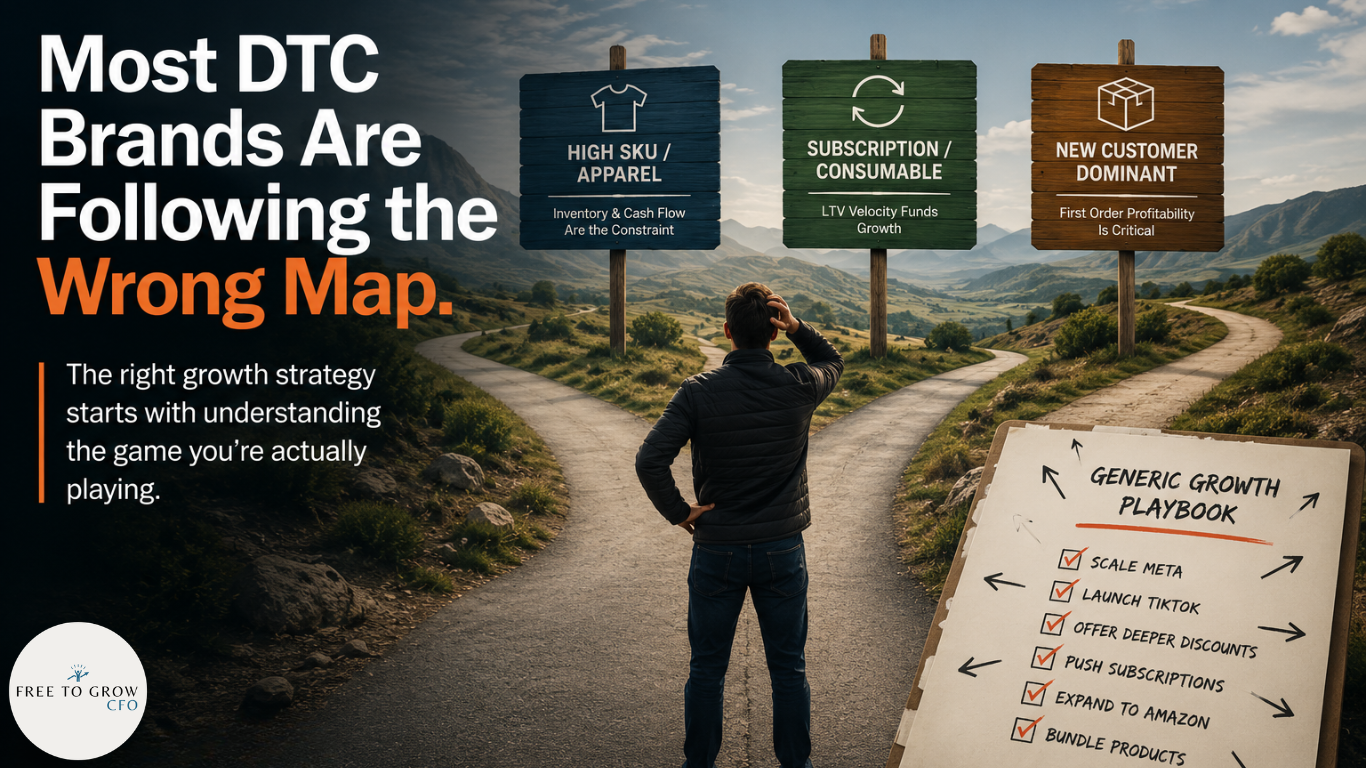
Scroll through LinkedIn or X for five minutes and you’ll find countless “proven” growth strategies for ecommerce brands.
Scale Meta. Launch TikTok. Offer deeper discounts. Push subscriptions. Expand to Amazon. Bundle products.
The problem isn't that these tactics are wrong. The problem is that they're usually applied without asking the most important question first:
Does this strategy actually fit the economics of my business?
After working alongside hundreds of scaling DTC brands, we noticed the same pattern repeating itself over and over again. Smart founders were borrowing marketing strategies from brands with completely different products, customer behaviors, and unit economics. Revenue often increased, but profitability and cash flow moved in the opposite direction.
That’s what led us to develop and refine what we now call the FTG Growth Marketing Playbook.
It's our proprietary framework, built through years of advising DTC brands, designed to align marketing strategy with financial strategy. Instead of chasing the latest growth tactic, the playbook starts with one simple question:
As we scale ad spend, are total contribution margin dollars increasing or decreasing?
That question has become the North Star behind every recommendation we make. Because at the end of the day, revenue doesn’t drive increasing profitability.
Contribution margin does.
Most Brands Are Playing the Wrong Game
One of the biggest insights we've uncovered is that there isn't one universal DTC growth strategy. In fact, the FTG Growth Marketing Playbook begins by identifying which Growth Marketing Game a brand is actually playing.
We've found that nearly every DTC business falls into one of three categories:
1. High-SKU and apparel brands Often generate meaningful lifetime value, but it may take a year or longer for repeat purchases to produce significant contribution margin. Their biggest challenge isn't customer acquisition — it's managing inventory, working capital, and cash flow while waiting for repeat purchases to generate customer-level profitability.
2. High-LTV subscription or consumable brands Can often justify taking a controlled loss on the first purchase because repeat orders generate contribution margin quickly enough to recover acquisition costs. In these businesses, retention (LTV) velocity is the engine that funds growth.
3. New customer dominant brands Have very little repeat purchase and thus insignificant LTV. Think high quality durable goods. Every dollar of profit must come from efficiently acquiring new customers, making first-order profitability essential.
All three can become exceptional businesses.
But each requires a fundamentally different growth playbook.
That’s why the FTG Growth Marketing Playbook doesn’t begin with marketing tactics. It begins with understanding the financial game your business is playing.
Every Brand Must Declare Its First-Order Profitability Rule
Once we’ve identified a client’s Growth Marketing Game, the next step is establishing what we call the First-Order Profitability Rule.
How profitable should a customer’s first purchase be?
For some businesses, every first order must generate profit.
Others can comfortably break even because repeat purchases create customer profitability over time.
A select group can intentionally lose money acquiring customers—but only because historical cohort data proves those losses will be recovered within a defined payback period.
None of these approaches are inherently right or wrong. The mistake is applying the incorrect rule to your brand’s game.
As customer acquisition costs increase, many founders unknowingly move from profitable acquisition into sustained losses without understanding the downstream impact on cash flow, working capital, and long-term profitability.
Our playbook forces that decision to be made intentionally before scaling begins.
Growth Always Breaks Somewhere
Another principle behind the FTG Growth Marketing Playbook is that every game has a scaling constraint.
Growth rarely fails because demand disappears.
It fails because something else breaks first.
For apparel brands, inventory often consumes cash faster than profits replenish it.
For subscription businesses, the CAC payback period eventually stretches beyond acceptable levels.
For brands dependent on first-time customers, acquisition costs eventually outpace the contribution margin generated from each first order.
Every game has a limiting factor. The winners identify it before they reach it. That's exactly what our playbook is designed to do.
Financial Strategy Should Drive Marketing Strategy
Marketing teams should absolutely test creative, offers, pricing, channels, and messaging. But those decisions should be guided by financial reality — not internet trends.
The brands that scale profitably:
Understand their unit economics
Monitor contribution margin relentlessly
Forecast profit and cash flow before increasing ad spend
Continuously evaluate whether their marketing strategy still aligns with the economics of their business
That’s where finance becomes a competitive advantage.
An elite DTC CFO doesn’t simply report what happened last month.
They connect financial performance to marketing decisions, inventory planning, pricing strategy, customer acquisition, and cash flow forecasting.
They help founders understand not only whether growth is happening, but whether that growth is creating long-term profit, cash flow, and enterprise value.
The Bottom Line
At Free to Grow CFO, the FTG Growth Marketing Playbook is the framework we use with every client.
We help DTC founders:
Identify the growth marketing game they're actually playing
Establish the right financial rules for scaling
Model the constraints that will eventually limit growth
Build a financial strategy that allows marketing to scale profitably — not just quickly
Because sustainable growth isn't about finding the next marketing hack. It's about building a business whose economics support growth long before the next dollar is spent.