Why 13-Week Cash Planning Is Pointless for Most DTC Brands
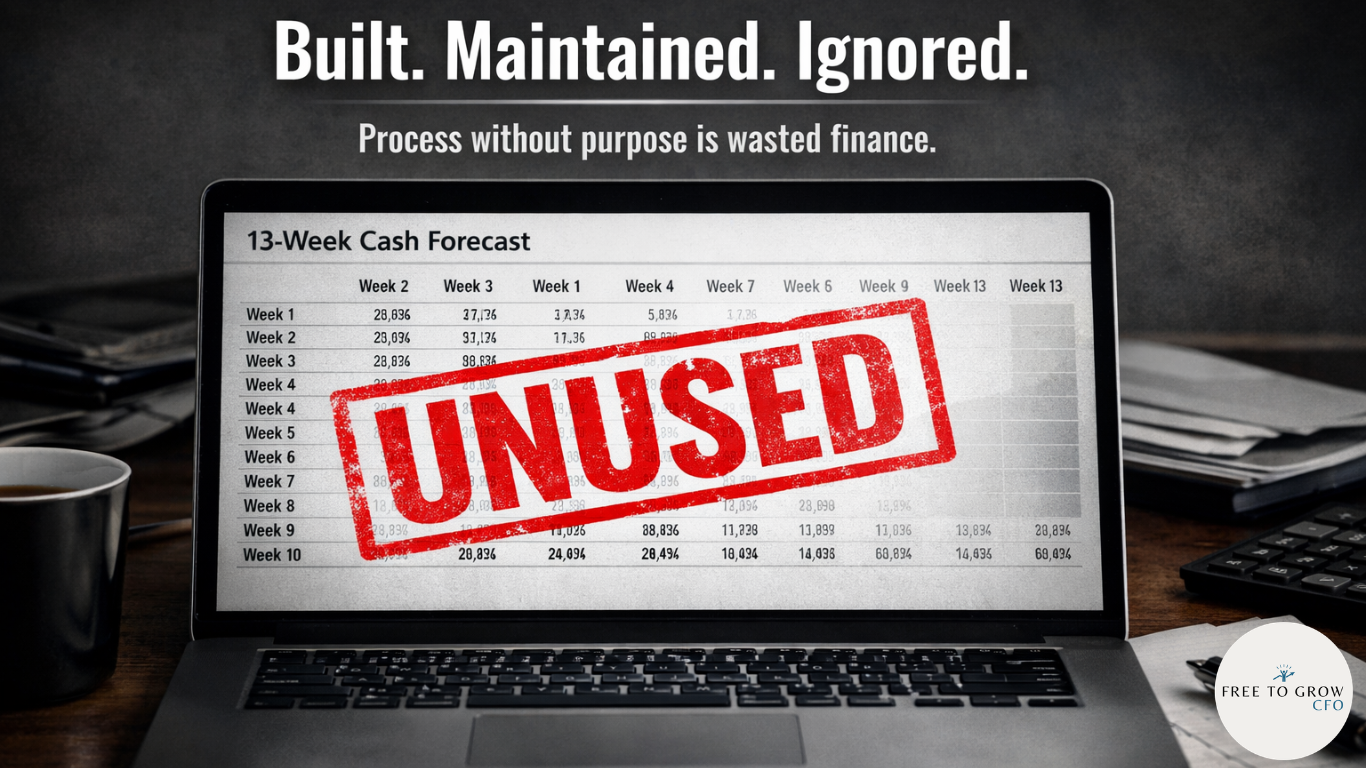
Most fractional CFOs will tell you that every DTC brand needs a 13-week cash forecast.
I disagree.
Not because cash planning isn’t important—but because blindly defaulting to a 13-week model is lazy finance. It prioritizes convention over decision-making and process over usefulness.
Some brands absolutely need a 13-week cash forecast.
Most do not.
The problem isn’t the tool.
The problem is using the tool without first asking why.
The Real Question: What Decisions Are You Trying to Make?
Cash forecasting should exist for one reason only:
To help you make better decisions.
If a forecast doesn’t actively support a decision you need to make, it’s wasted effort. And wasted effort is one of the most expensive things in a growing DTC business.
Before you build any cash forecast, you should start with two simple questions.
Question #1: Do You Actually Need Weekly Cash Visibility?
Most brands default to weekly cash forecasting without stopping to ask whether weekly visibility is even necessary.
In practice, monthly visibility is often more than enough for the decisions founders are currently making.
At Free to Grow CFO, we don’t start with weekly cash models.
We start with monthly three-statement forecasts.
Why?
Because monthly models usually tell you when cash might get tight long before it actually does.
If we see a future month where cash looks constrained—under realistic operating scenarios—that’s when weekly cash planning becomes useful. Weekly forecasting is a diagnostic tool, not a default operating system.
Think of it this way:
Monthly forecasting tells you if there’s a potential problem.
Weekly forecasting tells you how that problem might show up.
If your monthly model shows plenty of runway, weekly cash planning often adds complexity without adding clarity.
Question #2: What Time Horizon Is Actually Useful?
This is where the 13-week rule really falls apart.
Why 13 weeks?
Because it’s one fiscal quarter?
Because someone decided it sounded official?
Because “that’s what everyone does”?
None of those are good reasons.
The right time horizon is not determined by tradition—it’s determined by decision timing.
When I was running finance at Guardian Bikes, we had a 13-week cash model. And here’s the truth:
I rarely used anything beyond week six.
Occasionally week eight.
Never week thirteen.
Which raises an obvious question:
Why spend hours maintaining forecasts that never influence decisions?
A Practical Example: Weekly AP Decisions
Let’s say the main reason you want weekly cash visibility is to approve accounts payable.
In that case, how far out do you really need to see?
In most DTC businesses:
2–4 weeks of weekly visibility is sufficient
2–6 weeks at most
Beyond that, AP schedules change too frequently to be reliable or useful. Purchase timing shifts. Vendors get renegotiated. Inventory plans evolve. Forecasted numbers stop being decision-grade data.
Accuracy drops. Confidence drops. Value drops.
So again—why force 13 weeks?
When a Longer Horizon Does Make Sense
This isn’t an argument against cash planning. It’s an argument for intentional cash planning.
There are situations where looking further ahead is appropriate:
Seasonal businesses preparing for large inventory ramps
Brands approaching debt covenants or liquidity events
Companies actively navigating a short-term cash constraint
In those cases, extending the horizon can surface risks early enough to act.
But even then, the horizon should be chosen deliberately, not automatically.
The Core Principle: Forecasts Should Serve Decisions
Here’s the philosophy we use at Free to Grow CFO:
Build forecasts specifically to support the decisions directly in front of you.
No more. No less.
Anything beyond that is wasted time.
And time—especially founder time—is not something DTC brands can afford to waste right now.
Instead of asking: “Should we have a 13-week cash forecast?”
Ask:
Do we actually need weekly cash visibility, or is monthly enough right now?
How far into the future do we need to see to make quality decisions?
Answer those two questions honestly.
Build only what supports those answers.
And don’t add complexity until your decision requirements change.
That’s not anti-finance.
That’s good finance.
Until next time, scale on!