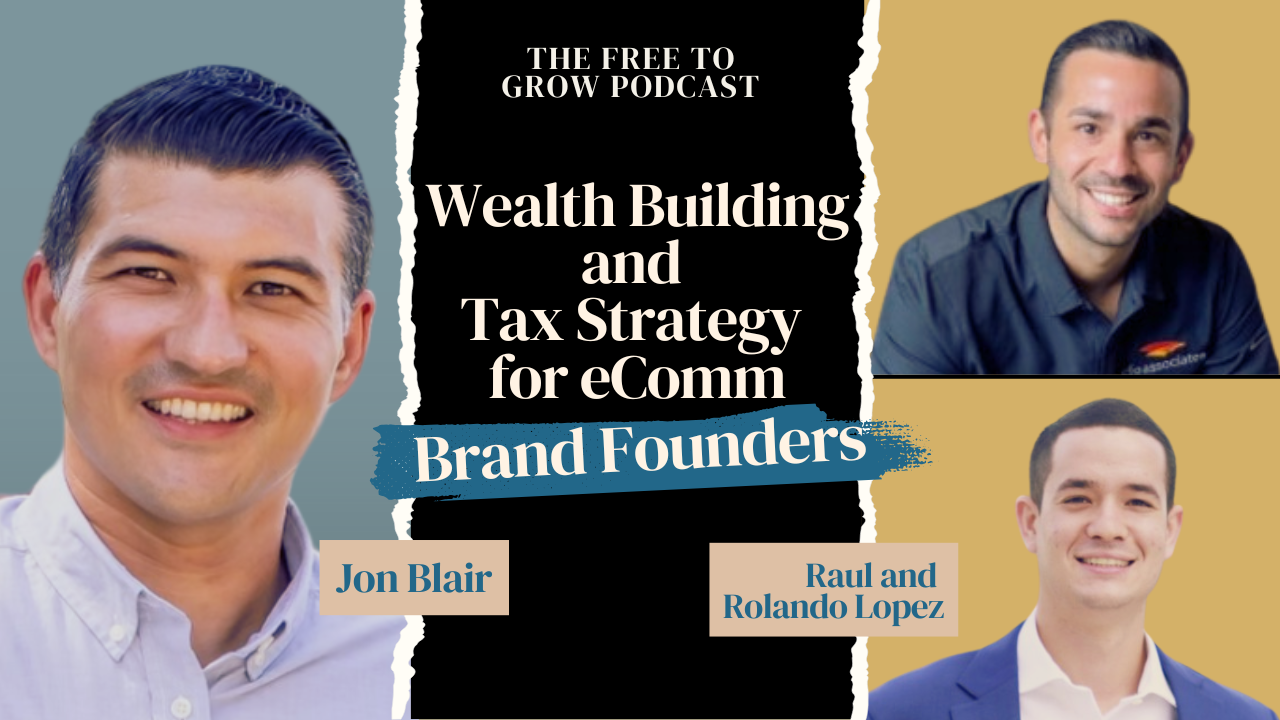
Podcast: Wealth Building and Tax Strategy for eComm Brand Founders
Episode Summary
In this episode of the Free to Grow CFO podcast, host Jon Blair speaks with Rolando and Raul Lopez of CFO Associates about the intersection of tax strategy and wealth building for e-commerce brand founders. They discuss the importance of proactive tax planning, the benefits of real estate investment, and the nuances of various retirement accounts. The conversation also covers entity structuring and key tax strategies that can help DTC brands maximize their profits and minimize their tax liabilities.
Key Takeaways
Real estate can be a powerful tool for building wealth and reducing tax liabilities.
Qualified real estate professionals can offset active income with losses from real estate.
Proactive tax planning is essential for maximizing wealth.
Episode Links
Jon Blair - https://www.linkedin.com/in/jonathon-albert-blair/
Rolando Lopez- https://www.linkedin.com/in/rolandolopezcpa
Raul Lopez - https://www.linkedin.com/in/raul-lopez-764026a5/
Free to Grow CFO - https://www.freetogrowcfo.com/
Meet Raul Lopez
Raul Lopez is the Chief Financial Officer of his firm, where he oversees daily operations, client onboarding, compliance, financial management, HR, and employee development. With nearly a decade of experience in accounting, finance, and client advisory, Raul brings a deep understanding of both business operations and long-term wealth strategies.
In addition to his role as CFO, Raul is a licensed Florida real estate broker and has held his license since 2016. He is the Founder and Principal Broker of LPZ Realty, a brokerage firm dedicated to helping clients buy, sell, and invest in real estate using tax-advantaged strategies to grow and preserve wealth.
Meet Rolando Lopez
Rolando Lopez Founded CFO Associates 11 years ago to provide client accounting, tax and financial planning to Private Equity Firms, Closely Held Corporations, and Family Offices in the Real Estate, Hospitality, eCommerce, Technology and Healthcare industries. Helping them plan their future goals, exits, and how they will get there. By outsourcing accounting and back-office to clients his firm is able to improve financial reporting, receive better tax planning, and consolidate all of their financial questions and needs to one source and point of contact through their assets' lifecycle.
Rolando is a licensed CPA with advanced expertise in US GAAP, tax planning, transaction diligence, auditing, real estate accounting, and inventory accounting. I have worked with companies of various sizes including Fortune 500 Enterprises, but have found that my true passion is working with small and medium size investment organizations where in many instances the financial infrastructure can be strengthened to save and preserve owners and investor money.
Transcript
~~~
00:00 Introduction to CFO Associates and Their Mission
04:19 Wealth Building and Tax Strategy for E-commerce
12:50 Understanding Depreciation and Its Tax Advantages
19:33 Retirement Accounts and Their Benefits
26:25 Entity Structure Strategy: S-Corp vs. Sole Proprietor
30:21 Understanding Tax Strategies for LLCs
34:47 Entity Structuring and Its Importance
35:23 Maximizing Tax Benefits for E-commerce Brands
39:54 Navigating Cash vs. Accrual Accounting
40:12 The Dynamics of Family Business Partnerships
Jon Blair (00:00)
Hey everyone, welcome back to another episode of the Free to Grow CFO podcast where we dive deep into conversations about scaling a profitable DTC brand. I'm your host, Jon Blair, founder of Free to Grow CFO. We're the go-to outsourced finance and accounting firm for eight and nine figure DTC brands. And today I'm super stoked to have a duo on the show. I think you guys are actually only the second ever duo. Rolando and Raul Lopez, welcome to the show guys, what's happening?
Rolando Lopez, CPA (00:28)
Thank you, Jon. Thank you. Appreciate you having us.
Raul Lopez (00:28)
Thank Thank you for having us on.
Jon Blair (00:30)
Yeah man, okay so, brothers, right? And running CFO Associates. Who wants to jump in and just briefly introduce CFO Associates? What do you guys do?
Rolando Lopez, CPA (00:40)
Yeah, so we're a CFO and tax advisory firm. We have two offices, one in Tampa, Florida, one in Puerto Rico. We also know a program down there called Act 60, which is a big tax strategy for people. So, you know, me and Raul, as you mentioned, we're brothers. We were actually born in Havana, Cuba. So, you know, in hindsight, it's a privilege to be a CPA and run a CPA firm with my brother, ⁓ being in this country.
So we do have that perspective as accountants that we really do enjoy entrepreneurship overall. And Raul is also big in real estate as well.
Jon Blair (01:13)
Yeah, yeah, so Raul, you do a little bit on the broker side of real estate,
Raul Lopez (01:17)
Yeah, yeah.
So as Rolando mentioned, we help a lot of clients on the tax planning side, obviously on the control ship and accounting side as well. But I have my broker broker's license in Florida. And to be honest, we love helping clients. It's easy to digest the P &L and see, hey, you're renting here. Let's make sure we can get you into a building that you own and you can pay yourself rent. So we definitely like to see that and analyze that with all of our clients.
Thanks.
Jon Blair (01:46)
Yeah, so, okay, so elephant in the room, people are probably going like, wait a second, you're bringing other fractional CFOs onto the show, right? And like, so let me explain how we know each other and why this is actually gonna be a really great conversation. So we actually originally met through a mutual client in which CFO Associates was providing bookkeeping and tax advisory. And we provide ⁓ to this particular client CFO services.
Rolando Lopez, CPA (01:55)
Yeah.
Jon Blair (02:11)
⁓ obviously as you guys know, with our focus on DTC we go really deep into specific areas around like marketing and ad spend and some other things. But what we found, what I found is, ⁓ I get asked constantly actually probably more than any other, like, I think I get asked most frequently for one recommendations to ad agencies because of our focus in DTC and then two tax advisory. Right. And I, but I always get asked specifically.
about like a tax advisory firm or a firm that does tax advisory that understands e-comm, right? And I've searched high and low and had a lot of challenges with finding said firm, met Raul and Rolando, and we've kind of found this really great, you know, ⁓ ability to partner on getting people referred over to a tax firm.
CFO Associates, I know you guys do other things, like in part tax advisory, and they have an e-comm practice, right? So they work with lot of e-comm brand founders, which is super key. But then we kind of bonded on this second thing, like Raul was mentioning real estate investing. Something we've talked about on the podcast before is using your business to build wealth without putting all your kind of, putting all of your wealth in a potential exit.
Right, so what we're gonna talk about today is wealth building and tax strategy for e-comm brand founders. More specifically, the connection between tax strategy and wealth building strategy. Why is this important? Because the less you pay in taxes, the more money you can invest in building wealth faster. So before we dive in to this, can you guys just give a brief background on like,
Rolando Lopez, CPA (03:39)
Absolutely.
Jon Blair (03:54)
what your kind of perspective or passion is around wealth building plus tax advisory.
Rolando Lopez, CPA (04:00)
Absolutely, absolutely. know, part of wealth building tax planning has to be involved, right? And especially once you have a cash flowing business, the most important part is how do you keep the most in your pocket or reinvest it back in the business? The way that we look at a client is based on their assets in their specific business. In this case, you know, DTC clients that we're talking about today. What are the tax code and areas that you're able to leverage now out there in social media? You see a lot of people, you know, buy this, buy that.
Ultimately, what's really important is what are the assets and what are the low hanging fruit for that specific client that we're looking at. And what we like to do is, you know, on a quarterly basis is, you know, show them, Hey, year to date an example, Jon, when we work with you, right? We get your P&Ls from you guys. We say, year to date, you're here. This is how much you owe if you do nothing. However, there's these four or five things that are available to you based on the assets, based on the things that we've discussed and the goals that you have. And so that's how we kind of really customize the tax planning.
for that specific client because, you know, I tell people this, a lot of times when somebody comes for tax planning, it's not that their CPAs aren't bad, they're just not approaching it in this manner. And they're only touching base with them once, maybe twice a year when they reach out to them. We in our planning engagements, we schedule out four to five calls throughout the year. Whether, you know, we pull you into that, we pull the numbers, we calculate it for you and put it in front of you so you're aware. And that's ultimately what even leads to being able to strategize, right? Because without that,
Jon Blair (05:05)
Mm-hmm.
Totally.
Rolando Lopez, CPA (05:24)
then it's kind of, it makes it very difficult, you know, in hindsight when everybody comes at tax file.
Jon Blair (05:29)
Totally. It's
already done. You're like, man, I wish I knew the tax year is already over. And you're like, if we had talked earlier, right, what we could have done, right? And like, so being proactive is super key. I want to ask Raul, and then maybe I'll ask the same question to Rolando afterwards, but Raul, okay, this is like editorial, your opinion. We're talking about tax efficient investing strategies for e-comm brand founders to build wealth. Real estate, stocks, or something else if you had to choose one.
Rolando Lopez, CPA (05:34)
Exactly, exactly.
Raul Lopez (05:35)
Correct, yes.
Yeah, without a doubt, I'm gonna say real estate a little biased,
We've seen multiple of our clients build wealth this way. But also, you know, for DTC companies in general, if it's possible for you to buy a real estate building in the United States, as everyone I've seen this year, there's been a lot of variabilities from tariffs, you know, even cutting lead time. Right. If you have your own building in in the United States, you don't have to prepay for three to six months. You can keep that cash flow for ad spend or whatever you need.
while you're paying yourself rent as well, right? You're already paying rent to someone else if you have a brick and mortar, but if you can pay yourself rent while then creating that wealth and also being able to use depreciation, which is a non-cash expense, to lower your tax bill is definitely the number one way to go, in my opinion, specifically.
Rolando Lopez, CPA (06:47)
And Jon, because we have access to our clients' P&Ls, like this is a good example of where Raul, you know, a good case study, where he identified a PNL like that, and Raul, I'll let you explain it, you know, how that client ended up.
Raul Lopez (06:57)
Yeah,
yeah, absolutely. They were paying rent for literally 10 years. They've been paying rent to somebody else and I came to them and was like, hey, you guys are paying literally $14,000. You can buy yourself a million dollar building, pay less in rent and less of an expense to your business while also building wealth by owning an asset that's most likely gonna appreciate long term. So that's definitely a great case study that we saw.
Jon Blair (07:19)
sure.
Well, okay, so I wanna highlight something. hear a lot of, I have a lot of brands who've come to me over the years and been like, hey, should I go spend my money on this to lower my taxes? But I wanna bring up a key distinction that you made in your example, right? Which is, were you gonna spend money on that already? Or are you just looking for something random to spend money on, lower your taxes? Those are different things. And unfortunately, there are a lot of tax advisors out there
Rolando Lopez, CPA (07:44)
Exactly, exactly.
Jon Blair (07:51)
who are like, tell people to go buy things that aren't necessarily good investments. And they're like, it'll lower your taxes. where, in my opinion, generally speaking, where it's really advantageous is if you were gonna spend that money anyways, but you can structure it in a way that one, builds wealth, two, is tax advantage potentially in another way. And that's a perfect example, swapping out a lease expense for a mortgage payment, right? And amongst other things,
like appreciation plus the mortgage pay down, right? You're building equity, whereas you're never building any equity in a lease payment, right?
Rolando Lopez, CPA (08:24)
top of that.
Raul Lopez (08:27)
And you have exactly, you have other options too, right? You can leverage that building. If you need to take cash out, refile, you don't get tax on refinances, right? If you need to take that cash and put it into somewhere else, or if you are gonna sell your business long-term, you could always keep the building and always collect rental income on a business that you know is cash flowing and is gonna be able to pay you rent, right?
Rolando Lopez, CPA (08:41)
Exactly.
Jon Blair (08:42)
Totally.
Oh, so I know a
guy, check this out. This is like, he's a family friend. He's kind of bad ass. He ran this, he ran this, uh, roofing supply distributorship for a long time, for like 12, 13 years. And he opened up locations all around the country. He didn't, don't think he necessarily owned the real estate and all those, but he did own the yards where they were like bringing in all the materials and then distribute them. He sold the business for hundreds of millions of dollars.
But he did not sell the real estate and actually the, the acquirer rents it back from him still to this day. And so that's, I mean, as a, Yeah.
Rolando Lopez, CPA (09:15)
real estate. It's still getting checked.
That is the best position to be in. Yep, yep. And it's mailbox
Raul Lopez (09:20)
Yep.
Rolando Lopez, CPA (09:25)
money after your cash out, right? It's the best.
Jon Blair (09:27)
Exactly. Exactly. Well, okay. So
there's another thing I want to double click into that you just mentioned about the, ⁓ the ability to leverage, but change the leverage on the asset, the real estate asset over time. Cause this is, I think a big thing people missed. That's a distinguishing factor between, ⁓ investing in say index funds in the stock market and investing in real estate. This doesn't make one better than the other, but there's a key lever you don't have.
in investing in the stock market, right? Which is like, and this is kind of the game I'm playing with my personal real estate portfolios. Like I'm buying rental properties that even though interest rates are high, they've been in like the sevens, right? I'm finding deals that still generate some cashflow, right? But at some point when real estate, when I can refi those at maybe five and a half percent, I can pull out a good chunk of change actually. Those will still cashflow. Well, I can do one of two things.
I can either refi and just crank up the monthly cash flow, right? Which may get me closer to retiring. Or if I'm still in acquisition mode, right? Or I have other places where I could put that capital if I do a cash out refi, I can get that money out, like you said, tax free, right? That ability to adjust your leverage over time is a massive, wealth building tool that you don't have with stocks.
Rolando Lopez, CPA (10:51)
Exactly. Exactly. Well, and look, in the example that Raul gave to Jon, this person had been paying rent to your point. It was in their P &L. And I say this to people, the easiest way to be a vertical business, if you're paying rent, go buy the real estate you're paying rent in. You're effectively, you know, making the real estate part of that. And on the end, you have that leverage to say, hey, here's a triple net lease with the building and then sell the business. And now you're just collecting the rent like your buddy was doing. And we see that as well on our end. And it's a great strategy. And that's why it's...
Jon Blair (10:56)
Totally.
Totally.
Rolando Lopez, CPA (11:19)
If you're going to make an investment and leap into real estate, at least you should do it in a property that you can control, that you're operating and you're running your business out of. You understand it. And that derisks it a lot too, right, Jon? Because a lot of people, that is the fear, the fear of a lot of money up front for real estate. Well, then buy your own building. You're paying rent to somebody else. And so that's how we look at that.
Jon Blair (11:24)
Totally.
Totally, totally. I wanna ask
you, I wanna ask you a little bit more about depreciation, right? Cause that was another thing. That's another key. we talk, when I think about the tax efficiency, right? Of real estate, depreciation is definitely a key part of that. Can you just really quickly run through high level how that works and why it's tax advantageous? And then I do wanna go after that a little bit deeper into cost seg.
studies and you know accelerated depreciation but how does that work and why is it why is it tax advantaged?
Rolando Lopez, CPA (12:07)
So I'll talk in the context of commercial because that's what DTC would probably owner would buy, right? So commercial real estate is depreciated over 39 years. Now that means if you buy a building for a million, you don't expense a million this year. You take it and less the land. You got to allocate some to land. You divide it by 39 years. Now currently with the new updates to the tax code, you now have a hundred percent bonus depreciation, depreciation back all the way to 2029. So instead of depreciating over 39 years, you can do what you were mentioning. Jon's called us cost segregation.
which takes that same building and breaks them down to smaller asset components that accelerates the depreciation forward. Now all of this is a paper expense, right? You're not outlaying any more cash or any less cash. It's all a paper expense. And the beauty about real estate is even if you leverage to buy the property, meaning taking out debt, you still get the same amount of depreciation, right? And that's where the beauty of what I like to call phantom income,
⁓ occurs because in a scenario that Raul was explaining that person is now that client of ours now paying rent to her herself and her and her husband's building and then now that depreciation is offsetting that income, right? So rather than now, you know paying it to somebody else they're creating wealth and saving taxes at the same time.
Raul Lopez (13:17)
Right,
but also, you know, what Rolando is saying is, in layman's terms, right, let's say you make $100,000 in your bank account, you have $100,000 from your rental property. On your taxes though, you get to depreciate, for example, to make it easy, on this example, really, let's say your depreciation for that year is $100,000. Well, on your tax return, you netted $100,000, you have $100,000 in your bank account, but on your tax return, you're actually gonna show zero, no income that year.
Jon Blair (13:43)
zero.
Rolando Lopez, CPA (13:44)
That's
Raul Lopez (13:45)
⁓ That's the
Rolando Lopez, CPA (13:45)
the Fanta Income, right?
Jon Blair (13:45)
Well, yeah. And so, well, and what you're talking about with leverage, I'll explain this another way is let's say you're buying a million dollar building, but you only put 10 % down. So you, you outlaid a 100 K. You actually are going to be able to depreciate. Well, you got to back out land, but more than a 100 K the full value, right? Even though you use someone else's money to purchase it. And the beauty that, well, let's, let's actually, I want to ask you Raul about
Raul Lopez (13:46)
infantum income Rolando was talking about.
Jon Blair (14:12)
Let's say someone is an ecom brand founder, they're scaling, they're taking cash out in the form of distributions and they're buying rental real estate. Walk me through the example of how depreciation works with residential real estate if you're doing buy and hold and maybe there's positive cash flow, but tax, from a tax perspective, it's even better because of depreciation.
Raul Lopez (14:37)
and
what I guess to under for depreciation, you have to understand that it can only be offset other passive income as well. Right. Like you can't have a W2 job and then have that offset. So let's say you have five properties and one of them happens to be your DTC, you know, company's property. Well, if you're cash flowing a bunch in one property, you can depreciate. can do ⁓ bonus appreciation on a different property and you can offset. Basically, it all goes into one bucket. Right. Is what I'm getting at. So you can offset your other losses with your other rentals.
income with different properties that you may or may not have. But that's a key concept that people need to understand as well. You need to make sure that when you're doing this appreciation, it's only offsetting your passive income and not your active income on day-to-day operations for other businesses.
Rolando Lopez, CPA (15:21)
Unless you're a real estate professional,
Jon Blair (15:22)
What?
Rolando Lopez, CPA (15:23)
which is one strategy.
Jon Blair (15:23)
That's what I was gonna ask you about next. That's how I was gonna, so let's talk about that next. So actually Raul's got a sweet set up being, I mean, I don't know how your personal tax situation is, but I do know people who run a given business, but they're also a real estate professional and they're able to meet the qualifications to be what the IRS considers a qualified real estate professional. What does that do?
Raul Lopez (15:32)
you
Right, right, which is 750.
So that allows you that completely.
Ignore exactly what I said just two seconds ago, and it completely eliminates that because then, since you are real estate professional, any sort of real estate activity is now considered active, and it falls into now the same bucket. Same thing with short-term rentals, right? If you have an Airbnb and you rent it out on average of seven days or less, that's considered active income, and you can use that appreciation against your regular income as well.
Jon Blair (16:11)
So, to, to, this is not a strategy for that's for everybody, right? Because there are certain qualifications. What are the, what are the, the general criteria that must be met to be able to, to be considered a qualified real estate professional?
Raul Lopez (16:25)
You have to spend 750 hours in real estate and also more than 50 % of your time also has to be allocated to real estate activities throughout the year. So those are the two main points that you need to make sure that you follow with your CPA and make sure that you're tracking this on an annual basis. those two are the main points that make you a real estate professional in that year. Luckily, I'm a ⁓ broker, so I do spend that time throughout the year ⁓ on my personal
taxes per se.
Rolando Lopez, CPA (16:54)
Yeah,
and also one thing I want to clarify and I'm glad Raul said that just because your broker doesn't automatically make you and vice versa just because you're not a broker doesn't mean you're not also either, right? So those qualifications are really for everybody as long as they're spending it in a real estate trader business throughout the year. Unfortunately, a lot of business owners to your point, Jon, have a hard time kind of splitting away from their day to day business. So it makes it difficult. Raul does have that plus. It's funny as brothers.
Jon Blair (17:01)
Yeah.
Rolando Lopez, CPA (17:20)
Well, you we invest together even in our own building in the office and we did a cost seg on it. Raul gets a lot sweeter deal than I do ⁓ on our tax returns. He has a way lower effective rate than I do on our tax returns. But that's part of the power of being a real estate professional.
Jon Blair (17:27)
Yeah. Yeah.
Raul Lopez (17:33)
Another,
no, in another way, and if you're married, your spouse can be a real estate professional. And then since you married filing jointly, even if you have an active business or whatever it may be, you can still offset it because you're marrying filing jointly with your passive losses with your ordinary income.
Rolando Lopez, CPA (17:40)
Yep, exactly.
Jon Blair (17:51)
So that's my personal setup. My wife, that is what she primarily does, is run our real estate business. She doesn't have another W-2 job. And so that is our personal setup. And we're building a, we own, we close on our 10th door on Friday, so we're building a buy and hold, like long term rental, thank you. And you know, what really resonated with me and switched me from
Rolando Lopez, CPA (17:51)
Yep, and that's the workaround.
Raul Lopez (18:09)
Congrats.
Rolando Lopez, CPA (18:09)
Congrats, that's awesome.
Jon Blair (18:17)
focusing on stocks and we'll get into stocks next because I do want to ask you guys about a couple strategies there but I primarily had been following the called the Dave Ramsey plan like buy index funds mutual funds which is a great way to build wealth but it's different right on a number one you don't have the level you don't the depreciation component right to you don't have the ability to use debt
and leverage as a tool, right, which me being a finance guy, I understand debt financing at a deep level because I've raised so much for ecom brands that like, a light bulb went off when I was learning this and I was like, man, this is a, this leverage component is huge, huge wealth building tool, right? But then the other thing is the qualified real estate professional, if you can qualify for that legitimately and it can offset some of your active income, it is,
Rolando Lopez, CPA (18:54)
It is huge.
Jon Blair (19:06)
it has a huge tax impact. But here's what it comes down to. When I read Robert Kiyosaki's Rich Dad Poor Dad, which is what gets so many people investing in real estate, he talks about, find an asset class you like. And one of the reasons is, let's say it's real estate, because you want to find one that going and putting in the hours doesn't feel like work, you're just excited about being a real estate investor. And the more actively involved you are, the more likely you are to have the ability to potentially qualify to
to be a qualified real estate professional. so anyways, I've just found quite a, the other thing is too, and actually this is probably gonna segue right into us talking about investing in stocks through things like Solo 401K, SEP IRAs and whatnot. But like the other thing I realized is like, hey I know there are ways to take money early out of like these retirement accounts, but when I think about generally speaking, I gotta take that money out when I'm old and I wanna retire.
I want to retire earlier or I want the ability to retire earlier than that. And so a light bulb went off to like real estate is, it's good in my mind was an easier way to pull that early retirement off than, than, know, investing in these retirement accounts. But so let's segue to retirement accounts. I know there's things, there's solo 401ks, there's SEP IRAs. Anyways, who wants to hop in and like walk through the major, the most common kind of retirement accounts you guys are advising?
Rolando Lopez, CPA (20:02)
⁓ No.
Raul Lopez (20:02)
Yeah
Jon Blair (20:28)
e-comm brand founders on potentially using to invest in the stock market.
Rolando Lopez, CPA (20:31)
Yeah, and I could take that one. It all depends on the type of business, how many employees a person has. So that's the first thing, Jon, that I always like to ask our clients, right? Like, hey, how many employees do you have? How many would be eligible for it? And I say that because a Solo 401k, as the name already implies, it's only for a solopreneur or their spouse. So if it's just the husband and spouse, then that's good, or vice versa. So Solo 401k and same with the SEP IRA.
It's good when it's smaller business, one to two people. The problem with SEP IRA though is if enough employees and you have many that qualify for it, you then also have to contribute for them, right? So that can get expensive too. Now the solo 401k and SEP IRAs are the ones that have the best and highest amount that you could put into. So it is ideal when somebody has, you know, the ability to leverage those. And for the most part, those are the first two that we've pushed them into unless they otherwise can't.
from a compliance reason, right? So they have employees, because you can't discriminate and these other, you know, financial plan issues that pop up. But once you have employees, then really a Safe Harbor 401k is, you know, good for the company. Now, one thing that I explain to people is even if you have a Safe Harbor 401k for the employees and yourself, you still have that 70 grand a year that you can still do through other vehicles, right? So you can still do it through an IRA. You could even do still a SEP IRA if you have self-employment income.
⁓ Right? Because at that point you're not discriminating and only giving to yourself. You've already taken care of your employees through the 401k, the safe harbor. So those are the ones that we typically see the most. Another area that I actually really like to go, Jon, outside of retirement account is SSA accounts. Right? So that's pre-tax money that if you end up not having to utilize it for, it can convert into sort of a retirement account and grow as well. Right? So those are the first.
really vehicles that we see. There is additional more advanced strategies like a defined benefit plan. Typically, know, high earning individuals will use that. But at the same time, that also is very similar to the other plans where you have to contribute for all the employees. So that one is the one that has the most, that's like almost $275,000 a year you can put into it.
Jon Blair (22:33)
Got it.
Rolando Lopez, CPA (22:40)
but it can get expensive as well if it doesn't make sense. So typically it's the Solo 401k, the Sep IRA and the Safe Harbors that most of our clients stick to overall.
Jon Blair (22:50)
And is it, I know how the solo 401k works and the SEP IRA, but are all those that you went through, whatever you contribute in the current year is deductible in the current year, and then you pay taxes when you take it out later on at whatever tax rate you're at at that time, is that how those all work?
Rolando Lopez, CPA (23:06)
Correct.
Correct. They're all pre-tax, right? So all of those vehicles reduce your taxes now until you take it out in the future. Now the beauty of it, Jon, is you can actually pay it all the way to the extension time where you're filing. So really, you could pay for a solo 401k, assuming you made the calculation, for 2024 as of today, right? Deadline's not here yet for that. So you have until the next year to even contribute to some of these. So those are the few, I would say, tax strategies that are available after a year.
Jon Blair (23:17)
yeah.
Rolando Lopez, CPA (23:32)
⁓ in reality because you get a little bit more time to contribute the money.
Jon Blair (23:36)
I didn't realize you could go all the way to the extension. I thought that you could go... Got it. Okay, for the employer person only.
Rolando Lopez, CPA (23:41)
For the employer portion, for the employer portion, not the employee
portion, because the employee portion goes in your W-2 that has to stay within that year. But the employer portions and the profit sharing portions, you have all the way up to personal deadline extensions, actually.
Jon Blair (23:48)
Got it. Makes sense.
Okay, I love that, I love that. That's a good tidbit. Where does cash balance plan fit into all this? I've heard about that before from someone.
Rolando Lopez, CPA (24:03)
So back in the day, know, pension plans, that's what like a lot of corporations used to have. A defined benefit plan is effectively that same kind of system. It's a little mini pension plan for your company. Now it allows, you know, high earning physicians, lawyers, or DTC business owners, they can put a big chunk up to, you know, 200,000 plus into it. As long as you have a high W-2.
Jon Blair (24:10)
Okay.
Rolando Lopez, CPA (24:24)
But the problem with that program is that you also have to contribute it for a certain amount of years and you have to commit to it because it is a pension plan. And if you break it, if you break it, then the IRS taxes you on all the money that you you contributed to it. So that's the risk and you have to make sure that somebody has very good cash flow because if you commit to it, you got to see it to the end. Exactly, exactly.
Jon Blair (24:31)
Got it.
Got it. You gotta finish it. Got it.
Okay, so Raul, I've got a question for you, because you mentioned this before I hit record. Entity structure strategy. And I want to ask a very specific question, because I get asked this more frequently than anything else. we have a lot of brands that we work with that are like closely held, owned by just one founder or maybe a founder, maybe two founders, but it's not uncommon to have like a single member LLC that we work with, right, in terms of the ownership structure.
And I'm finding a lot of brands who don't realize they don't know the difference between being taxed as a sole proprietor, right? And being or taking the S Corp election and deciding to be taxed as an S Corp. Can you walk through this scenario and like what the major considerations and advantages or disadvantages are?
Raul Lopez (25:34)
Yeah, so, you know
An S-Corp is an LLC. It's just what the IRS is taxed as an S-Corporation, right? So an LLC could be a partnership, a sole proprietor, or an S-Corp, right? So what an S-Corp does is... Let me backtrack. Everyone in the United States needs to pay Social Security and Medicare, right? Whether it's on your W-2 or at year end on your tax return, you will pay Social Security and Medicare. That's just how the system works. So what an S-Corp does is basically you're gonna pay yourself a reasonable salary per the IRS.
a reasonable salary based on your income or sales that year. On that income, you will pay Social Security and Medicare. So you actually have to go to a payroll software or go manually and do it, which I don't recommend, but you get a payroll software and actually pay yourself payroll with payroll taxes taken out that you're paying the IRS. A lot of people get that confused when they come to us. It's like, I'll just send, I'll just wire money to my personal. It's like, no, you gotta actually pay the IRS the taxes, right? So on that small portion, you're paying Social Security.
Jon Blair (26:17)
Yeah.
Yeah.
Raul Lopez (26:33)
Medicare, which then shields you from paying Social Security and Medicare on all of the income you made that year, right? And obviously it's exactly a self-employment tax, which is Medicare and Social Security. if you, that's, you know, that's what everyone talks about, self-employment tax, but really it's the Social Security and Medicare. Now that is 7.65 % Social Security plus the Medicare.
Jon Blair (26:39)
which shows up as what self-employment tax, right? Is that what they call it? It's a self-employment
Raul Lopez (26:56)
on the employee portion, but the employer has to match that. So when you're your own owner, you're a boss and you're running your business, you have to pay that at end of the year. So you got to make sure that, you know, that combined. So when you multiply 7.65 % times two is 15.3%. So what people don't understand is that if you don't structure yourself this way, you're literally paying 15.3 % plus whatever income tax bracket you fall in that year on an annual basis. You're just going to eat that.
every year if you're not structured right as an S corporation.
Jon Blair (27:29)
Well, and
I don't want to get into the nuances of phase outs because I know that I'll confuse people, but like, but just as a simple example, right, that like if you are an LLC taxed as a sole proprietor, right, you don't take the S-corp election. Let's say your LLC makes $250,000 of effectively that flows through to your personal tax return. We'll move, we'll like put phase outs aside. You're effectively paying, you know, 15.3 % on that.
Raul Lopez (27:34)
Yeah.
Jon Blair (27:58)
250 K. If you, if you said took the S corp election and you deemed that a reasonable salary for your position is a hundred thousand dollars a year and you pay that on payroll, you pay the 15.3 % on the a hundred thousand, but you're not paying it on the other one And so it actually, if you do the math, even though which portion of it phases out at, um, is it the social security phase that, but, but that phases out at what, what's the amount for this year?
Rolando Lopez, CPA (28:18)
Social Security does. Social Security, Yeah. 160,
Raul Lopez (28:19)
Social Security, which is the bigger part of it actually. It changes
every year. It changes every year.
Rolando Lopez, CPA (28:25)
it's, mean, but it's around 160. Yeah, but yeah, it's indexed for inflation.
Jon Blair (28:28)
Yeah, so that phases out, but the 2 % and change for Medicare goes on for-
Rolando Lopez, CPA (28:33)
The Medicare everybody
Raul Lopez (28:33)
Yep.
Rolando Lopez, CPA (28:34)
plays, yeah,
Raul Lopez (28:34)
No matter what. Yep.
Rolando Lopez, CPA (28:35)
forever, if you're not a structure, yeah. So you'd be paying that 4%.
Jon Blair (28:36)
Yeah, so I mean, let's just say, for example,
let's say your LLC taxes the sole prior makes a million dollars, right? And like, you're gonna pay that 2. whatever percent forever, right? And so that's still, that can add up to a lot of money. And so like, it's really important to understand this. A lot of people get this wrong. And honestly, like go set up like Gusto or some easy payroll software, ADP. I mean, literally like you can set it up for 50 bucks a month.
Rolando Lopez, CPA (28:47)
on the whole thing.
Jon Blair (29:03)
and it does everything automatically, it's well, well worth it. Not to mention if you do, if you're set up, if you're able to do so, set up a solo 401k, you can do the employee portion of it through payroll as well. then, right, and so, exactly, so like, I highly recommend, this is like a little, this is a tax strategy that is like very simple to set up that I see a lot of brand founders just not consider that can.
Rolando Lopez, CPA (29:18)
Exactly, and then match.
Jon Blair (29:29)
save a ton of money.
Rolando Lopez, CPA (29:30)
Yeah, I mean, the first step of tax planning is entity structuring, Jon, right? Because to your point, if you're already set up in the wrong entity, you're just making more and more money, you're giving more and more away. And so it's important to make sure it's set up from the beginning as it should And typically, for the most S-Corp is the route for DTCs right? If you're an owner operator and you're working on S-Corp is the route, maybe because of the changes in code, perhaps,
Raul Lopez (29:31)
Absolutely.
Jon Blair (29:35)
Totally.
Totally.
Rolando Lopez, CPA (29:56)
a C Corp, if you're somebody who's building brands and exiting them, there's a new part of the code, well not a new part, it's been part of the code, but section 1202 now is really even better because if you grow a brand for, and then sell it within three years, 50 % of your gain is exempt. If you hold it for four years, 75 % is exempt. If you hold it for five years, 100 % is exempt. It is crazy, it's a new...
Jon Blair (29:59)
Totally.
crazy.
Rolando Lopez, CPA (30:19)
It's updated, the Section 1202, Qualified Small Business Stock, has been updated because it's always been around and it's been a five-year hold. However, it's been made much simpler now from a timeline of hold and also it went from a company that is 50 million can now be 75 million. So as long as you're below 75 million in assets when this exit happens, up to 10 million per shareholder of gain is exempt. Which, I mean, that's...
Jon Blair (30:44)
That's huge.
Rolando Lopez, CPA (30:45)
It's huge. It's huge, especially with people that are really, really good in the DTC space at building the brand and starting from scratch. Right. You have people like that that are just extremely good at it. And I think that's an area too, that historically hasn't been looked at much by DTC and even small business owners alike. and they would qualify as long as they're buying their own product and inventory and it's their brand, they will qualify for, for qualified small business stock. ⁓
Jon Blair (31:00)
Totally.
Raul Lopez (31:09)
Yeah, as long as there is a C-Corp from inception as well.
Rolando Lopez, CPA (31:12)
Yes,
they would have to be a C Corp from inception. So that's why, you know, the structuring of things, Jon, from day one, depending on the intent, right? Typically, if you're going to be running the company, S Corp all the way. If you tell me, hey, I'm trying to build this brand and exit in a couple of years, hey, we should consider that section 1202, right? That's why.
Jon Blair (31:27)
And use like
outside capital. I think what, let me break this down to like conceptual. What you're basically saying is when you're thinking about entity structure, you should be thinking about who's capitalizing the business. Because generally speaking, institutional money, they don't like S-corps. C-corps don't have a flow through. They don't want flow through, right? And you're probably not expecting.
Rolando Lopez, CPA (31:30)
true.
Jon Blair (31:52)
You're expecting to take capital, capitalize the business, keep most of it in the business the whole time, right? Until you exit. And so you're not talking about like, like the S-corp closely held, just extracting distributions all the time, right? That may or may not make any sense because of the double taxation. Now, so who, where are you getting capital from? How are you distributing capital or are you even distributing capital as you continue to scale? And then what's the exit plan?
Rolando Lopez, CPA (31:58)
Exactly.
Jon Blair (32:17)
And you gotta think about all those things to make the right decision for entity structuring, right? And so it's not just one dimensional, it's multi-dimensional. Okay, so I wanna ask you guys really quick here. What is, if you could choose like the top one or two tax strategies for ecom brand founders that we haven't already talked about. We've talked about real estate and retirement plans and stuff, but like what are some of the other top one or two strategies that are your go-to?
Rolando Lopez, CPA (32:20)
Absolutely.
Jon Blair (32:44)
or that you oftentimes see are available to e-comm brand founders.
Rolando Lopez, CPA (32:49)
So I would say the lowest hanging fruit, and it goes in line with what we believe as far as how you should allocate your capital, which is backing your business, is really the whole cash to accrual component under Section 471, right? So if you're below $30 million on average in revenue for the last three years, you're considered a small business taxpayer, believe it or not, even a $20 million, $30 million business. And you can take this election of Section 471 that basically allows you to expense your purchases and materials.
upfront when you buy it and actually purchase the product. So what we like to have, and we've done this with some of our clients, neutral clients, Jon, right, is take a look at Q1 of next year. And again, we're not about buying nonsense. Look at Q1 next year, prepay for your product, ⁓ prepay for marketing, prepay for insurance, right? What are things that you're going to already consume that you can now deduct in this year being cash-based as taxpayer?
and reduce your taxes, so you're just keeping more money in your pocket, right, for the same stuff you're gonna acquire here in the next few months. So that's, to me, that is the lowest hanging fruit based on the size of the DTC. Once you get past 30 million, unfortunately, that's not available, but for any brand between zero to 30 million, that's something that they should look at and consider. The other area now that we see too is R &D, you know,
For the last couple of years, R &D was kind of messed up by the prior changes, but now it's back to being able to be expense and get the credit ⁓ immediately. Up until this year with Trump's new changes, we had to then amortize the cost over five years. So ⁓ where I see it in the DTC space is if people are formulating their own brands, creating their own product, right? They have their own molds, whatever the nature of that manufacturing or production is, some of that
Jon Blair (34:12)
Mm.
Got it.
Rolando Lopez, CPA (34:34)
will qualify for R &D. So it's an area that we're also talking to our clients to really understand what they're doing, right? Because R &D is specific of there's certain things that are qualified research expenses, there's certain things that are not. But you have to talk through with a client, a business owner, to really kind of dive in. And we do that during tax planning to see if there's any available juice to squeeze out of that. And then the section 12.1.1 too.
Raul Lopez (34:55)
Yeah, that's a huge change.
That's a huge change because like Rolando said, you're, you're amortizing that. You're literally paying someone let's call it a hundred thousand dollars, but you would only be able to deduct that on your tax return. You know, a portion of that rather than, Hey, I literally just, this money went out my door. It's like the opposite of what we talk about, phantom income with real estate. It's like, you're literally, you're literally having an expense that you can't fully expense.
Jon Blair (35:09)
Mm.
Rolando Lopez, CPA (35:09)
20th.
Jon Blair (35:12)
Yeah, for sure. For sure.
Raul Lopez (35:18)
that went out the door because of that amortization. it really is a big change and definitely something that DTC brand owners should pay attention to.
Jon Blair (35:26)
I love that. And on the cash basis tax filing too, if you are not putting deferring or if you're not hanging up inventory on the balance sheet, let's just say you're carrying a million dollars of inventory, you're like, you are basically recognizing all of that. Like you're not having to defer that to the balance sheet and pay taxes on it for the period that you're holding that asset, right? Like, so I mean, that's another interesting advantage. Last question is,
Rolando Lopez, CPA (35:43)
Correct. Correct.
Jon Blair (35:54)
What we get this all the time and you and I have you we've already talked about this, you know offline but like there's this misconception out there that like if you're doing cash basis tax books you have to do cash basis books for internal management and I think I believe that it's because a lot of the small mom and pop shop CPA firms that are doing the bookkeeping and doing and they're just like a tax shop they don't they tell their clients that because they don't want to keep two sets of books they just want to keep
like cash tax books, but like is that is that allowed to keep accrual books internally and keep cash books for or I mean convert them to cash for tax return purposes?
Rolando Lopez, CPA (36:33)
So the way that the IRS looks at it is if you only keep accrual books internally, then no, it's not allowed. But if you keep cash-based books and can maintain them in concurrency with a tax return, you can. And to your point, Jon, if you want to analyze on a separate set of books or being able to do it off the same trial balance, then you can. But the IRS does want you to keep your books at least in the same method that you're filing with. So you could do it and also keep it in an accrual manner.
You can't just only keep a cruel and then file tax or cash basis, right? So that's the caveat with that overall.
Jon Blair (37:09)
For sure, yes. So we have several clients where we effectively end up keeping both because we have the ability to switch back and forth between the two, right? And so within the software that we use. I don't know how that's done in other softwares outside of QuickBooks, but like in QuickBooks, we can keep the books on a cash basis and an accrual basis simultaneously and effectively analyze them most of the time on an accrual basis. Okay, so
There's a ton more that we could talk about, we're already going over. So I gotta land the plane here. I'm gonna ask you guys a, I'm gonna ask Raul, I always like to end with a fun personal question. So Raul, here we go. What's it like running a business with your brother?
Raul Lopez (37:51)
It is it's honestly we talk about it all the time we get that question all the time too. It's I wouldn't want to be in business with someone other than a family member or my brother in this case because I
I have his full trust, he has my full trust. Yeah, of course, some days you're gonna get into it, but I'd rather get into it with someone that I fully trust with my whole heart than some random person, you know? So, being in business with my brother, it's definitely more rewarding than anything, on top of the fact that he's my older brother, so I look up to him. So, he's been my role model. Being in business with him is by far the best decision I've made, and I've been doing it since I grew college so I'm very grateful for that.
Jon Blair (38:31)
I grew up in a household where my parents ran a business together. So like I come from a family business in the household. I always loved it. Actually the only other duo I've had on the show was a husband and wife combo that ran a business together. yeah. ⁓
Rolando Lopez, CPA (38:37)
gosh, there.
Good for them, good for them. That's
Raul Lopez (38:47)
Yep.
Rolando Lopez, CPA (38:48)
even harder, I'll tell you that. I'll tell you that. That might be even harder than this.
Raul Lopez (38:50)
Yeah, it's definitely harder.
Jon Blair (38:50)
For sure, for sure. I grew up with it,
I definitely know. Rolando, where can people find more information about you guys and CFO Associates?
Rolando Lopez, CPA (39:02)
Yeah, so on our website, thecfoassociates.com, you can schedule a call with us. We are happy to do free consultations, especially for tax advisory services, to kind of just understand what people are getting. And then we explain to them our method of tax planning, which is a lot more proactive and handholding through the strategies in order to actually execute them rather than just talk about them. And so on our website, you can share our emails too Jon. ⁓
We'll be happy to schedule a call.
Jon Blair (39:29)
right now, mean, you guys have been our go-to when people ask us for tax advisory from a firm who understands e-comm and we're excited to keep growing our mutual client base with you guys. And yeah, I mean, we'll probably have to have you come on for round two, because we only got to about half the stuff I wanted to talk about. I appreciate you guys coming on, looking forward to continuing to work with you guys and collaborate. And yeah, appreciate you being here, man.
Rolando Lopez, CPA (39:45)
Yeah, happy to.
Raul Lopez (39:48)
I'd love to.
Thank you, Jon. Appreciate it,
Rolando Lopez, CPA (39:57)
Yeah, likewise, Jon. I appreciate
you taking the time and inviting us. And actually, I have a call with your team on Wednesday regarding one of our mutual clients. we'll keep helping each other out here.
Jon Blair (40:05)
Yep, looking forward to it. All right, guys.
Raul Lopez (40:07)
Thanks so much, Jon.
Rolando Lopez, CPA (40:08)
Take it easy, Jon. Have a good one.
Jon Blair (40:09)
Alright,
Don't forget, if you liked today's episode, please hit the subscribe button wherever you're listening and leave us a review. It helps us reach more people like you. Also, if you want more tips on scaling a profitable DTC brand, follow me, Jon Blair on LinkedIn. And if you're interested in learning more about how Free To Grow CFO can help your brand increase profit and cashflow as you scale, check us out at freetogrowcfo.com.