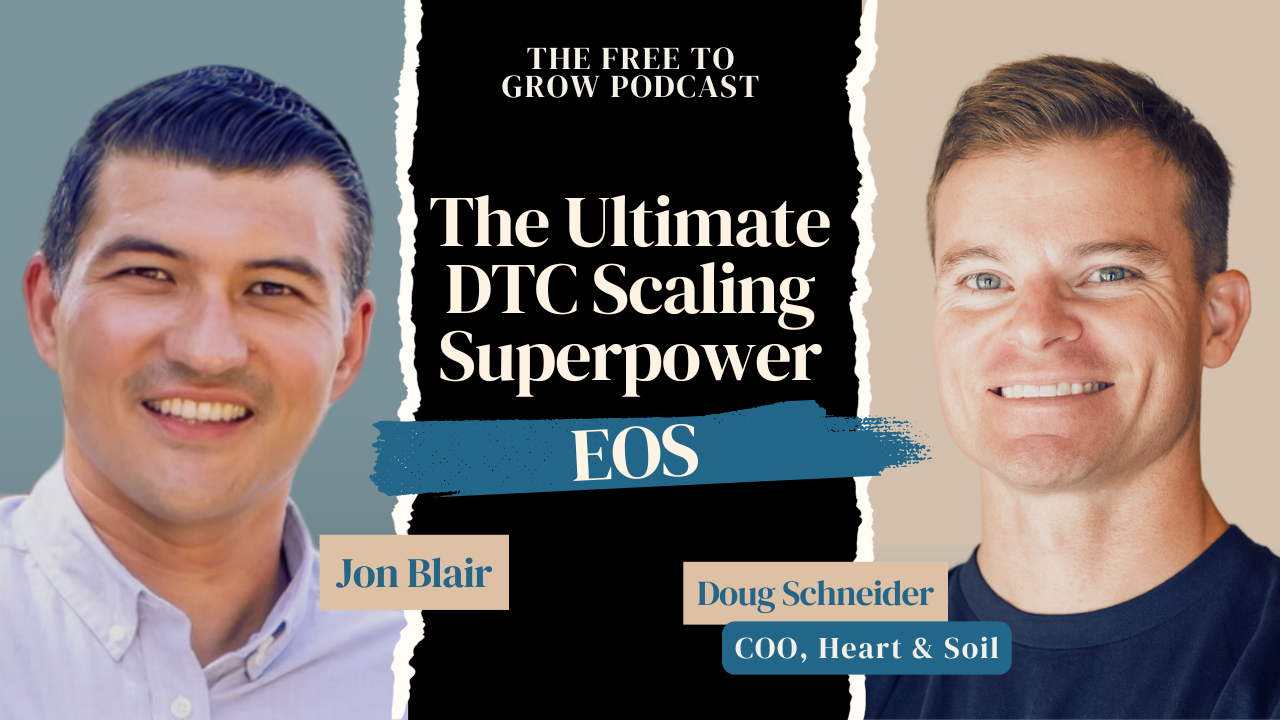
Podcast: The Ultimate DTC Scaling Superpower: EOS
Episode Summary
Hypergrowth is exciting — but it also hides broken systems.
In this episode of the Free to Grow CFO Podcast, Jon Blair sits down with Doug Schneider, COO of Heart & Soil, to unpack what it really takes to implement EOS (Entrepreneurial Operating System) inside a fast-scaling ecommerce brand.
Doug shares how Heart & Soil grew from zero to $70M in annual revenue — and why “successful chaos” eventually becomes operational debt. They break down the EOS tools that created real traction, including Level 10 meetings, scorecards, Rocks, and the IDS issue-solving process that helps companies make problems go away for good.
They also discuss the people side of EOS, why broken systems burn out good employees, and what founders should expect when implementing structure and accountability for the first time.
If you’re scaling fast and feeling the cracks, this episode is a roadmap for building an operating system that can actually support growth.
Key Takeaways
Growth without structure creates hidden operational debt
IDS is the difference between solving issues and recycling them
Meetings should drive decisions, not storytelling
EOS is a multi-year maturity process — not a quick fix
Episode Links
Jon Blair - https://www.linkedin.com/in/jonathon-albert-blair/
Doug Schneider- https://x.com/DTCDoug
Free to Grow CFO - https://freetogrowcfo.com/
Heart & Soil - https://heartandsoil.co/
Meet Doug Schneider
Doug Schneider is the COO of Heart & Soil Supplements. As a founding manager, he played a pivotal role in scaling the brand from $0 to $50M in just three years.
Transcript
~~~
00:00 Introduction to EOS and Heart and Soil
04:35 The Importance of Implementing EOS
09:06 Unlocking Potential with L10 Meetings
13:36 The Issues Component of EOS
17:55 People Management in EOS
22:23 Overcoming Implementation Challenges
26:57 Final Thoughts and Advice
Jon Blair (00:00)
Hey everyone, welcome back to another episode of the Free To Grow CFO podcast where we dive deep into conversations about scaling a profitable DTC brand. I'm your host, Jon Blair, founder of Free To Grow CFO. We are the go-to outsource finance and accounting firm for eight and nine figure DTC brands.
Jon Blair (00:17)
Alright, today I've got my buddy Doug from Heart & Soil back on the show. Doug, what's happening, man?
Doug Schneider (00:24)
Not a lot man, good to see you again.
Jon Blair (00:26)
Yeah, thanks for making the we're gonna be spending some time talking about some nerdy stuff. Some really awesome stuff. EOS.
For those you that don't know, EOS stands for Entrepreneurial Operating System. It's a framework for thinking about how to run your business. It breaks your business down into six key components, vision, data, people, process issues, and traction. And the reason I've got Doug back on is because Doug has taken on the endeavor, no small feat, of implementing EOS at Heart & Soil a rapidly growing ecom brand. And so,
is near and dear to my heart. I implemented EOS at Guardian Bikes. We run Free to Grow on EOS. I formerly was an EOS coach. So I was like, Doug, come back on the show and let's get super nerdy about what you guys are doing with EOS at Heart & Soil. So for those of you that want to hear the comprehensive background of Doug, go back many months to previous episode where he was first on. But really quick, what's the sound bite version, Doug, of who you are and what you do?
Doug Schneider (01:23)
So I'm COO of Heart & Soil and I've been here since day we've been operating for about five years now. We went, or a little over five years, and we've scaled from zero to 70 million annually in revenue in that time.
Jon Blair (01:40)
Amazing. Okay. So I, you, you said something really important, which is that you were there from day one. So like, I was also at Guardian Bikes from day one. And so was like the three of us on the founding team to eventually we're like, shoot, we got 30 people. What's the system we run this business on? Right? Cause it's no longer just the founding team calling each other on the phone or like, or just having conversations whenever we want. You got to keep all these people in the same loop.
And the business getting more and more complex. So going from the founding team that you were a part of to where you were when you decided to implement EOS, what were some of the things going on in the business where you're like, dude, we need a system.
Doug Schneider (02:19)
Well, it's like, so you basically, you're like a maturing child when you're first starting the business. And we went through, you know, for us, and I'm sure it was the same at Guardian, was like this period of hyper growth. It's like your teenage years, you're going through these growth spurts. And what's happening when you're going through this hyper growth, at least for us, was...
Jon Blair (02:24)
Yeah
Doug Schneider (02:40)
tends to create this like successful chaos where everything you're doing is working You don't really really understand why but you're accumulating like this debt kind of how I started to to look at it not a financial debt but a debt in systems and process where everything is working it's masking the fact that you haven't actually Developed those muscles to be able to really run a successful
Jon Blair (02:50)
Hahaha
Doug Schneider (03:08)
team. And what I also felt was that we had to transition from this like family vibe where everyone is in the same room and working together and kind of owning everything about the business to it needs to be an actual team and people need to have clearly defined roles and then you have clearly defined goals and KPIs and there needs to be accountability and everything needs to function together because as you grow and scale in people that becomes
more and more and more important because the drama that takes place when you don't have something that people can work within and succeed, it breaks them. And I had this quote that I got from, actually got it this weekend, it was this YouTuber guy that Dean, our CEO, showed me, guy named Ryan Deese. I thought it was really poignant for this discussion where he said that good people
Jon Blair (03:49)
for sure.
Doug Schneider (04:05)
Don't fix broken systems broken systems break good people and if it feels like you're operating in chaos and People are treading water and like they're drowning. I think a lot of people's first Instinct is to get more people into help But if you're bringing more people into a broken system You're actually going to break those people even if they're good people so it became really apparent to us about three and a half years into the business that we had to approach things differently and the different approach was implementing EOS.
Jon Blair (04:38)
So there's a lot of, there are a lot of different operating systems out there, right? Like I'm a huge nerd, so I've read about Scaling Up, there's StratOp, there's more than there needs to be. All of them have, in my opinion, overlapping similarities, and then maybe there's some tangential differences, right? That make it somewhat unique.
Doug Schneider (04:43)
Hmm.
Yep.
Yes.
Jon Blair (05:00)
for you in your exploration of like, what's the operating system that we use? Why EOS?
Doug Schneider (05:06)
Well, you're right that there is definite similarities at the core to all of these, which is, think they're getting to this core truth about human psychology in general and how we behave in groups and organizations and what is needed to actually be successful as an organization. But for me, I read this book, Traction,
Jon Blair (05:18)
Totally.
Doug Schneider (05:32)
Actually, while I getting my MBA, before I joined Heart & Soil, and... My MBA...
It was useful, but this was one of the most useful things I got out of the whole thing. was just one of my classes, they told me to read this. And I was like, man, there's some really good, practical stuff in here. I think it's just the fact that it hits at these unavoidable principles of how groups of people need to organize themselves to be successful.
Jon Blair (05:42)
For sure.
Totally, yeah, I agree with the overlapping principles being like, hey, this is just the truth. And so I've actually, the reason why I latch on to EOS, I also really love Scaling Up, but EOS is just simple and straightforward, right? Scaling Up has some complexities that I think make sense. like, and actually at the end, before I left Guardian, I had a sort of a quasi, mostly EOS, a couple things from Scaling Up.
Doug Schneider (06:15)
you
Jon Blair (06:27)
Like the daily standup was something from Scale Up and the monthly management meeting from Scaling Up. But there's actually a tight connection between the guy who started EOS and Vern Harnish who is the Scaling Up guy. They actually know each other and worked with each other in the earlier days. And the guy who started EOS was just like, I'm gonna make it basically a simpler version of this. like, yeah, I think that the way that EOS breaks down your business into six key areas, vision, people, data.
Doug Schneider (06:27)
Yep.
Jon Blair (06:53)
issues, process and traction or meetings is just super key and it's super practical, super actionable. It's not like super theoretical. It's like, no, I can just, I can go implement this in my business. So, what did, what was the most surprising? I guess, which of those modules, which of the seven modules was the biggest unlock for you at the beginning with, getting EOS implemented?
Doug Schneider (07:17)
Well, we...
So again, yeah, we were like you where it was a little bit of a hybrid, especially before we were like, we're going to really adopt things from EOS where we were creating our core values and we followed the methodology described in Traction. We had our three year vision, things like this. We adopted Rocks but when we really started to get really serious about it was when we adopted the L10 meeting structure.
Jon Blair (07:46)
Mmm.
Doug Schneider (07:47)
⁓
Jon Blair (07:47)
Yeah.
Doug Schneider (07:48)
and got a lot more serious about scorecards and accountability with scorecards and the scorecards are where the KPIs are housed and I think one thing that happens I alluded to the successful chaos that we experienced is it becomes really easy to hide and the KPIs when everything's working are maybe you know the accountability to those KPIs are maybe
ignored somewhat and we need to get a lot more serious about having it be really visible and having clarity across the whole organization to be able to have people be accountable to these numbers. And the other thing that we did that was really really important, the thing that was starting to break in our system was you started to have these different teams form up and you know have your marketing side, have your supply chain, you have for us we have research and development, we have customer experience and the way that those teams can work together with one another was becoming more more difficult ⁓ to create those arteries between the different teams to have the information and the collaboration be really smooth. And we used the L10 meeting structure and created, we actually did all of this in Asana
Jon Blair (08:50)
Mm.
Doug Schneider (09:06)
But we have L10 boards for each team our company where our leadership team can delegate different issues to be discussed by different teams. And everybody runs their L10 meetings the same way every week.
Jon Blair (09:19)
Yeah, okay, so me having implemented at Guardian and helped several other businesses implement EOS, it's interesting to see which module gets unlocks for the business in different seasons. And I'll say, to start,
Doug Schneider (09:32)
Yep.
Jon Blair (09:35)
that doesn't already have a clearly defined vision, which like, Heart & Soil has a pretty strong guiding principles before EOS. I'm sure you guys were able to sharpen those as you followed the template for building out your vision. But you guys, some brands haven't even really thought through any of that before, right? So that's usually where I see the first unlock when a brand doesn't have things like very clearly defined core values or reason for existing or clear vision on where they wanna be three, five, 10 years from now.
But the next place where I see the most, biggest unlock is the level 10 meetings, just like you're saying. And I think the thing about the level 10 meetings, for those of you that don't know, a level 10 meeting has a very specific structure. And it's a structure where at different teams, you do it at the executive leadership level and then at the functional team level. What you do is you share good news, you...
review your scorecard, which are the KPIs mutually agreed upon by the team. And each KPI has one owner, right? And there's a bar where you set it like on track or off track. So you review that, then you review headlines of how things are going with the team and going with customers. And then you, this is key, you review the to-do list you agreed to the previous week. That's accountability. This person said they were gonna get this done by this week. Is it done or not?
And then you dive into what's called the issues list. And I want to, I want to camp on issues in a second after this, but the issues list is a place where people on that team have parked issues on this list that the team prioritizes. This is the key. So many meetings get destroyed because you bounce around agenda items. Instead with an L10 meeting, you may have 30 issues on the issues list, but the team agrees these three are top priority and you work through those three first. Sometimes you don't get them all done.
If you do, then you choose the next three together. And so you're knocking out highest priorities. And then the last thing you do is recap and any to-dos that were assigned, you clearly recap. And again, those get reviewed at the beginning of the next call. sorry, the one thing I missed, which is important for issues is you do a quick rock review. Rocks are your quarterly goals. They have a single owner. They have a due date on track or off track. So what have we done in this meeting? We've checked on KPIs.
accountability and performance, right? We've checked on our goals on track or off track, accountability and performance. Accountability of did we get our action items done from last meeting that we said, and then the team prioritizes the issues to be solved and to-dos get assigned to make that issue go away forever. That is that in and of itself. I actually run every meeting with a quasi L10 like,
agenda, even if it's not an L10, I try to like ask myself, are there similar principles to cover in a, a like kind meeting? Cause you get what's most important done and you assign solutions, right? That someone owns and is supposed to carry out by a certain date. What, what did you find was the most valuable piece of L10 meetings when you first got it going at the leadership level?
Doug Schneider (12:42)
So.
I was the president of my fraternity when I was in college and we followed Robert's rules of orders to run all of our meetings. And all of our meetings had the same agenda and it was a very ritualistic thing and it's kind of similar to the way that the L10 is set up. So I really liked that ritualistic approach to the meeting and making the meetings really, really snappy.
One thing that I really liked about L10 that was an immediate benefit was before we were doing that, like you said, meetings tend to be like kind of storytelling sessions, a little bit meandering, and things tend to fall off. And you would catch yourself being like, you know, before L10, it's like, yeah, we said we were gonna do this or that thing. Wait, what happened to that? yeah, yeah.
Brian was supposed to do that. Let me go peek my head in the office, you know. And there's a lot of that where things will just fall off. But if it's important, it goes onto the L10 board and there's that accountability. And what happens is you hit it every week until it's done. And you're driving this accountability. not letting things fall off that are important because it's really easy to do when you're operating in chaos.
Jon Blair (13:40)
for sure.
Doug Schneider (14:03)
And so that was just an immediate benefit.
Jon Blair (14:06)
Yeah, and even
if it doesn't get done, like in a perfect world, action items or to-dos per the traction system technically should not have a due date beyond seven days. Now every once in it's not perfect. Like sometimes it doesn't, that doesn't make sense. Sometimes something doesn't get done. That's not really necessarily the issue or like it may take a couple meeting cycles to get something done just because of chaos.
Doug Schneider (14:15)
Yep.
Jon Blair (14:29)
But every week you have to answer to the whole team, I haven't gotten this done yet, right? And so things start getting done a whole lot faster. I want to talk next about issues because I've actually got in front of me this EOS training that I developed back in the day for, that I give to everyone who came to work at Guardian Bikes and anyone who comes to work at Free to Grow is like a high level overview of EOS.
Doug Schneider (14:34)
Yes. ⁓
Cool.
Jon Blair (14:53)
What I always used to say and still say to this day is like, Hey, the weirdest thing probably are the about EOS that you've probably never encountered before is this issues thing. Right. And why? Cause most organizations suck at solving issues. And furthermore, there's no systematic way that they solve issues. tends to be ad hoc. Right. And, and so the issue side of EOS is all about having a system for
Doug Schneider (15:14)
Right.
Jon Blair (15:20)
solving issues. Can you talk me through like how that has improved Heart & Soil as a business? The system behind issue solving?
Doug Schneider (15:29)
Yeah, so the issues list goes through what's called IDS, which is identify, discuss, and then solve.
That is the system for getting working through an issue and with the I identify you're just clearly stating and we document this. What is the issue? And it's a very, very simple statement of what the issue is. And then when we discuss what we're doing is we're aiming for the root cause of the issue every time. That's what the discussion is around is identifying what is the root cause of the issue. And once you've got clarity, on those two things. First off, needs to be an important issue. It needs to actually be an issue. So you need agree on that. Then you need to discuss what's the root cause of this. Because when you're talking about solutions, for me, I hate band-aids. I don't want band-aids. And if you're not getting to the root of something, the core of something, you're only going to create a band-aid. So when you're coming up with solution for an issue, it needs to solve that root cause of the issue. So it's just working through
Jon Blair (16:10)
for
Totally.
Doug Schneider (16:34)
in that way. Identify it, is it really an issue, what's the root cause, what's the solution for that root cause, and then you go execute.
Jon Blair (16:42)
Well, and so there's a couple things I want to add to that. When you read that chapter in Traction, it talks about the way that they define the purpose of the issues component of EOS is that you have a system for knocking down issues and making them go away forever. And so many organizations that maybe do systematically solve issues don't make the issue go away forever.
Doug Schneider (16:59)
Yes. Yes.
Jon Blair (17:07)
quite often time, it's usually one of two reasons. One, you didn't get to the root cause. you, you solved a symptom instead of the cause. Two, you find the cause and you come up with a solution, but you don't have the accountability of who's going to do what to make it go away. Right. And so usually the solution is either a group
Doug Schneider (17:13)
Yep.
Yes.
Jon Blair (17:28)
Like the group says, yes, we agree that the company is going to do this going forward. And it's more of like a PSA to the rest of the business. And no one has an action item other than that. This needs to be communicated and pushed down the org or one or a couple people have specific action items that they're assigned that go on the to-do list with a due date that get reviewed, reviewed on the next L 10 to confirm they got done. Because if they got done, then that issue should be knocked down and solved forever.
Doug Schneider (17:46)
Yep. Yep.
Jon Blair (17:55)
This is like, this is a game changer because I would say so often there's a lot of process issues within a business that I think break good people like you were saying. But I think one of the biggest things that I see time and time again is that good people are like, dude, we've known we've had this issue and then this issue and this issue and no one has solved it. It's never gone away. And so I'm finally done. I'm going somewhere else where they actually solve issues. Like I think this is probably one of the biggest ones.
Doug Schneider (18:06)
Yep.
Jon Blair (18:24)
that organizations screw up on. I wanna ask you about the people side, because the people side is so huge in EOS. Can you walk me through the people side of EOS and how you implemented it at Hard and Soil?
Doug Schneider (18:34)
Yes.
So this is one of the areas where we actually took borrowed from.
We actually borrowed from Common Thread Collective. in EOS, it's get it, want it, capacity to do it. The people side of the business as you grow, especially when you hit like 12, 15 people, it starts to rear its head as like this is an issue that's creating this cultural drag on the organization. This drama is causing problems.
You go from solving problems on the business continually to now suddenly you've got all these personnel issues that you have to go and address. We actually adopted something called the KEI, Key Employee Index. We got this from Common Thread Collective. It's similar to the People Analyzer where you are looking at each person on your team and you're putting them through basically a rubric
in your mind about how they're doing, like how they're performing. And this KEI system is really geared towards like the cultural side of our business and whether or not this person is creating drama attacks on the business and somebody that is, do we view them as a key employee? Because these people issues
they rear their head and it's like it becomes like a garden where you have to tend to this garden continually or it will become overgrown and will become chaotic and the good people like you talked about what they want is they want to be productive they want to be contributing and they want to be progressing in their career and if you don't have your brand your business set up for good people
to come in and do that, then those people will become frustrated. They'll start to, you'll get some alternative narratives being spun up over here on this team about what the reality is. sometimes you're like, how did these people come up with this? it's something that, it's like human nature, it will happen. And it happens with good people too. Where if you don't have your business set up for them to be productive and succeed and to progress, then they will be
come dis satisfied and frustrated, it's really important to actually take it seriously and have a way to analyze the people on your team.
Jon Blair (21:08)
Totally,
yeah, and you brought up a couple of really important things, right? Like there's this framework within the people side of EOS where it's like, you know, at the highest level, do you have the right people, fit, core values fit, and do you have the right people in the right seats? And the right seats are like, what do they own? like you mentioned, do they get it, want it?
Doug Schneider (21:20)
Yes.
Yep.
The right seat, yep.
Yes.
Jon Blair (21:32)
and have the capacity
Doug Schneider (21:33)
Yes.
Jon Blair (21:34)
to do it. One thing I'll say about GWC that's really important that I always remind our team of is that GWC, so there's a bar for like the core values fit. Like someone could be a little bit below the bar and be told that they're below the bar and they can bring it back up. They can develop on GWC as well. It's your discretion of how much you want to allow the development, but G.
Doug Schneider (21:50)
Yes.
Jon Blair (21:57)
WC is actually a multiplication, G times W times C. So if any of them is a zero, it equals zero. And that's important because someone can get it, want it, not have the capacity to do it, and they're not in the right seat. Someone can have the capacity to do it, really want it and not get it, and they're in the wrong seat. so like remembering that you have to have all three of those, you can't have two out of three, you have to have three out of three.
Doug Schneider (22:03)
Yep.
Right.
Yes.
Jon Blair (22:23)
One thing that I want to ask you about is, one thing that I notice as an EOS coach is a lot of founders that want to get EOS implemented get overwhelmed by how much there is to implement. What's the wisdom that you can provide to someone who's interested about how to get started and how to take bite-sized chunks over time?
Doug Schneider (22:36)
Yes.
Yeah, I mean, I think it's with any like book, business book, I think it's there's some people that will tend to want to go like whole hog right away. And that there is some in leading a business, there's science and there's art.
And that there is an art side to leading a business and you have to have a little bit of a feel for What people can handle and what is needed what the priority is and for us, you know If we've gone through this kind of typical progression where getting you know our core values and our vision and getting people rallied around that and then you know adopting this L10 structure and the scorecards and the rocks to get things into
a more systematic and more team oriented, instead of family oriented organization, like those were natural progressions for us. so I guess I would say is that it does take a little bit of feel and instinct.
Jon Blair (23:52)
Totally.
Doug Schneider (23:52)
Just to know like what is needed at what time for your business and that yes It can be very overwhelming for people and the other thing is that when you're doing this you will probably meet some resistance from people and Yes, yes, and and that you have to keep pushing
Jon Blair (24:08)
You definitely will. You definitely will.
Doug Schneider (24:15)
and you have to really, if you're going to do it, you have to dedicate yourself to doing it. And it really, did take us, honestly like a year and a half for it to really start to set in and become something that was part of the fabric of the company and something that everybody really understood and was working within.
Jon Blair (24:35)
Yeah,
I was going to say, I, from my experience, takes about two years for it to be a hundred percent done. And, and, and the thing is, I always tell founders like, listen, each piece, each module, there's six modules, each module you implement standalone will change your business. It doesn't have to be connected to everything else. It's great when it is all connected and it's done, but one module will change the way that you do.
Doug Schneider (24:42)
Yep.
Agreed.
Jon Blair (25:01)
do business and it actually kind of doesn't matter which one you start on in many ways. And so that's something to keep in mind. think another thing that you mentioned and the book talks about this a lot. I've read the book like five times. So like it talks about that this will smoke some people out, right? And, and, but you have to, you have to change your perspective instead of going like, damn, why won't this person get on board? What you have to do instead is say,
Doug Schneider (25:15)
Yes, it will.
Jon Blair (25:25)
Where is this person misaligned with what we've just defined this business is all about? Right. And then, and so your job at that point is to investigate, can we get, is it possible to get them aligned? Is it, and, sometimes the answer is no. And when the answer is no, you now have something objective to rest upon when you decide that person has to be removed. You probably have multiple things that are objective. There's probably things from multiple modules in EOS where you're like,
Doug Schneider (25:31)
Yes.
Yes.
Jon Blair (25:53)
We have remove you because of core values and GWC and the KPIs and you're, you know, like, so I try to take heart in it. It's, it's, it is, it is tough. I've, I actually think in every EOS implementation I've ever done, at least one person didn't make it in the long run. And there was usually some indication or gut feel of multiple people on the team that there was an issue with that person.
It couldn't be defined, but once you have the six modules in place, it's like, can clearly see what the issue is now. And so it also empowers you to replace that person with someone who fits all the frameworks, right?
Doug Schneider (26:24)
Right.
And what's nice about that too, Jon is that it's difficult when, it's very easy to form bad habits. Before you have the system in place, there's a lot of people that are forming bad habits, and it's hard to break, this is one of reasons why it's hard to implement, is you're trying to break some habits, and that's hard to do. And some people just will not come around. But when you're bringing new people in, and this is how it's done.
Jon Blair (26:42)
Mm-hmm.
Doug Schneider (26:57)
when they're brought in, you're creating those good habits right away. And so really, there's a hesitation sometimes, and we've gone through it too, where this person's been with us for a long time, but it's clearly not working out. You're trying to make it work, trying to make it work, but you finally have that person move on and you bring someone new in and you're sitting there saying, why didn't we do that a long time ago? I mean, this is working much better.
Jon Blair (27:01)
Totally.
Totally.
What else have we not covered that was like a surprising benefit from implementing EOS?
Doug Schneider (27:26)
Interesting. I think that for us,
This might be a different way to answer this question, but for us dreaming up how to really integrate it with our project management software that we were already using, and we were using Asana, and coming up with a ⁓ really nice and interesting way to customize what we were doing in Asana for EOS, and then having that get wrapped into the way we were already going about our collaborative work.
Jon Blair (27:40)
Totally.
Doug Schneider (27:57)
within Asana but like running that whole system through Asana was like that for me was kind of rewarding because I went in and and and built that out and came up with a way to do this the L10 the scorecards the rocks and everything live in Asana and all this work being divvied up and collaborated upon within the software that we were already using so I actually think that looking at your tech and using some of these, whether it's scaling up or whether it's traction or EOS or something else, getting creative with how you integrate your own tech stack into or bring that system into your tech stack with your team was rewarding for us.
Jon Blair (28:44)
Totally.
I was like trying to hold back a huge smile because I was the COO at Guardian Bikes and like, we ultimately ended up implementing this in Asana as well. And we have multiple L10 boards in the Free to Grow Asana but I'm smiling because like as a COO, there's like this very nerdy satisfaction of like, there's an integration between tasks and the higher level.
Doug Schneider (28:50)
Yeah.
Nice.
Jon Blair (29:09)
like outcomes that we're trying to build, right? All in the same system, not in disparate systems. I would say that is the hardest job of like a COO. Like I think most, a lot of times people think of COO, like, you know, think about supply chain. They think about like making the product, moving and shipping the product. But like the hardest job of a COO in my opinion is like overseeing that the act, the activities in the business are
Doug Schneider (29:11)
Yes.
Yep.
Jon Blair (29:33)
driving towards the big objectives that the CEO and visionary has created, right? That's the hardest job. The job of the EOS integrator is like, I mean, I was the integrator at Guardian, I will say, I learned a ton and it was great, but it's not a job for the faint of heart. It's quite possibly the hardest job on the leadership team in many, many ways. I know I'm maybe somewhat biased, but I really think it's the hardest job on the team.
Doug Schneider (29:39)
Yes.
Well, it was interesting because what happens is, and this happened for me, where...
As we were growing as this business, like I mentioned, going from teenager to adult, my role switched from being really heavy on external operations and getting our supply chain and everything in our business model kind of working and humming from an external point of view to now the internal operations of the business started to become, it was apparent that that needed a lot of work. then, so it switches to how do we work as an org?
and that transition from looking at external operations to internal operations and making sure that those are working effectively for our team so that we can ultimately service our customers, that was part of that transition.
Jon Blair (30:48)
Totally. We didn't even get to scratch the surface, but that's okay. EOS you could talk about for hours, but this is a really good actionable stuff. What I want to leave everyone with is to remember that like, it may feel insurmountable or like too much, but if your business is growing really fast, this kind of work, working on EOS one module at a time, it is some of the most worthwhile work you could do in your business.
Doug Schneider (30:51)
Yeah.
Jon Blair (31:12)
It's totally worth it. Have a long-term mindset because it's going to happen over the course of we'll call it a couple years, give or take. but just enjoy the journey because it really, really makes a difference. Like Doug, what final thoughts do you have for someone who's listening right now? And is like, Hey, this piqued my interest. Like what, what are the final thoughts you have for them?
Doug Schneider (31:29)
Right.
Yeah, think listen to your gut because if...
If you are experiencing this chaos and this dissatisfaction on your team, your gut is probably telling you, and you're trying to push it to the back of your head and ignore it and pretend like you can just be this small group of people that are creating this great stuff and doing it all in the same room forever, but you have to move on, you have to become an adult. And that there has to be scalable systems and that EOS is one that
as these core principles of how groups of human beings work best together when they're a part of a team. So I think that pick one, stick to it, listen to your gut about what is needed and when, and then do it and really, really, and don't be afraid to make changes. I think with any system, I always tell my people, hey, if a system's breaking, start from scratch, always start from scratch.
be afraid to start from scratch and get it going.
Jon Blair (32:35)
advice, man. I appreciate you taking time out and look forward to hanging out sometime soon,
Doug Schneider (32:40)
Yeah man, thank you. Alright Jon, thanks man, it was fun.
Jon Blair (32:43)
Don't forget, if you liked today's episode, please hit the subscribe button wherever you're listening and leave us a review. It helps us reach more people like you.
Also, if you want more tips on scaling a profitable DTC brand, follow me, Jon Blair on LinkedIn. And if you're interested in learning more about how Free to Grow CFO can help your brand increase profit and cash flows you scale, check us out at to freetogrowcfo.com.