Podcast: How to Bootstrap a DTC Brand From $3,500 to $20 Million
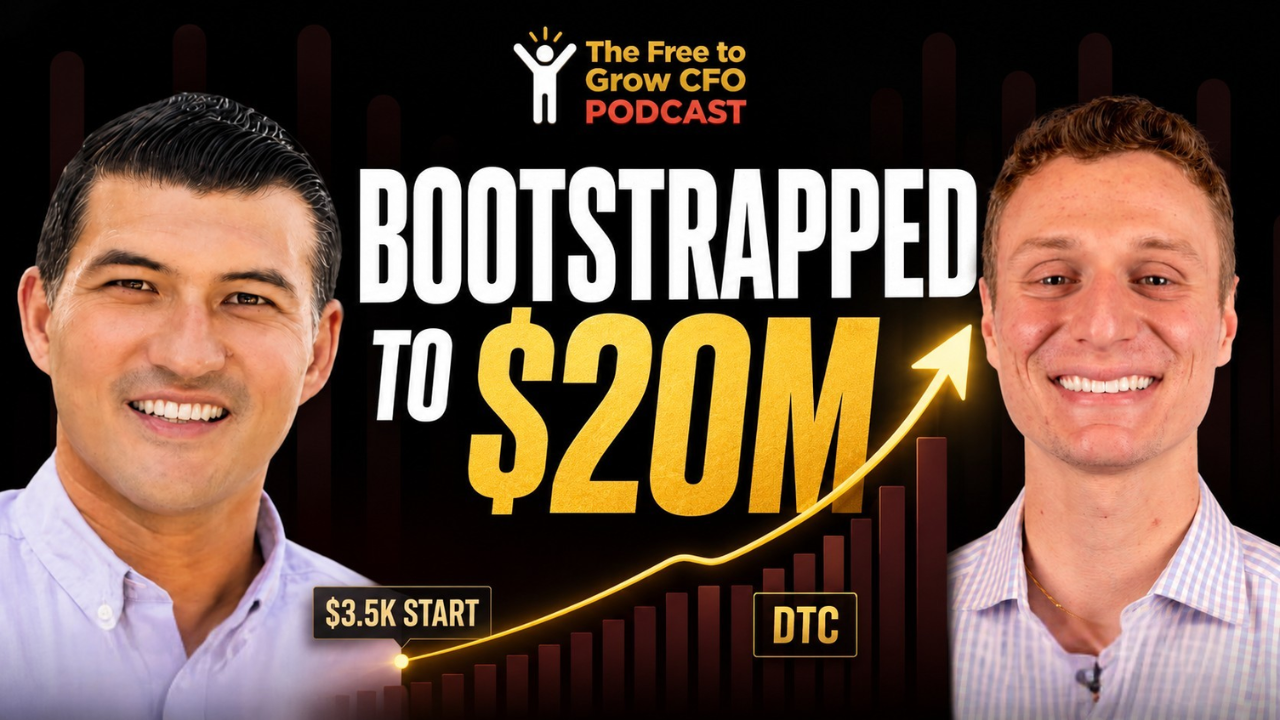
If you think scaling to $20M requires venture funding, a big team, or expensive agencies, this episode will challenge that.
In this episode of The Free to Grow CFO Podcast, Jon Blair sits down with Anton Krecic, founder and CEO of Seven Weeks Coffee — a pro-life, faith-driven coffee brand Anton bootstrapped from $3,500 in a business account to nearly $20M in revenue, all while donating close to $2M along the way. Anton breaks down how staying scrappy and founder-funded shaped every decision, from piecing together part-time and fractional help before ever hiring full-time, to targeting fixed overhead near 10% of revenue, to pushing first-order subscription take rate from 30% to nearly 70%. Jon and Anton also get into why Seven Weeks can run thin first-order margins and still scale aggressively, because retention does the heavy lifting, and why keeping ad spend as the one variable lever in the business makes growth far more controllable and sustainable.
If you're a bootstrapped founder trying to figure out when to hire, how to think about CAC and retention together, and how far discipline can actually take you, this one's for you.
Episode Links
Jon Blair - https://www.linkedin.com/in/jonathon-albert-blair/
Anton Krecic - https://www.linkedin.com/in/anton-krecic-b3071954/
Free to Grow CFO - https://freetogrowcfo.com/
Seven Weeks Coffee - https://sevenweekscoffee.com/
Key Takeaways
Target fixed overhead near 10% of revenue as a modern DTC brand, regardless of company size.
A subscription brand doesn't need great first-order margin and elite retention — strong retention alone can offset thin first-order economics.
Keeping ad spend as the single lever you flex, while holding other costs fixed, makes a subscription brand's growth far more controllable.
Meet Anton Krecic
Anton Krecic is the founder and CEO of Seven Weeks Coffee, a mission-driven direct-to-consumer coffee company dedicated to promoting a culture of life. Since launching in 2021, Anton has grown Seven Weeks into one of the most impactful pro-life brands in America — donating 10% of every sale to pregnancy care centers nationwide. To date, the company has raised almost $2.0 million in donations and has supported more than 1,500 pregnancy care centers across all 50 states, directly impacting women and families in need.
His vision was simple yet powerful: offer direct trade, specialty-grade coffee while directly supporting the sanctity of life.
Under Anton’s leadership, Seven Weeks Coffee has become more than just a coffee brand; it’s a movement. With a background in marketing and a heart for faith-based entrepreneurship, Anton has built a brand that aligns quality products with purposeful impact.
He frequently speaks on values-based business, the role of faith in commerce, and the importance of creating companies that serve both customers and causes.
Anton lives in Virginia with his wife and their son. His journey as a father himself — bringing an even deeper meaning to the mission behind the company he built.
Transcript
~~~~~~~~
00:42 Introduction
01:29 The Journey of Bootstrapping a Business
05:03 The Importance of Curiosity in E-commerce
10:42 Strategic Team Growth and Hiring Principles
13:32 The Role of a Fractional CFO in Scaling
19:14 Understanding Customer Retention and Subscription Models
Jon Blair (00:42)
All right, we are back and I've got a special guest today. I c consider him a friend and you know, one of our beloved Free to Grow clients. he is the founder and CEO of a brand called Seven Weeks Coffee. Anton Krecic. Anton, what's up, man?
Anton Krecic (01:00)
Hey man, good to be here. Thanks for having me on.
Jon Blair (01:03)
Yeah, dude, I'm excited. There's so many fun things to talk about. I'll try to keep us focused on on on my plan, but we we may veer off. But look, there's a number of reasons why I wanted to have you on the show. One, it's been a really fun journey helping you scale the business. And I think there's some there are some unique aspects of your business financially that have been really eye-opening to us as we have helped you on this journey of growing the growing over the last year or two.
But also you've also been very calculated about growing your team. When to hire someone, why, what is it they're gonna do? Where's the ROI? And so I think your story and some of these various aspects we're gonna dive into is gonna be super helpful for our audience. But before we dive into that, can you give everyone a brief background about you seven weeks coffee and where you guys came from?
Anton Krecic (01:38)
Mm-hmm.
Anton Krecic (01:55)
Yeah, I mean, love love to share. We are about five years in now as a company. And I literally started this, Jon. I mean, I think probably told you, but for your audience, like completely bootstrapped. I started it literally two weeks after I got married in the fall of twenty twenty one with thirty five hundred dollars in a business account with an idea. I didn't have any background in D T C, understanding Shopify, the ecosystem, and like truly started from scratch. so it's been a pretty wild journey to get to where I'm now, you know, doing nearly
20 million in revenue this year, which I hope we get to. So I've definitely learned a lot about the the industry and the business. But yeah, this is definitely like bootstrapped from the bare bones early on. And really, you know, with anything in D T C a lot of people talk about is like product matters. And we just found a really good product sweet spot with our mission as a pro life coffee company kind of filling the void with like Christians and Catholics and kind of the faith-based consumer out there. There's millions and millions and faith-based consumers, and our product really
fell right into that. you know, simply a pro life coffee company did not exist when I had the idea. And so, yeah, been growing it ever since from the fall of twenty twenty one to where it is now and been blessed to be been able to donate nearly two million dollars back and continue to be a profitable D T C business.
Jon Blair (03:13)
Dude, I actually just kinda got goosebumps while you're talking through that. Cause you and I talked for I think maybe a year before we even started working together. So I think we've probably been I've probably been talking with you for at least the last three years or something like that. Three of the last five. And I was just thinking through some of the numbers that we looked at originally together. And you sitting here talking about, you know, expecting a twenty million dollar year. And and the other thing is you mentioned having no
E-com background, no DTC background before this. But one thing that struck me from day one, and it's still there to this day when I met you is like your just endless curiosity. You always were just like asking questions. Like, if I don't understand this, I'm gonna ask a question. I'm gonna try to figure out how this works. Can you just cause I y it's not uncommon for me to find an e-comm brand founder that I meet who has doesn't have an e-comm background, but they
they they do have a background in the product they sell. They're very passionate about the product they sell. Can you talk a little bit about just like your journey of just following your curiosity and figuring out e commerce over time?
Anton Krecic (04:19)
Well, it starts with just being bootstrapped because it's a blessing in disguise when you don't have any other of other people's money to burn, you have to be so like scrappy. And what the only thing that's free is people's advice. So, you know, I think it's like just like best business practices, like, you know, when I was when I really went full time in this, it was about like spring or summer of twenty twenty two. Like we were probably doing like thirty thousand dollars a month. And so six months in. So it was obviously catching on and but that's when I was like, I'm gonna make that's when I did this.
left my other job and was like, this is this is what I'm gonna do like moving forward. And that's when I was like, I need to learn e-com in the business. And man, did I try to pick everyone's brain and get as much business advice, e com advice, Shopify, Shopify advice, because that's the only way you can learn and grow. And it's the only way you can kind of do without spending money that you don't have. And so yeah, even when we met Jon, I mean I was picking your brain because you had you have a ton of success in the industry and the space and it you really just have to just be
everywhere talking to as many people as you can and like really learn from the best. I mean the amount of times like just for example, like our website, I I've I've built it, you know, for the first five years now. Now we have like some part-time devs, but like literally built it from scratch in Shopify. And when I'm like not kidding you when I say this, like it was a daily, daily basis where I would go into our theme and make an adjustment or go into our theme and change something and like see what other people were doing in the e-com space and the coffee space from all the
big players who basically sell on Shopify. And man, did I absorb so much and I still do because you have to be like so like obsessed with learning. And I still do that where, you know, it's it's simp it's a simple in a sense. You find what brands are doing really well and like you can just kind of mirror like a similar you know, styles and copy them in some capacity or figure out what was working because a lot of brands do have a similar playbook that are that are winning.
and so you just gotta figure out kind of what that is and back into it. And yeah, you gotta be very hungry and scrappy for for what works because you know, like I said, we didn't have money to hire like, you know, a top dev agency or specialist and all that. It was just it was just basically me for the first two and a half years.
Jon Blair (06:34)
That's the it it's funny because it was maybe maybe three years ago, two and a half, three years ago, when when I made the choice that Free to Grow CFO was gonna work exclusively with bootstrapped and founder-funded brands. And it's because the mentality is so different, right? Venture-backed. It's it's not that there's not a place for fractional CFO and venture-backed brands. There certainly is, but it's such a different game. It's different conversations. It's different, there's different stakes. Every dollar.
The return you need from every dollar, there's different expectations, right? When you have a founder funded brand, the mentality you're talking about, it pervades it's pervasive throughout all of our clients who are playing that same game. So, so we as the fractional CFOs, we get good at playing that game. And the way you allocate capital as you scale is different when you're bootstrapped. And so I I love it. It's it to me, it's the essence of
Anton Krecic (07:25)
Mm-hmm.
Jon Blair (07:31)
Capitalism and being an entrepreneur is like figuring out how to create value without somebody else's money. You have to get there's a lot of constraints placed on your creativity, right? Or sorry, constraints placed on your decisions that drive creativity. And that that's the key. Totally.
Anton Krecic (07:45)
Yeah. And it's actually the best way. It's the best way to run a business because like if you can break like that exit velocity and the constraints ultimately what prune you to be like a you know, a successful, profitable, hopefully long term, you know, business that can last, you know, you know, decades into the future. And that's what we hope to do. And like those constraints of I'll tell you my first basic CFO
you know, hat that I put on when we were starting the company. It was literally like just have more money left over from last month because we spent less than we made. Like it was just like turn any profit. And when I mean early on, it was like, can we make three thousand bucks this month and six thousand bucks the next and, you know, ten thousand bucks the next. Just like just keeping it moving. Cause I kept thinking in the back of my head, like, I'm gonna learn this business as it's if it just stays alive. Like I just need time on my side. And time on my side meant like
just turn somewhat of a profit early on. And that's, you know, what I did for the first couple of years. And then I was slowly able to like kind of learn the business, the industry and, you know, e commerce. I'm, you know, not an expert, but definitely more versed than I was back then. And that was the simplest thing we had. And yeah, I wouldn't have thought that if I was using other people's money.
Jon Blair (09:02)
Totally. I love that, man. Okay. So there's a there's this segues nicely into one of the things that I really want to dig into with you, which is growing your team along the way. Because you're bootstrapped, right? You have to be very selective about it's not just hiring a full time employee, it's also the agencies that you use. You've always been super thoughtful, including again, as I mentioned, you and I talked for I think at least a year.
before we were really started working together and you were very thoughtful that whole process. And and I know you do the same with your other agencies. So can you like looking back over the last five years and just kind of jogging your memory on the the agencies you've worked with, the contractors and the full time people that you've brought on board, what are some of the principles that you have followed as you're thinking about like, man, it's time for me to tap into someone else's expertise that I need to start paying for?
Anton Krecic (09:55)
Yeah, I mean, it's really to move slow. You have to the first thing, you have to wear all the hats yourself. I mean, it's you need you it's so hard to get into like a phase where you can start hiring full time. Like you it's just you need a lot of gross margin, you know? And so for me, we didn't have that early on. And it was about just finding the most like important need that you can like delegate part-time. So we we hire always part-time to start. I mean, the first person like we hired was a just a customer service rep.
Just to take off the tickets of the daily emails that would come in. And so it's just finding what can free up your time the most. And for a part-time customer service rep, that was the easiest thing we could invest in, because that's the lowest amount of like capital intensive thing to hire for. And it freed up my time. So as we were growing, I was always just trying to buy back my time a little bit in whatever capacity. And it was always with like part-time, fractional, and you have to be scrappy. Like if you want to be a
A bootstrap founder, you're not gonna be like the guy launching on LinkedIn with like a big C suite team and all these like cool titles and people under you. Like you're not gonna have that. Like for me, it was like a part-time customer service rep, a buddy of mine who ran our bookkeeping before you guys who did a great job, but that's all I could afford. I I could afford like my friend's rate. And then I had like another buddy helping out with like our partnerships. So like when I'm not
Jon Blair (11:11)
For sure. Yeah.
Anton Krecic (11:20)
And they're actually funny, they're through my church small group. Like I literally had like three people through my church small group like helping me out and piece together like these these small little areas that would just take time, you know, you know, I can get my time back essentially a little bit and just have it moving forward. You have to think in that terms, like 'cause each task, like we can jump to like, we need a full time person for this. But no, you really need to like eliminate eighty percent of the problem, which takes probably like, you know.
50% of like, you know, a part-time time time, you know, basically like not a full time role, a part-time role. And and just see it through that lens of like, okay, if I can just piece together like the majority of this pain would go away. That makes sense. And so that's what I've been doing for, you know, quite honestly till now. It's like you have to be so prudent. and right now we're, you know, we're a growing company, we still have a lot of contractors and only five full time employees now, but it's been five years to where we've gotten to this point and we still have a small and lean team.
Jon Blair (12:18)
Would you mind sharing the just high level like roadmap of who you hired over time? And I'm talking about full time. And the reason why I'm I'm asking about this, it's cause I get as a fractional CFO, I get this question all the time like, when should I hire this? What are other brands doing about hiring this? Can you just just high level, who did you hire when and what was the need that you felt like, hey, we need to solve this?
Anton Krecic (12:44)
Well, I'll speak just to like D T C specifically, is that's you know, obviously your audience. I mean, for me, there's there's really two main roles in D T C. It's like creative, because you're you run through like a paid ads funnel, and there's like just ops. So those are like your two buckets. Outside of that, it's like window dressing, things that are nice to have but not neat. So like so for us, the first kind of role that I need to help was ops. And that was like customer service. But I was still doing the majority of ops. So placed in someone who could just
pull in to help with some type of back end operations. And then after that, the next role was really creative marketing. You know, had some had a ton of part-time creators. And then we hired a full-time like director of marketing. And that was a a couple years ago. But even that person who's now our director of marketing, she she started as part-time, was a freelancer, and then moved into like, you know, more of a part-time role with the company and then full-time. So it was probably like a year of development till we even got them to full-time.
Again, because the goal was to just piece together creative services. And I think you have to think through what is the outcome I want? And what is like the most simplistic way and the most cost affordable way to get the majority of the way there. And so instead of like two years ago or three years ago sitting like, hey, we have to increase our creative, like, let's hire a full-time creative person. It's like, no, let's piece together like three part-time creators who can help with the creative output. Cause what the what the goal you really need is like,
50 new creative assets into the Meta account. Like that's the actual goal you need. And so like it's so easy to think like, I must need like a full-time person to do that. It's like, no, you probably need like five decent creators to get 80% of the way there. And so that's how you have to really think it just really think in terms of the outcome you want. And then you can then you can figure out how to piece that together. because yeah, brands, I think, and you I'm sure you know this, they always make the
mistake usually of over hiring or especially VC back brands. It's like it's so easy to like throw like money at the problem versus like, can I just figure out what's the outcome I need and how I can work my way back into that.
Jon Blair (14:38)
Totally.
Jon Blair (14:48)
Yeah, I love it. And the the bottom line is today in 2026 and beyond, like the modern e com brand is going to stay lean and mean. That that ain't changing. And when people ask me, I've actually gotten much more prescriptive on like when a brand asks me, like, what should my fixed overhead be as a percentage of revenue? I'm like, you should be targeting 10%. Like I used to say 10 to 15. If you're if you're above 10, it's not a death sentence. So don't hear that, right?
But I'm saying you're you should always be challenging yourself. How can I be at 10% max? And I've seen it work. I've seen it work on a number of different brands, but you do have to be constantly asking yourself these questions that that Anton is walking us through. And you have to be really deliberate about why you're hiring, what outcome you're trying to drive. I'm curious, like, what were some of the key things for you that drove you to want to add on the fractional CFO piece when we first start talking?
first started talking. Like what were you as the founder going like, man, I'm craving this and I think I'm getting to the point where I might need to upgrade my finance function.
Anton Krecic (15:56)
Yeah, I mean, it like I said, we were talking for a while and it was definitely a slow conversation because even with like investing in something like a fractional CFO, it's a it's a you it's a it's a increased cost, it's it's an investment. Like I wanna be very prudent with that. And so when we were getting to, you know, not definitely is five million plus in terms of company size and starting to really scale our Meta ad spend and really have to figure out okay, like how much can we push and like how much money are we still able to like make each mod.
That's when the you guys coming in was like super value add because that allowed us to have more like just confidence in decisions. Because once we got to a certain point, like financial decisions are much more costly. Like anything you do is just gonna be like it's a it's a way more like early on you can like screw up like a thousand times and like you just turn it off or something. It's very like it you can hit reverse very quickly with either
Jon Blair (16:39)
Totally.
Jon Blair (16:47)
For sure.
Anton Krecic (16:50)
You know, small creators you're working with or, you know, things like that. But now when we're really trying to scale our ad spend, we have a lot of like different like commitments, either, you know, advertising deals that are much more costly, like you have to be, you know, much more aware of like the impact that will have, especially on the business and financial. So that's when working with you guys has been great because we got that clarity of insight where I went from a position of like having like a continuous fear and worry of like.
How are we gonna do this month to understand like, okay, I know exactly where our business is and like the outcome we're gonna see this month. And like if it doesn't, here's the two scenarios that we'll probably end up in and then we have like a game plan from there. So I feel like you get that peace of mind, which has been super helpful.
Jon Blair (17:31)
Totally.
Jon Blair (17:35)
Well, what's interesting is you're playing what we call the high LTV game, right? The subscription game. And what a lot of people don't realize is that game can be very lucrative, but it's also very risky because you're you're typically at some level of scale, you're choosing to lose money on new customers, right? And so that's a risk that represents a cash outlay that if you don't execute, you may not get back, right?
Scaling that subscription game, scaling ad spend, where has the CFO advice that our and reporting that our team has provided been valuable and specifically the balancing act of like CAC to LTV while you're scaling ad spend?
Anton Krecic (18:18)
Well it's really just understanding that month over month. I mean, for us, it's having a good CAC target that we feel like we're getting from you guys when we work with you guys on the CFO and the reporting and the forecasting is like, okay, we know exactly like how much we should be spending to acquire customers this month. And then like tracking that out, you know, on a basically daily basis of like what we're pacing for on spend, CAC, and then hopefully profitability obviously profitability at the end of the month. So that's been the biggest thing because
Yeah, we wanna like at this point, like I feel like we can continue to like push, you know, down on the pedal here, but like we want to do that in a way that's like sustainable for our business because yeah, we are always losing money on new customers. That's that's that's the the business we're in essentially. So we have to be super aware of understanding like how much we're losing, but then how much we're making from returning customer spend and all of that. So but it's a fun, it's fun when you kind of like understand like these numbers. And I feel like I've slowly learned a little bit about, you know.
finance and CFO stuff that I I when we get on these calls to you guys I feel like okay, like I get what we're where we're going this month. I understand like what we're what we're what we're striving for from a financial perspe perspective and yeah, I think what's led us to be much more free.
Jon Blair (19:27)
You know what the
Well what the key is you don't have to become a CFO, but when you start to understand the levers, right, you you start having a visceral sense of like, dude, if we do this, this will happen. If I do this, this will happen. This is how I'll know this breaks, right? Knowing how to spot something breaking is actually freeing compared to like, I'm not sure if this is already broken. You know what I mean? And and so that that's super key.
Anton Krecic (19:36)
Yeah.
Anton Krecic (19:56)
Yeah.
And I think the other thing is like for us, like I want to keep our business as simple as possible and like eliminate as many variables as we can to where there's like one main variable each month that we can control that kind of dictates like how we're gonna perform. That's really ad spend. So like you you want to keep everything super, you know, stable across board from ops to other, you know, expenses, like keep everything as fixed and as low as possible. So you're always pulling that lever of like ad spend.
And like if you're having a bad month with spend, like you can always back off. Like it's so it's very controllable. That keeps your business, I think, in like in a very safe position to where it can like continue to grow, be sustainable, where I don't feel like I'm juggling other things to like the success of the business. It's really just understanding our ad spend throttle month over month. And then you have like a clear picture of like what you need to focus on, execute onto either like creatively, but also.
You just have a very much like more comfortability with like the understanding of your business fundamentals and financials by just having one lever that you're manipulating.
Jon Blair (21:05)
So what's interesting is, you know, I was I was personally the the fractional CFO for you guys first. You guys have moved on to someone who I is truly much better than I am at the scaling the the subscription game at a at a high level. But there was something really fascinating that I learned working with you guys. And I've taken this as a lesson to just other brands that I've that I've spoken to. We're not gonna talk specific numbers, but there's something that struck me.
I don't know if you remember me mentioning this to you when we first started working together, but I was like, man, our our first order margin dollars, they're not that high. They're they're actually kind of low. It's coffee, but your retention completely offsets that. And that that makes your game work at a very, very high level. I'm saying that because I want people to understand, of course, is like having your cake and eat eating it too in this game is like
High gross margin dollars on order one and crazy high retention that never goes away. But you don't have to have both of those. If you can offset challenging first order economics with very strong retention, you guys have incredible retention. What do you attribute your retention success to primarily?
Anton Krecic (22:13)
Mm-hmm.
Anton Krecic (22:25)
It's definitely multifaceted. it's been something we invested in more. So the first one is like we want to be subscription first presenting on our website. Because, like you said, like the cool thing about our business and other subscription business, like as you get more cohorts through the door, like you have more ret more dollars from your returning customers to then invest into new customers. So it's like this compounding effect where you get like basically more to play with. And so it's a subscription first. I mean, we went from like
Jon Blair (22:47)
Totally.
Anton Krecic (22:51)
30% to nearly close to 60% on first order subscription take rate. And I think we're gonna get closer to 70 some percent by the end of the year. so for us, it's it's really like subscription first website. And then on the retention side, man, like we're really investing into like what it is for a consumer's journey, you know, on the fulfillment aspect, making sure they like wanna stay subscribed, the
Jon Blair (22:56)
Crazy.
Anton Krecic (23:16)
Points loyalty free gifts. We're launching a whole new subscription program that I'll tease a little bit here coming this fall where they're gonna have like we really are investing in the entire 12 month journey of the subscriber where they're gonna get free gifts, you know, each month and all these other loyalty points and a lot of stuff that like we're gonna be spending money on to hopefully keep a subscriber from that first order through the year, which I'm excited for. And it's gonna provide a lot of value to the customer. So
I mean, it takes time. You have to invest in the the idea that a consumer's money is not something you take for granted. Like they they have to come back and order again, and you gotta give them the reason why. I mean, the core reason is like the product is great. Like we, you know, spend so much time on the quality of our coffee. But all the other things that go around it, from the email to the to the the loyalty side, that's what we want to push more into. So it's it and it's really the messaging too. Like we want to do better with our messaging, like, hey, like.
Jon Blair (23:55)
Totally.
Anton Krecic (24:10)
This is the coffee that's replacing your $5 Starbucks. You know, it's gonna save you money in the long run by just making it at home and like build people into the story of what you're doing. And obviously we give 10% of every sale. It's a huge portion of our profits away. So telling people that story and the impact they're having with every order is huge to our loyalty. Like it and it's it's it's awesome. Like it's a win-win. It's the the amount of dollars you get to give back, it's a reason why customers stay with us and wanna stay subscribed.
So you have to have like legitimate offerings. You can't have just like a nice cancel flow. Like you have to have like an exceptional product. You have to have a mission that like you're personally involved in and believe in. You have to give that mission to the customers and the story of it and why it's important. And actually you have to show the proof. Like you can't fake your way to like, you know, a 12 month retention, you know, retained customer. Like you have to do the stuff. and so that's what we spend a lot of time on.
Jon Blair (25:00)
Totally.
Jon Blair (25:06)
I love it. It's your superpower, man. It it truly is. And you can see it in the financial data. but that's the beauty to me That's your moat too. Your retention is how you are building a defensible brand, right? And and why coffee's commoditized, but Seven Weeks Coffee is not commoditized because of all of the effort you're putting into the product and the retention efforts. That is what gives you a durable
Business over time. So I love it, man. Look, before we land the plane here, where can people find more information about Seven Weeks Coffee?
Anton Krecic (25:40)
Yeah, just all on our website at sevenweekscoffee . com. You can take a look, grab a bag and happy to chat with anyone who's interested in chatting about D T C or Free to Grow and all that jazz. It's been great obviously working with you guys and we're excited to keep growing with you.
Jon Blair (25:54)
Dude, I really, really appreciate you, man. It's been a blessing. It's also been a blessing to have you as a part of this group of faith-driven entrepreneurs that we work with at Free to Grow. And I look forward to helping you guys break through twenty million and beyond, man. Thanks for coming on today. Talk to you soon, Anton.
Anton Krecic (26:08)
Awesome.
Anton Krecic (26:12)
Thank you so much.